Monthly payment
—
Total repayment
—
Total interest
—
Principal
—
Amounts in: M JPY
| No. | Payment | Principal | Interest | Balance |
|---|
* Illustrative figures. Actual lending depends on bank underwriting; Flat 35, variable/fixed rate mixes, group credit life insurance and ancillary fees are separate.
Level payment vs level principal
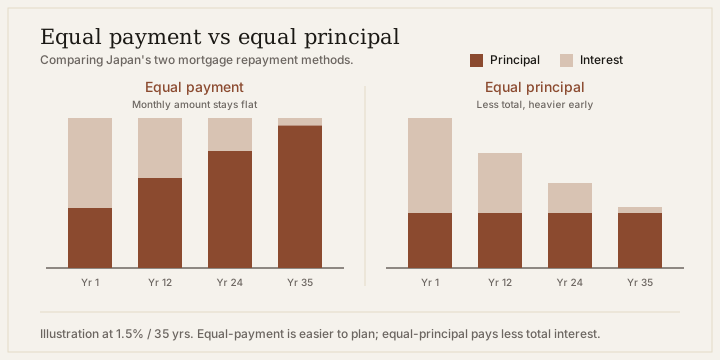
"Level payment" keeps the monthly amount constant, which is easy to budget; early on more of it is interest, so total repayment is a little higher. "Level principal" repays the same principal each month — early payments are larger, but the balance falls faster and total interest is lower. This tool lets you switch between the two and compare.
Interest-rate types
The main types are a variable rate (lower at first but with future-rise risk), a fixed-period rate (predictable payments), and Flat 35 (fixed for the whole term). The choice trades a lower rate against payment stability; a mixed loan combines variable and fixed.
Debt-to-income (DTI) guideline
DTI is the share of annual income going to loan repayment. A common safe guide is within 25% of take-home pay; above 35% tends to strain the household. Plan with room, counting other costs such as education or a car loan.
How to use
What you'll learn: Work out the monthly payment, total repayment and debt-to-income ratio from price, down payment, rate and term.
- Enter the price, down payment, rate, loan term and repayment type.
- Choose and adjust the options shown.
- Read off the monthly payment, total repayment and repayment ratio.
FAQ
How much down payment do I need?
Around 10–20% of the price is a common guide; a smaller down payment means a larger loan and more total interest. Closing costs (registration, taxes, fees) are also needed.
Is early repayment worth it?
The earlier you prepay, the larger the interest saving. You can either lower the payment or shorten the term.
Level-payment vs. level-principal?
Level-payment keeps the monthly amount constant (lighter early on, more total interest); level-principal repays a fixed principal each month (higher early payments, less total interest). The tool supports both.
What's a reasonable debt-to-income ratio?
Annual repayments as a share of annual income; 25–35% is a common comfort guide. The tool computes it automatically (lender screening criteria differ).