
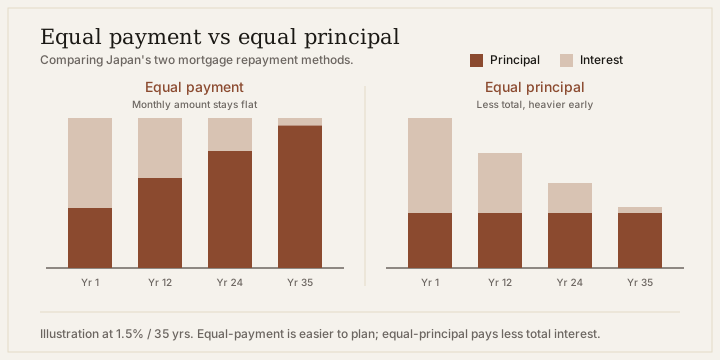
How do you choose a mortgage in Japan? Three rate types: Flat 35 (fully fixed), floating, and fixed-period. A safe zone guide is 5–7× annual income and a repayment ratio within 25–35%; the mortgage tax credit refunds 0.7% of the year-end balance for up to 13 years (higher caps for high-performance homes).
Part of the guide: Building a custom home in Osaka
For most people a home loan is the largest borrowing of their life. The total repaid can swing by millions of yen depending on how you borrow, and picking "the cheapest rate available right now" is not necessarily the right answer. Here we set out the three axes — rate type, term and structure — plus your own safe borrowing limit and the 2026 mortgage tax credit, at a level you can actually decide on.
1. Three axes for choosing a loan
A home loan is easiest to think about along three axes: rate type, repayment term and structure. Rate type comes in three kinds (variable, all-period fixed, fixed-term); the term is typically 20–35 years; and structure has three patterns (sole, pair loan, combined income). The combination drives both your monthly and total repayment. A good order of decision: first set the rate type by asking "can our household survive if rates rise," then set the term by "will it be repaid before retirement," and last choose the structure by "how much can — and should — we borrow." A low rate is only one factor at the entrance; the right approach works back from your household's resilience and the exit of repayment.
2. Flat 35: all-period fixed, the reassurance option
This is an all-period fixed-rate loan offered jointly by the Japan Housing Finance Agency and private banks. Its defining trait: the rate is fixed at signing and never changes through to the final payment. The 2026 level is roughly 1.8–2.0%, higher than variable, but in exchange you buy the certainty of "knowing the repayment for all 35 years." Properties meeting standards such as long-life quality housing, ZEH or seismic grade 3 qualify for "Flat 35S," a −0.25% rate cut for the first 5–10 years. It suits those uneasy about rising rates, child-rearing households with hard-to-predict expenses like education, and single-income households. Because the property must meet technical standards, confirm conformity at the design stage.
3. Variable rate: low now, but with risk
The flagship product of mega-banks and online banks, the 2026 rate of about 0.3–0.7% is the lowest of all types. But because the rate is reviewed every six months, your future repayment is not fixed. Two buffers soften sudden increases — the "5-year rule" (the repayment is held for five years) and the "1.25× rule" (the next five years' repayment rises by at most 1.25×) — but these defer the increase, they do not waive it. If rates keep rising, "unpaid interest" can arise where the monthly payment no longer covers the interest, swelling the total repaid. After testing whether your household still works with a 1% rate rise, this suits those with room to prepay or a shorter loan term.
4. Fixed-term rate: the middle option
This fixes the rate for a set period — 3, 5, 10 or 20 years — after which you re-choose variable or re-fix. The rate during the fixed period is typically higher than variable and lower than Flat 35, sitting between the two. Its use is clear: a life-plan-linked design such as "fix for the ten years when education costs peak to stabilise the household, then return to variable." The watch-out is after the fixed period — the repayment can jump depending on rates at that moment — so it is safest paired with a funding plan that allows prepayment or refinancing in the year the fix expires.
5. Pair loan vs combined income
| Method | Borrowing | Group credit life | Mortgage tax credit |
|---|---|---|---|
| Sole | own income only | 1 person | self only |
| Combined income | spouse's income added | 1 person | self only |
| Pair loan | two loans, larger cap | both | each separately |
Combined income and the pair loan are how dual-income households stretch the borrowing. Combined income adds the spouse's income to the screening on a single loan — simple to arrange, but credit-life insurance and the tax credit cover only one contractor. A pair loan is two loans, one per spouse: a larger cap, and credit-life insurance and the tax credit for both — its biggest advantage. The downside is that divorce, parental leave, job change or the death of either leaves two loans outstanding, a heavier risk than combined income. Rather than maximising the borrowing, choose after first confirming "can we still repay if one income stops."
6. A guide to how much you can borrow
- Income multiple: 5–7× annual income is the safe zone; over 8× warrants caution
- Repayment ratio: annual repayment ÷ income. Ideally within 25%, 35% as the ceiling
- Down payment: 10–20% of price is typical; a zero-down loan raises the monthly burden
What a bank "can lend" and what a household "can comfortably repay" are different things. You may pass screening, yet too high a repayment ratio leaves nothing for education or retirement. In practice, use a repayment ratio within 25% as the benchmark and avoid leaning on bonus repayments (bonuses move with the economy). Putting 10–20% down lowers the borrowing, the interest and the monthly payment all at once, raising household stability above a full loan. But never pour all your cash into the down payment — the iron rule is to keep six months to a year of living costs plus the transaction fees.
7. The 2026 mortgage tax credit and watch-outs
The mortgage tax credit deducts 0.7% of your year-end loan balance from income and resident tax for up to 13 years. On a ¥30M balance that is about ¥210,000 back in the first year — far from trivial. The borrowing cap varies by housing performance and move-in timing, rising for long-life quality, ZEH and energy-standard-compliant homes, with a further top-up for child-rearing and young-couple households. In other words, the higher the performance, the wider the credit, so the spec choices made at design time feed directly into the tax saved. Also build into the plan that, separate from the loan itself, transaction costs (guarantee fee, registration, fire insurance) run 2–10% of the price, and that group credit life insurance is effectively mandatory.
A home loan is not decided on "the cheapest rate right now" alone. Build it around whether your future self, 30 years on, can keep repaying with peace of mind, combining rate type, term and structure. Our design office is glad to help draft an initial funding plan.
Send us your drawings or plot info and we'll estimate the budget.
Get a free estimate