Estimated total (incl. tax)
— – —
Total per tsubo (incl. tax): —
Total period (design → handover): —
Breakdown (midpoint)
| Main works | — |
| Ancillary works | — |
| Exterior works | — |
| Design & supervision | — |
| Permits & inspection | — |
| Contingency | — |
| Consumption tax (10%) | — |
| Total (incl. tax) | — |
* Indicative only. The real figure varies with specification, ground, site conditions and the market. Ground improvement, demolition, utility connections and road conditions can push the budget up. Discuss the details per project.
Structure and exterior finish are separate
The frame (timber, steel, RC, SRC) and the exterior finish are different choices. Exposed concrete and a glass curtain wall, for example, are finishes applied to an RC / SRC / steel frame — not structures in themselves. This tool lets you pick structure and finish separately.
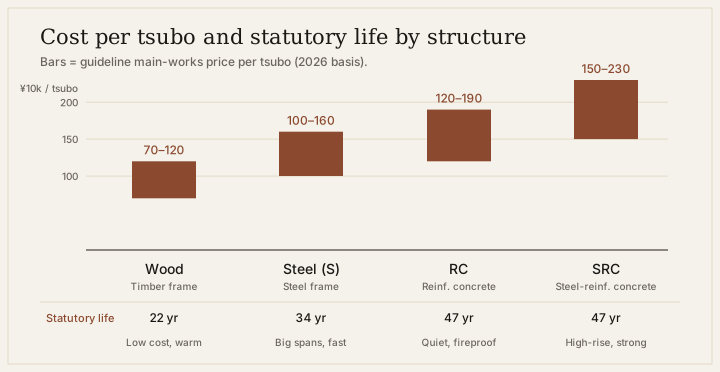
Main-works cost per tsubo by structure (2026)
Construction costs have kept rising (labour-rate increases, a weak yen lifting material prices, mandatory energy standards). The table shows each structure's overall range; grade (standard to ultra-premium), region and finish move the figure within it. Selecting a grade in the tool narrows the estimate to the matching band. These are main-works cost per tsubo only; with ancillary works, exterior, design supervision, permits, contingency and consumption tax added, the all-in total is roughly 1.4–1.5× the main works.
| Structure | Main works per tsubo (std–ultra) |
|---|---|
| Timber | ¥700k–1.20M |
| Steel | ¥1.00M–1.60M |
| RC (reinforced concrete) | ¥1.20M–1.90M |
| SRC (steel-reinforced concrete) | ¥1.50M–2.30M |
Cost per tsubo also varies by region. Cold areas such as Hokkaido tend to be dearer (extra insulation, deeper frost-line foundations, snow-melting), while big cities like Tokyo and Osaka carry higher labour and haulage costs. The tool applies a rough regional adjustment.
What this tool assumes (included / not included)
This tool assumes a custom-built home (individually designed and built by an architect's office or general contractor). Spec / tract homes are mass-produced to standard specifications, so their cost per tsubo is far lower and falls outside this tool's scope. In Japan a custom home is always handed over fully finished inside, so the main-works cost already includes interior finishing and fixed equipment.
Included in main works
- Structure, foundation, roof, exterior walls
- Interior finishes (floors, walls, ceilings) and joinery
- Fixed equipment (system kitchen, unit bath, washbasin, toilet)
- Indoor electrical, water-supply / drainage and gas piping
Required separately (not in main works)
- Exterior works, ground improvement, demolition, utility connections, outdoor plumbing (added as separate items in this tool)
- Furniture, curtains, some light fixtures, interior decoration (soft furnishing) and appliances
Where budgets overrun
Totals usually balloon not on the main works but on the surrounding costs — ground improvement, demolition, exterior, utility connections (water, power, gas), permits and road conditions. A basement is especially costly (excavation, shoring, waterproofing), so plans with one carry a premium. Confirming site conditions early sharpens the estimate.
How to use
What you'll learn: Estimate the per-tsubo main-works price and the total cost from structure, grade and floor area.
- Enter the use, structure, floor area, storeys and grade.
- Choose and adjust the options shown.
- Read off the per-tsubo main and total price with a breakdown.
FAQ
How much does a custom home cost in Osaka?
In Osaka a custom home runs roughly ¥700k–1.20M per tsubo for timber and ¥1.20–1.90M for RC as a main-works guide. Adding ancillary works, design supervision, soft costs and consumption tax brings the all-in total to about 1.4–1.5× the main works. Pick structure, area and grade above for a tax-included estimate.
How much more expensive is an RC house than timber?
As a rule of thumb an RC (reinforced-concrete) house costs about 1.5–1.8× the per-tsubo price of timber. RC offers durability, fire and sound performance and design freedom, but the frame, formwork and longer schedule raise the cost. See the per-tsubo table by structure.
Can you judge building cost by per-tsubo price alone?
No. Per-tsubo price usually means main works only; ancillary works, exterior, ground improvement, design supervision, soft costs and tax are extra. The same per-tsubo figure can yield very different totals depending on shape, spec and site, so compare on the tax-included total.
What's the difference between building cost and per-tsubo price?
Building cost (the total) is the sum of everything needed to build, while per-tsubo price is that cost divided by gross floor area (in tsubo). Published per-tsubo figures are usually main-works based, which differs from an all-in per-tsubo that includes ancillary and soft costs.
Why is there a range?
Even at the same structure and area, grade, shape, equipment and site conditions move the real figure, so we show a low–high estimate.
"Base price" vs "tax-included estimate"?
The base price is only the building's main works; the tax-included estimate adds ancillary works, exterior, design supervision, permits, contingency and tax.