How do you budget a custom home? Total = shell construction (70–75%) + ancillary work (15–20%) + fees (10–15%). Tsubo rates cover the shell only — a 40-tsubo RC estate runs roughly ¥65M–100M all-in as a guide.
Part of the guide: Building a custom home in Osaka
1. Main construction cost (70–75% of total)
The cost of building the structure itself: foundation, frame, roof, exterior, interior and systems. The "price per tsubo" refers only to this.
・Wood residence: ¥0.7–1.2M / tsubo
・RC residence: ¥1.2–1.9M / tsubo
For a 40-tsubo RC residence, the shell alone runs ¥48–72M as a guide.
2. Ancillary works (15–20% of total)
On-site work beyond the building itself—frequently overlooked items.
- Ground improvement (when needed, ¥1–4M)
- Exterior / planting (¥2–6M)
- Demolition (if an existing building, ¥1.5–4M)
- Water/sewer/gas connections (¥0.8–1.5M)
- Temporary power / hoarding (¥0.5–1M)
3. Soft costs (10–15% of total)
- Design / supervision fees (8–12% of the shell)
- Confirmation and structural-review fees (¥0.2–0.8M)
- Registration / stamp duty (¥0.3–0.8M)
- Acquisition / fixed-asset tax (3–4% of assessed value)
- Fire / earthquake insurance (¥0.4–0.8M over 10 years)
4. The whole cost structure at a glance
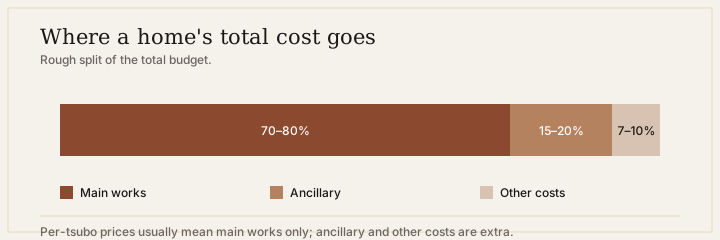
Think of the budget in three layers: shell + ancillary + soft costs. Looking at price-per-tsubo alone drops ancillary and soft costs, leading you to misread the total. Use the table to fix the proportions.
| Category | Share of total | Main contents |
|---|---|---|
| Main construction | 70–75% | foundation, frame, finishes, systems |
| Ancillary works | 15–20% | ground, exterior, demolition, connections |
| Soft costs | 10–15% | design, permits, tax, insurance |
5. The price-per-tsubo trap
Ads touting "from ¥600k per tsubo" almost always refer to a limited-spec version of the main cost only. Adding ancillary + soft costs makes the total 1.3–1.4×. The rule is to decide on the "total (tax included)."
6. Total simulation for a 40-tsubo RC residence
| Main construction (¥1.5M × 40 tsubo) | ¥60M |
| Ancillary works | ¥10M |
| Soft costs (incl. design/supervision) | ¥9M |
| Total | ~¥79M |
7. Funding plan and payment timing
Construction cost is paid in installments tied to progress, not in a lump sum—typically four: at contract, at start, at framing (interim) and at handover. When using a mortgage, bridge financing is often needed before completion, so the funding plan must be worked out with the lender from early design. Settling the balance of cash and loan first stabilizes the whole plan.
8. How to prevent budget overruns
The main causes of overrun are spec changes, added ground improvement and overlooked remaining work. Reserving 10–15% of the total as contingency at contract spares you panic when the unexpected hits. Setting a "ceiling on the total" first and prioritizing within it—reasoning backward—curbs late additions.
9. Smart budget allocation
Allocate limited budget heavily to "parts hard to change later." Structure, insulation, waterproofing and windows are hard to renew after completion; skimping here becomes a lifelong regret. Interior finishes, furniture and decoration, by contrast, can be renewed later, so a modest initial spend is recoverable. "Spend on the skeleton, do the makeup later" is the allocation that satisfies for the long term.
People say "hiring a design office is expensive," but design/supervision is 8–12% of the shell. Conversely this fee defends against a contractor's asking price, often cutting millions of yen through bid scrutiny.
Send us your drawings or plot info and we'll estimate the budget.
Get a free estimate