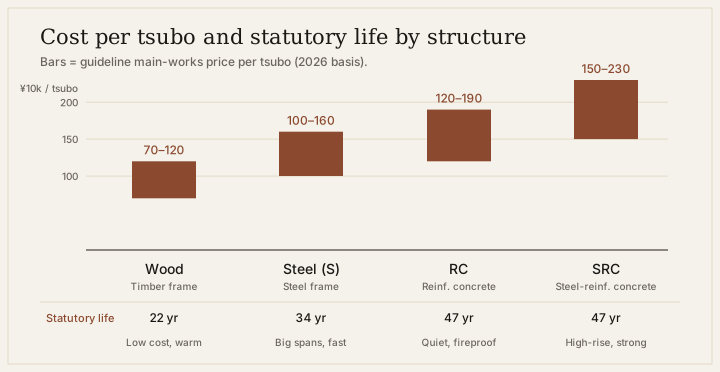
RC or wood — which to choose? Guide rates run RC ¥1.2–1.9M and wood ¥700k–1.2M per tsubo (shell, pre-tax). RC wins on seismic, fire and lifespan; wood on cost, timeline and humidity control — at the estate level, decide by facade design × location × budget.
Part of the guide: RC homes in Osaka
"Surely a luxury home has to be RC?" "Isn't timber weak in earthquakes?" These are the first questions every client asks. The honest answer is not which is better, but which suits your site, budget and way of living. Below we compare the two calmly across six axes — cost, seismic performance, lifespan, insulation, sound and maintenance — with the numbers attached.
1. Cost
| Item | Timber | RC |
|---|---|---|
| Cost per tsubo (shell) | ¥700k–1.2m | ¥1.2m–1.8m |
| Foundation | Standard | +30–50% (more rebar & concrete) |
| Design & supervision fee | 8–10% of shell | 10–12% of shell |
RC costs roughly 1.5–2× timber. The foundation runs 30–50% more for the extra rebar and concrete, and the supervision rate is higher too. With matching interior and equipment grades in the luxury bracket, RC ends up about 60–80% more expensive in practice. The right comparison, though, is total cost of ownership over 30–60 years — and depending on lifespan and maintenance (below), the gap narrows.
2. Seismic performance
Since the 2000 revision, the Building Standards Act requires both structures to "not collapse at seismic intensity 6-plus to 7." Properly designed and built, timber and RC are therefore equivalent by code. The difference shows in how the shaking feels and how much damage occurs: heavy, stiff RC sways less, so interior cracks and warped joinery are rarer. Timber can close much of that gap with seismic grade 3 plus damping dampers.
3. Lifespan
- Timber: statutory useful life 22 years; in practice 60–100 years with proper maintenance (many historic homes survive)
- RC: statutory useful life 47 years; in practice 60–100 years (carbonation control is key)
Timber does not die as young as its reputation suggests. The statutory figures (22 / 47 years) are tax depreciation numbers, not physical lifespans. Timber's enemies are water and termites; RC's are carbonation and rebar corrosion. Both are greatly extended by waterproofing, ventilation and cover depth at the design stage, plus regular inspection and repair. Lifespan is decided by how you maintain it, not by "build and forget."
4. Insulation
Timber has low thermal conductivity and pairs well with infill insulation, making a strong UA value (insulation performance) easy to achieve. RC stores heat in its mass; left as internal insulation it is prone to condensation at thermal bridges. Wrap the frame in external insulation and that thermal mass works in your favour — warmth lingers in winter and the interior stays cool in summer. For both, insulation is decided less by the structure than by how the insulation is detailed.
5. Sound insulation
On sound, RC wins outright. Concrete mass translates directly into acoustic isolation, so it excels against neighbour and road noise and against piano or home-theatre leakage. Timber can reach a practical standard by layering mass, damping tape, acoustic board and an air gap, but low-frequency isolation has limits. If a music room, guest lodging or two-household living makes living noise a concern, building just that room in RC (partial RC) is an effective option.
6. Maintenance cost (30-year cumulative)
- Timber: exterior wall and roof repainting every 10–15 years; ¥4–6m over 30 years
- RC: wall repair is infrequent, but re-waterproofing and recoating run ¥5–8m over 30 years
Painting and waterproofing are cheapest when renewed before they fail. Timber needs wall and roof repainting on a 10–15-year cycle; RC walls degrade slowly, but roof waterproofing and sealant replacement are the key items. Because the first scaffold setup costs hundreds of thousands of yen, aligning the renewal timing of walls, roof and waterproofing to share one scaffold compresses the cumulative bill.
Conclusion — how to choose
As a baseline: RC for dense urban sites, three storeys and up, and sound-critical homes; timber for suburban plots, thermal comfort and a love of natural materials. In between sit steel frame (S-structure), mixed structures (RC ground floor with timber above) and partial RC. At Towa we first review the site's zoning, fire regulations and ground conditions together with how your family lives, then propose a structure on a total-cost-of-ownership basis.
"Luxury equals RC" is a fixed idea. In the prestige districts of Ashiya and Kita-Settsu there are many fine timber residences. Rather than letting structure dictate your budget, choose by site and requirements.
Wood vs RC: how the schedule differs
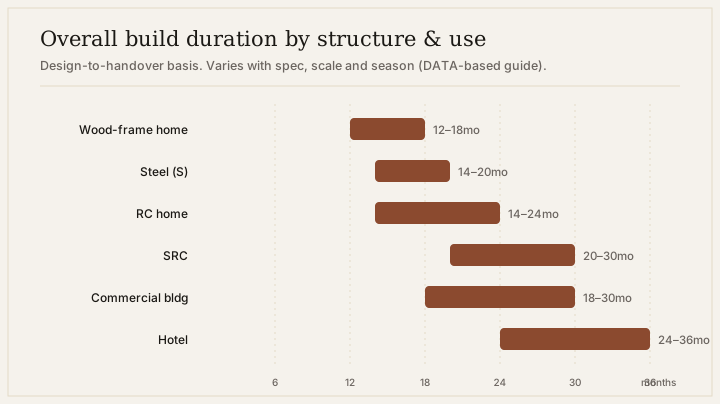
Schedule affects financing and temporary-housing costs. Typical guidelines by structure:
| Structure | Construction only | Incl. design & permit |
|---|---|---|
| Wood | 8–13 months | 12–18 months |
| RC | 8–16 months | 14–24 months |
See the construction timeline article for the full schedule.
Wood or RC: where the choice often goes wrong
Patterns people regret, and how to avoid them.
| Common regret | How to avoid it |
|---|---|
| Chose wood to save money, but fire-zone spec limits inflated cost and shrank the gap vs RC | Confirm the site (fire / quasi-fire zone) before choosing structure |
| Chose RC but weak insulation led to cold winters and condensation | With RC especially, invest in external insulation and openings |
| Underrated acoustics in wood; noise problems in a two-household / roadside home | Design acoustics in early — floor build-up, layout, glazing |
| Picked the cheapest quote; add-ons reversed the total | Get like-for-like quotes against one spec |
How to read price gaps: why quotes differ; overrun control: prevent budget overruns.
→ Estimate RC vs wood cost from floor area
We'll compare wood vs RC costs for your project.
Request a cost comparison