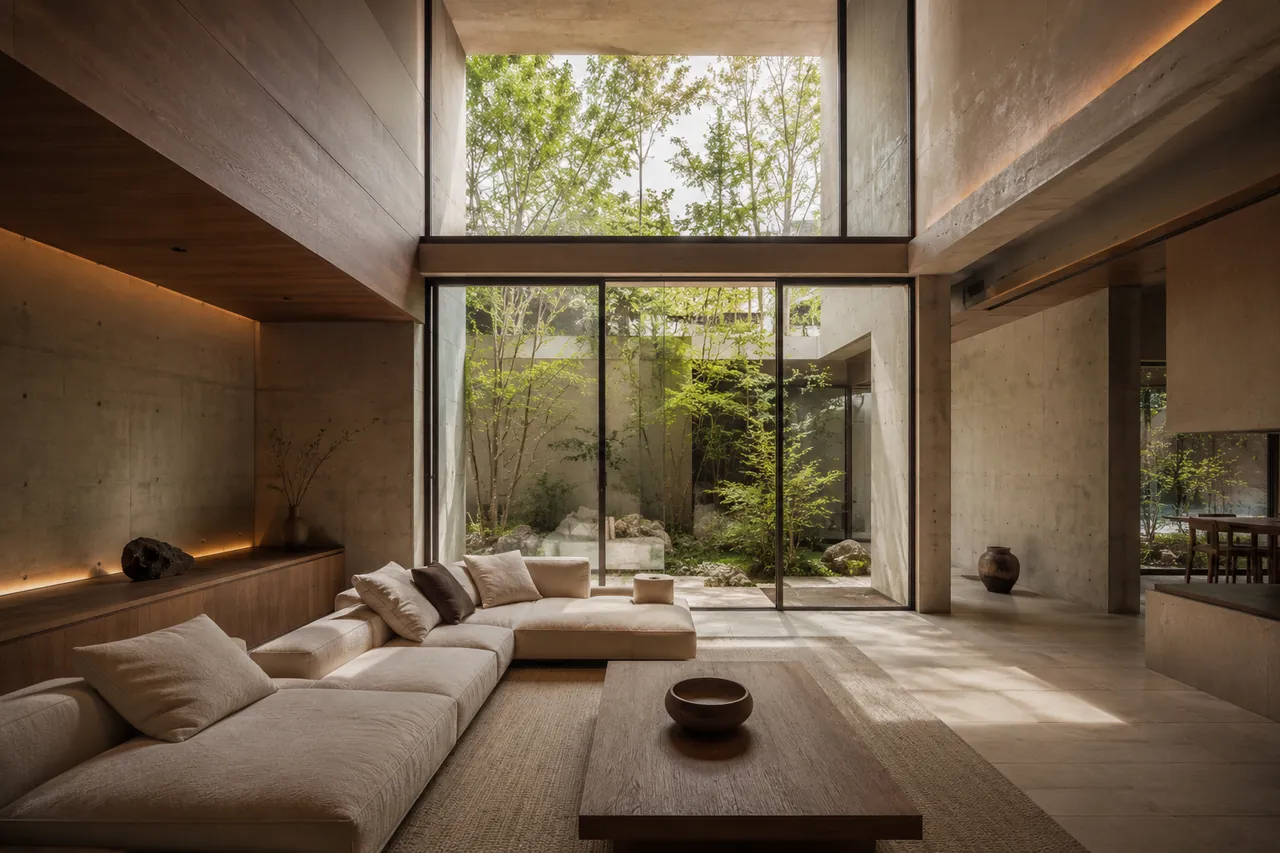
What is Rokurokuso-cho? A residential district on the southern foothills of the Rokko mountains in Ashiya, Hyogo, often called Japan's finest residential address. Developed from 1928 (Showa 3) by Osaka business figures as an ideal estate, it has been guarded ever since by a building covenant: a 400㎡ (approx. 121 tsubo) minimum plot, detached homes only, and all power lines undergrounded — so there are no utility poles, no apartments and no shops. About 250 households today.
Related guide: Osaka & Kansai luxury residential districts
1. What is Rokurokuso-cho — "Japan's finest residential address"
Rokurokuso-cho sits on the southern foothills of the Rokko mountains in Ashiya, Hyogo. Ashiya itself is a leading prestige address in the Hanshin belt, yet Rokurokuso-cho is treated as a class apart and has long been called "Japan's finest residential address."
The reason is not land price alone. With no apartments and no commercial premises at all, and not a utility pole or wire in sight, this leafy, spacious streetscape has been kept by its residents' own hands for nearly a century. Holding to about 250 households, with generously wide plots and streets lined by continuous hedges and trees, it stands apart from any other residential district in Japan. Land prices are the highest in the Hanshin belt, and plots reaching several hundred million yen for the land alone are not unusual.
2. The building covenant that guards the streetscape — main terms
What sustains the Rokurokuso-cho landscape is a building covenant set by the residents themselves, together with Ashiya City's district plan and landscape ordinance. Below are the commonly known main provisions. When you actually plan, always confirm against the latest covenant text and Ashiya City's district plan.
| Item | Main rule |
|---|---|
| Minimum plot size | 400㎡ (approx. 121 tsubo) or larger; subdividing a plot is not permitted |
| Use | Detached, private single-family homes only. Apartments, condominiums, shops and offices are not allowed |
| Building height | 10m or less (as a rule, up to two storeys) |
| Greenery | At least 30% of the plot must be planted |
| Wall setback | A setback from the boundary is prescribed, requiring a generous layout |
| Power lines | All power lines undergrounded (no poles, no wires) |
| Commercial activity | Convenience stores, vending machines and other commercial/business use prohibited |
These are not aspirations but a covenant binding on the whole district by residents' agreement. You cannot split a plot into two, cannot build a rental apartment, cannot open a shop — which is exactly why, nearly a century on, density has not risen and the landscape endures. Because learning the limits after you have fallen for a plot changes the plan from the ground up, reading the covenant before you acquire land is the rule.
3. History — 1928, an ideal residential estate
Development of Rokurokuso-cho began in 1928 (Showa 3). Naito Tamejiro and others, who took over the state forest land here, joined with Osaka business figures to found Rokurokuso Co. and set about creating a prestige estate that poured in the ideals of the day. The development is said to have been modelled on the foreign residents' estates of Hong Kong.
The district's defining feature is its undergrounded power lines. Because poles and wires would badly spoil the scenery, the developers undergrounded all power lines at great expense — something without precedent in Japan at the time. Rokurokuso-cho is known as the first residential district in Japan to underground its power lines. Undergrounding is spreading across the country today, but that its origin lies in early-Showa Ashiya speaks to the district's foresight. Landscape was not "fixed afterwards" but "designed in from the start" — and that thinking lives on today in the form of the building covenant.
4. What it means to build in Rokurokuso-cho
To build here, the design must satisfy two layers of rules at once — the building covenant and Ashiya City's landscape ordinance. That is the biggest difference from an ordinary plot.
- Making the most of a large plot: 400㎡+, 30% greenery and a wall setback are, seen the other way, permission to design with room to spare. Rather than maxing out the footprint, the residence is composed as one with garden, approach and planting.
- Quality within 10m and two storeys: since you cannot stack floor area, ceiling height, sectional composition and use of a basement — the skill of volume planning — decide how it feels to live in.
- An exterior that blends in: a restrained design in harmony with the surrounding greenery is preferred over a protruding statement. Wall colour, roof, fences and hedges are all weighed against the dignity of the whole street.
- Structure for a heavy building and basement: an estate-class RC build or a basement calls for sound ground assessment and structural design. Build cost runs about ¥1.2–1.9M/tsubo for the shell of an RC build (varying with scale and specification). Estimate land + build together with the build-cost calculator.
Ashiya is one of our service areas. From reading "what, and how far, the covenant and ordinance let you build on this plot" before you commit, through to design and construction, we can advise end to end. Our thinking on luxury custom homes across Osaka and the Hanshin belt is set out in the luxury custom home guide.
Frequently asked questions
Where is Rokurokuso-cho?
On the southern foothills of the Rokko mountains in the north-east of Ashiya, Hyogo Prefecture. Developed from 1928 (Showa 3) by Rokurokuso Co. as an ideal residential estate, it now numbers about 250 households. With no apartments, no shops and no utility poles, it is often called Japan's finest residential address.
What does the Rokurokuso-cho building covenant require?
Chiefly: a minimum plot of 400㎡ (about 121 tsubo) with no subdivision; detached single-family homes only (no apartments, condominiums, shops or offices); building height of 10m or less (up to two storeys); at least 30% of the plot planted; all power lines undergrounded; and no convenience stores, vending machines or other commercial use. Always check the covenant before buying land.
Why does Rokurokuso-cho have no utility poles?
Because poles and overhead wires were judged to spoil the scenery, the developers undergrounded all power lines at great expense — something unprecedented in Japan at the time. Rokurokuso-cho is known as the first residential district in Japan to underground its power lines.
Can you build a house in Rokurokuso-cho?
Yes, if you can acquire land — but the design must satisfy both the Rokurokuso-cho district building covenant and Ashiya City's landscape ordinance. You need to read the limits on minimum plot size, height, greenery and appearance before planning. Ashiya is one of our service areas; we can advise from checking the covenant through to design and construction.
Rokurokuso-cho was born of the idea that landscape is not so much governed by rules as "designed in from the start, and kept." Both the early-Showa undergrounding and the building covenant that endures today are expressions of that single, consistent thought.
Talk to us about your plan and a rough budget — free.
Book a free consultation