How is FAR set in Osaka? By zoning, from 50% to 1,300% — commercial districts centre on 400–1,000%, residential on 100–300%. The effective figure then moves with front-road width reductions, the building authority's designations and the comprehensive design system.
Part of the guide: RC homes in Osaka
1. What is FAR?
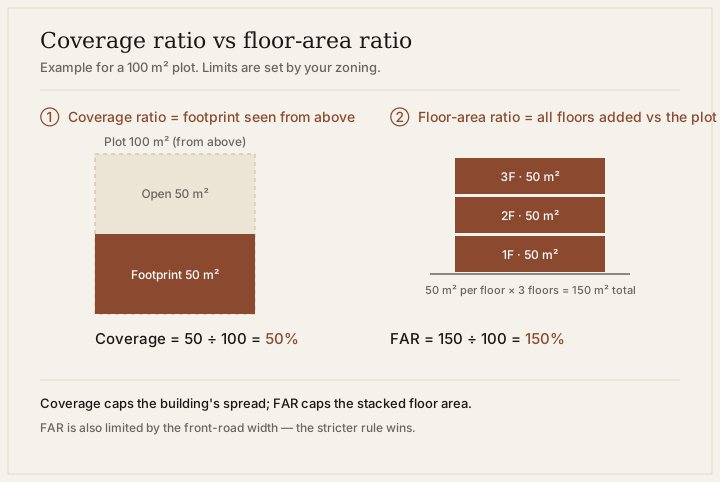
FAR (floor-area ratio) is total floor area ÷ lot area as a percentage — the metric that sets "how much floor you may build" on a piece of land. On a 100 m² lot at 200% FAR, you can build up to 200 m² across all floors. For the same lot area, 100% versus 400% means a fourfold difference in buildable scale, which makes FAR the single most important number governing a land's value. Within Osaka, zoning produces FARs from 50% to 1,300% — an extreme spread, so the same "in Osaka city" means something entirely different in a residential street versus along Midosuji. Note that several corrections apply on top — the frontage-road clamp discussed below, and exclusions for basements and common areas — so the nominal FAR is not always usable as-is. Always confirm the effective figure while still considering a purchase.
2. FAR by zone within Osaka city
The main Osaka use zones and their standard FARs are shown below. Even within residential, low-rise and mid/high-rise differ by more than double, and commercial zones jump sharply. You can confirm which category your candidate land falls into via the city's town-planning information (use-zone maps).
| Use zone | Standard FAR | Example areas |
|---|---|---|
| Category 1 low-rise residential | 100–150% | Parts of Tezukayama, Yuhigaoka |
| Category 1 mid/high-rise residential | 200–300% | Sumiyoshi, Abeno residential |
| Neighbourhood commercial | 300–400% | Station-front shopping streets |
| Commercial | 400–1,000% | Umeda, Namba, Shinsaibashi |
| Commercial (special) | 1,300% | Parts of Umeda, Midosuji frontage |
3. The frontage-road clamp
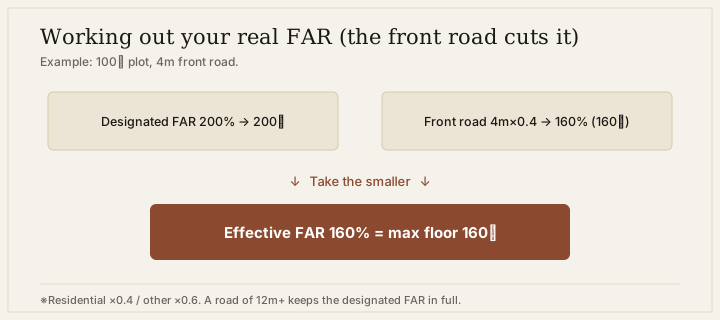
FAR is constrained not only by the zone's nominal value but also by frontage road width. The calculation is width (m) × 40% for residential and width × 60% for commercial; the actual cap is the lower of the nominal FAR and this figure. For example, a residential lot zoned 300% but fronting only a 4 m road is cut to "4 × 40% = 160%" — barely half the nominal value. A 6 m road would allow 240%. Flag-pole lots and deep back-alley sites fronting narrow roads often look cheap but shrink in effective FAR, so take care. A corner lot fronting two roads may use the wider road's width, which is advantageous.
4. Bonus mechanisms
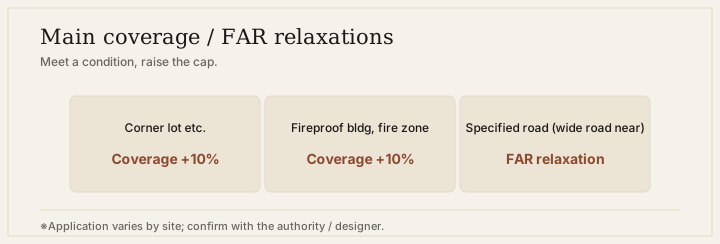
- Comprehensive design system: in exchange for providing publicly open space on the lot, you can add roughly 20–30% to the FAR. Heavily used on large buildings and apartment blocks.
- District plans: detailed rules the city sets area by area. In commercial-revitalisation districts such as the Midosuji frontage, extra floor area can be granted in exchange for design guidance.
- Specified administrative designation: through district plans and permits Osaka city designates, individual adjustments such as easing the frontage-road clamp become possible.
- Common-area / basement exclusion: shared corridors and lifts in apartments, and a dwelling's basement (up to one-third of the residential area if conditions are met), are excluded from FAR, effectively adding usable floor.
5. Practical implications for luxury residences
The most prestigious hillside districts tend to be Category-1 low-rise with tighter FAR — see the per-area picture in our ranking of Osaka's prestige residential areas.
A residential FAR of 100–200% is in fact a serious constraint when planning a 3-storey residence. On a 150 m² lot at 150% FAR, total floor is capped at 225 m² — split across three floors, 75 m² each. This is where design that exploits the "exclusions" pays off. ①Using a basement — a dwelling's basement can be excluded from FAR up to one-third of the residential area under conditions, letting you add a soundproof room, home theatre or wine cellar without consuming FAR. ②Double-height spaces and lofts — gaining ceiling height and openness within the area that is not counted as floor. ③Courtyards, terraces and other outdoor space — delivering a home that "feels spacious" without adding to total floor. Reframing FAR not as a "limit" but as a "design premise" is the key to maximising quality within a fixed number.
→ Building coverage ratio (limits & bonuses) → Slant-line limits (height & form)
Frequently asked questions
What is the floor-area ratio (FAR) in Osaka?
It depends on the zoning. Category-1 low-rise residential (parts of Tezukayama, Yuhigaoka) is 100–150%, Category-1 mid/high-rise residential (Sumiyoshi, Abeno) 200–300%, neighbourhood commercial 300–400%, commercial (Umeda, Namba, Shinsaibashi) 400–1,000%, and up to 1,300% under special provisions along Midosuji.
How does the front road change the FAR?
When the front road is under 12m wide, the cap is the smaller of the designated FAR and (road width × 0.4 for residential, × 0.6 otherwise). A high designated FAR still yields less buildable volume on a narrow road.
What should I watch for when building a luxury home?
The most prestigious hillside districts are often Category-1 low-rise with tighter FAR, so a three-storey residence can be difficult. When choosing land, check the real buildable size from both the designated FAR and the front road.
6. FAR and land value
FAR and land value are tightly linked. Land at 800–1,000% commercial FAR commonly reaches 3–10× the price of a 100% residential area. This reflects the development efficiency seen through "FAR × unit land price" — the same area yields more floor on a higher-FAR site, easier to recoup through rental or sale. For building a residence, however, it inverts. Using up the FAR is not the goal; sunlight, view, quiet and privacy decide the value, so buyers often deliberately choose residential land with a modest FAR but a good environment. High FAR for investment, good environment for living — the meaning of a "good FAR" reverses with your purpose.
FAR is not a number — it is the lot's potential itself. Site survey and zoning check before purchase determines whether the residence plan can be rational.
How much does the front road cut your FAR? A by-lot table
Your effective FAR is the smaller of the designated FAR and the front-road width × a multiplier (0.4 residential, 0.6 commercial). Here is the buildable floor area on a 100 m² lot, by zone and front road.
| Zone | Designated FAR | Front road | Effective FAR | Floor area (100 m² lot) |
|---|---|---|---|---|
| Cat. I low-rise residential | 100% | 6 m | 100% | 100 m² |
| Cat. I mid/high residential | 200% | 4 m | 160% | 160 m² |
| Cat. I mid/high residential | 200% | 6 m | 200% | 200 m² |
| Neighbourhood commercial | 300% | 4 m | 240% | 240 m² |
| Commercial | 800% | 6 m | 360% | 360 m² |
※A front road of 12 m or more applies the designated FAR as is. A corner lot with two roads may use the wider one.
What is excluded from the FAR calculation?
On the same lot, the following can be excluded from the FAR count, effectively adding usable floor. Limits and conditions vary by municipality and building — confirm with the building authority at design.
| Part | FAR treatment |
|---|---|
| Housing basement | Excluded up to 1/3 of the dwelling floor area |
| Built-in garage | Excluded up to 1/5 of total floor area |
| Shared parts (apartments) | Shared corridors, stairs and lifts excluded |
| Loft (attic storage) | Excluded if ceiling ≤1.4 m, etc. |
| Balcony / porch | Open-air parts excluded within limits |
Is a building that exceeds today's FAR (legal non-conforming) safe to buy?
A building that was legal when built but later exceeds the current FAR or coverage (due to rule changes) is “legal non-conforming” — not illegal. Living in it is fine, but: (1) home loans are harder to get, (2) on rebuild you can only build to today's FAR, so floor area shrinks, and (3) resale buyers and financing are limited. Before buying, always check the rebuildable scale (effective FAR) under current law.
Worked example: how many m² can you build?
Using a 150 m² plot in a Category-1 residential zone with a 6 m frontage road.
| Step | Calculation | Result |
|---|---|---|
| ① Max building footprint | 150 m² × 60% coverage | 90 m² |
| ② FAR from frontage road | 6 m × 0.4 (residential) | 240% |
| ③ Applied FAR | smaller of 200% (zoned) and 240% | 200% |
| ④ Max total floor area | 150 m² × 200% | 300 m² |
| ⑤ Floors guideline | 300 m² ÷ 3 floors | ~100 m²/floor |
For choosing land see land selection; check a real plot in the land potential tool.
→ Estimate how many m² you can build on your plot — free
Find out how many m² you can build on a plot — free check.
Ask about buildability