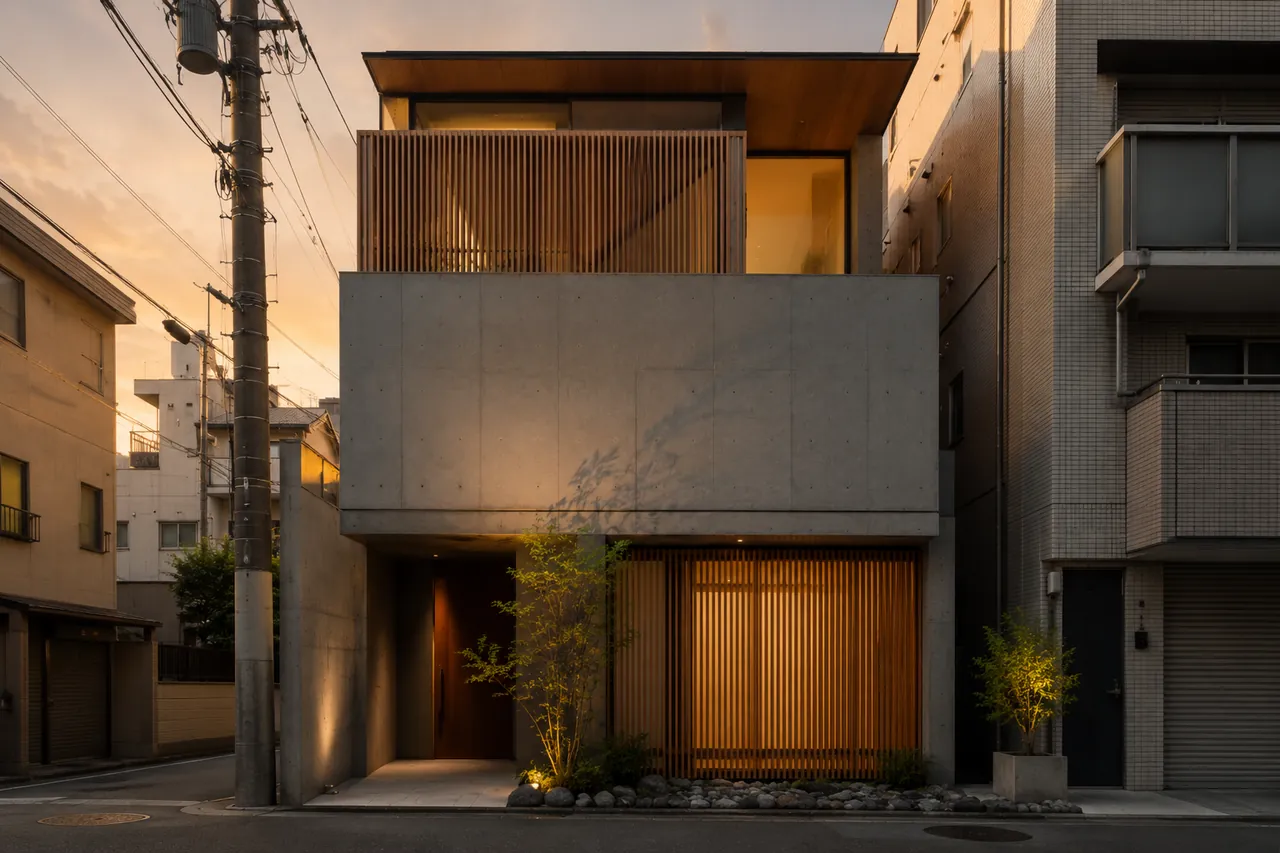
Why is RC the go-to in Osaka? Four reasons: durability against typhoons and heavy rain, fire resistance in dense districts, rigidity that suits soft ground, and sound insulation. Our standard RC estates run ¥1.2–1.9M per tsubo (the wider market spans roughly ¥1.1–2.4M by grade).
Part of the guide: RC homes in Osaka
1. Why RC dominates Osaka
Nationwide, the great majority of new detached homes are wood-frame; in the Osaka residences we plan above ¥1M per tsubo, RC (reinforced concrete) is the mainstream. Behind this lie three factors: climate, lot conditions and zoning. Frequent typhoons and heavy rain, fire zones covering most of the urban area, and widespread soft soil — where these three overlap, RC wins on the combined score of durability, fire resistance and asset retention even though it costs more upfront than wood. We examine each factor below. The question for an owner is not "RC or wood" in the abstract, but "which performance does my specific site demand."
2. Climate factor: typhoons + heavy rain
Within Kansai, Osaka sees relatively high typhoon traffic, with 1,300–1,400 mm of annual rainfall. Where wood-frame is prone to damage from wind, debris and flooding, RC's durability against external forces is far higher. The defining event was Typhoon Jebi in 2018: along the Osaka bay, roof material scattered and flooding and outages spread widely, and the difference in damage by structure stood out sharply. Since then more owners design their homes assuming a "once-in-decades" disaster, lifting RC's standing further. Especially in bayside areas near the sea and in low-lying or riverside land — where flooding, salt damage and wind strike together — the advantage of an RC frame that is itself strong against water and wind becomes clear.
3. Dense neighbourhoods and fire zones
Most of urban Osaka is designated a fire-prevention or quasi-fire-prevention zone. In dense neighbourhoods where the distance to the property line is small, the ability to stop fire spreading from a neighbour is demanded strictly, both legally and in practice. Because RC reaches the top fire rating (2-hour rated) relatively easily, it is far less constrained than wood — which needs fire-protective cladding and measures at eaves and openings — leaving more design freedom for large openings, deep eaves and thin exterior wall lines. Within the same fire zone, RC can satisfy the code while keeping design latitude, so the tighter and denser the lot, the greater RC's relative advantage.
4. Soft soil response: stiffness
The Osaka plain has thick alluvial soft soil spread widely. On the bayside reclaimed land and in the low ground west of the Uemachi plateau, liquefaction risk cannot be ignored. Uneven ground causes differential settlement, where part of a building sinks — in wood-frame this readily leads to misaligned joinery and wall cracks. RC's rigid box geometry, by contrast, carries load across the whole building, resists differential settlement and holds its form for decades. But RC is heavy, so soil countermeasures are essential: depending on the soil survey, you choose between surface improvement, column-type improvement or pile foundations to carry load reliably to the bearing layer and balance the weight. Choosing RC without checking the ground is a mistake — survey first, then foundation design.
5. Per-tsubo ranges for Osaka RC
The per-tsubo cost of an Osaka RC residence varies widely by specification grade and finishing method. The table below shows guideline ranges for four representative tiers (building body only; site works, design supervision and incidentals are separate). Exposed concrete costs more because of the formwork precision and one-shot pour control it demands, so, as the table below shows, the same RC can run close to double the standard spec.
| Grade | Per tsubo | Notes |
|---|---|---|
| Standard RC residence | ¥1.1M–1.8M | Typical custom home |
| Luxury RC residence | ¥1.8M–2.4M | Premium finishes |
| Exposed concrete residence | ¥1.8M–3.8M | Ando-style, precision formwork |
| RC + wood hybrid | ¥1.3M–2.0M | RC ground, wood upper |
6. The Osaka exposed-concrete tradition
Kansai is the land that produced Tadao Ando, and the precision-formwork craft and the skill networks able to handle a single continuous pour remain strongly present in Osaka and Hyogo. Exposed concrete is not hidden under paint or tile; the raw concrete surface itself is the finish, so nothing — the formwork layout, the separator positions, the vibration control during the pour — can be faked. That is exactly why the builder's skill translates directly into the result. The austere aesthetic of exposing the material, and the depth of craft that supports it, is the signature of RC architecture in the Osaka–Kobe region. If you want exposed concrete, always verify formwork precision through the builder's past exposed-concrete work and a sample mock-up.
RC isn't just a structural choice. It's a response to city, climate and craft tradition. Choosing RC in Osaka is rational on all three dimensions: land, history and weather.
Talk to us about your plan and a rough budget — free.
Book a free consultation