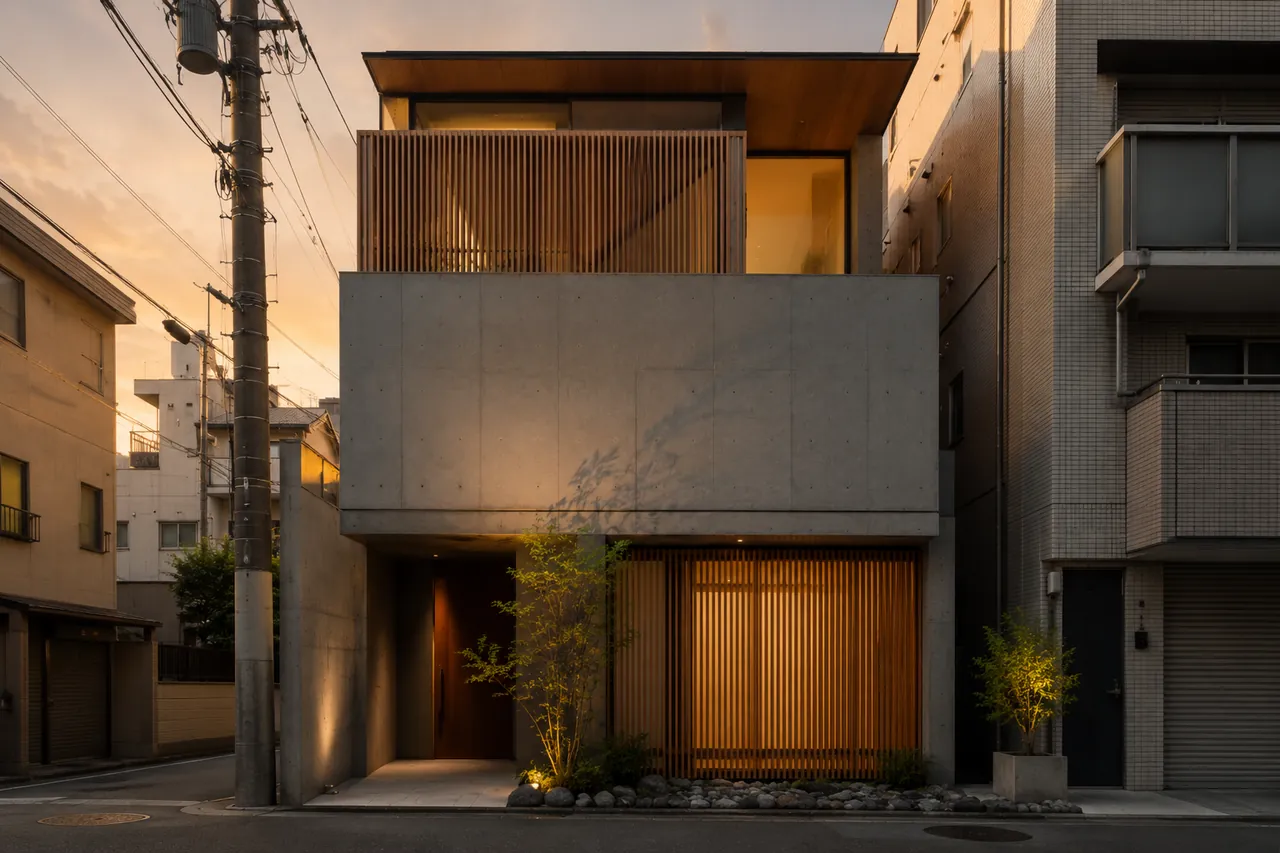
Where are Osaka's prestige residential districts? The classics: Tezukayama, Kitabatake and Yuhigaoka on the southern Uemachi Plateau, the estate streets of Abeno and Sumiyoshi, the city-core towers of Kita and Chuo wards, and Minoh in Hokusetsu. High ground with low flood risk and covenant-protected streetscapes — land prices vary widely by area.
Part of the guide: Building a custom home in Osaka
1. Osaka's Top 5 Luxury Residential Areas
Osaka's residential districts have two poles: traditional low-rise neighbourhoods spread atop the plateau, and the top floors of city-centre towers. First, an overview of five representative areas, with a guide to land price per tsubo.
- Kita-ku, Umeda / Tenmabashi — high-rise tower × penthouse demand. Land price ¥8–20 million/tsubo
- Chuo-ku, Shinsaibashi / Tanimachi — central residence + commercial mix. ¥5–12 million/tsubo
- Tennoji-ku, Uemachi plateau (Yuhigaoka, Karahori) — a traditional residential quarter on high ground overlooking Osaka Castle. ¥4–9 million/tsubo
- Abeno-ku, Tezukayama — a prewar residential district, a low-rise quarter representative of Kyoto-Osaka-Kobe. ¥3–6 million/tsubo
- Sumiyoshi-ku, Tezukayama-naka / -higashi — an academic residential area around Tezukayama Gakuin. ¥2.5–4.5 million/tsubo
Even within "luxury," the character of a central type that buys convenience and a plateau type that buys environment and dignity is entirely different. It is not a matter of which ranks higher, but a choice of how to live.
2. The Uemachi Plateau — "Osaka's Yamanote"
The Uemachi plateau runs south from Osaka Castle at an elevation of 20–30m. Flood risk is low, the ground is sound, and it has been inhabited since the Kofun period. It includes traditional quarters such as Yuhigaoka, Karahori, and the temple town, with a distinctive landscape where residences and temples mingle.
Sound ground is a major advantage when planning a heavy RC residence or a basement: the burden of ground improvement is small and structural freedom high. On the other hand, the temple town has many narrow alleys and small or irregular plots, so volume and construction planning demand design and build skill strong in dense areas. Reading the historic context while layering modern performance — the Uemachi plateau is land where one can savour that art.
3. Tezukayama — The Far Bank of the Hanshin Belt
A representative Kansai residential district on a par with the Hanshin belt (Ashiya, Nishinomiya). Within 5–10 minutes' walk of Tezukayama Station on the Nankai Koya Line, it is a low-rise district formed by prewar land development, with a high green-cover ratio and a striking dignity of residence density and planting.
Tezukayama's value lies, beyond the figure of land price, in the fact that the streetscape is protected. The long-maintained low-rise, green landscape demands that even a single residence harmonise with its surroundings, with walls, hedges, and external works shaping the quarter's dignity. For new build or rebuilding, a restrained design that speaks of quality while blending into the streetscape is preferred over a protruding statement.
4. Kita-Midosuji / Umeda-Kita — Vertical Residences
Central Kita-ku is led less by a traditional "residential district" than by the turning of tower-apartment top floors into residences. The top several floors of 30–50-storey towers in the Kita-Midosuji, Umekita, and Fukushima areas form a de facto residence market above ¥10 million per tsubo.
The appeal of the "vertical residence" is view and convenience, plus security and shared services. But because the frame and openings are dictated by the whole building, individuality as a residence is expressed through renovation of interior, equipment, and spatial composition. Care for the wind pressure, solar gain, and air-conditioning load peculiar to the top floor is essential. Gaining the city-centre summit without owning land — this, too, is one form of the modern Osaka residence.
5. Beyond Osaka City — Hokusetsu, the Hanshin Belt and Kobe
Most people searching for Osaka's prestige addresses are also weighing Hokusetsu (Minoh, Toyonaka, Suita) and the Hanshin belt (Ashiya, Nishinomiya). Out here, what separates one address from another is what you are allowed to build more than the land price: landscape ordinances, district plans and private covenants written at the original subdivision can dictate everything from whether a plot may be split to the colour of your exterior walls.
| Area | Character | Rules that bite before you design | More |
|---|---|---|---|
| Minoh (Hyakurakuso, Sakuragaoka) | Subdivided from the Taisho era; generous plots and hedgerows — Hokusetsu's classic estate district | Landscape-ordinance rules on form and colour; Category-1 low-rise zoning plus height-district limits. Mountain-side plots need urbanisation-control-area permission | Building in Minoh |
| Toyonaka (Higashi-Toyonaka, Midorigaoka) | A leading Hokusetsu prestige district; largely estate-class rebuilds | Most of the city is Category-1 low-rise plus height districts (strict north-side setback). Near Itami Airport, aviation-law height limits apply | Building in Toyonaka |
| Suita / Senri (Senriyama and around) | Master-planned residential streetscapes | Senri New Town district plan (minimum plot size, wall setbacks, use limits); retaining walls and fill on the hillside-造成 land | Building in Suita |
| Ashiya (Rokurokuso-cho and around) | Japan's foremost traditional estate district | Private covenants from the original subdivision bind minimum plot size and even structure; the landscape ordinance reaches height, wall colour and roof pitch | Building in Ashiya |
| Nishinomiya (Kurakuen, Koyoen, Shukugawa) | The heart of Hanshin-kan modernist estate culture | Scenic districts, Category-1 low-rise plus minimum-plot rebuild rules, cliff ordinance and landslide-warning zones | Building in Nishinomiya |
| Kobe (Mikage, Sumiyoshi, Okamoto / Mt. Rokko foothills) | Higashinada's traditional prestige districts, plus view estates on the slopes | Hillside plots assume retaining walls, and site-preparation cost eats into the building budget. Around Kitano's ijinkan quarter, landscape-formation districts govern the exterior; the coast demands salt-air protection | Building in Kobe |
Rokurokuso-cho in Ashiya — often called Japan's finest residential address — is also among its most tightly governed. A building covenant dating from the original subdivision sets the minimum plot size (that is, bars subdivision), the height and material of walls and fences, garish colours, and commercial use. Learning those terms after you have fallen for the plot changes the plan from the ground up — read the covenant before you buy. More in landscape ordinances and prestige districts.
All of these are areas we serve. Before you commit to a plot, we can read the site's real limits with you — free.
Frequently asked questions
Where are Osaka's prestige residential areas?
Within the city: the Uemachi Plateau (Tennoji), Tezukayama (Abeno and Sumiyoshi), and the upper floors of the central Kita and Chuo towers. Beyond the city, Ashiya and Nishinomiya in the Hanshin belt, and Minoh, Toyonaka and Suita in Hokusetsu, are among Kansai's finest.
Which Osaka luxury district has the highest land price?
By land price per tsubo, Kita ward (Umeda / Tenmabashi) is highest at roughly ¥8–20M per tsubo, followed by Chuo ward (Shimanouchi / Tanimachi) at about ¥5–12M per tsubo.
How much is land in Tezukayama?
Around ¥3–6M per tsubo in Abeno-ward Tezukayama, and ¥2.5–4.5M per tsubo in Sumiyoshi-ward Tezukayama-naka and Tezukayama-higashi — a low-rise estate district dating from before the war.
Why is Ashiya's Rokurokuso-cho special?
Often called Japan's finest residential address, its private covenant from the original subdivision fixes the minimum plot size (barring subdivision), the height and material of walls, exterior colours, and commercial use. Read the covenant before you buy land there.
6. Three Viewpoints for Choosing
① Ground: the Uemachi plateau and Tezukayama are sound; the bayside and downtown (Nishi-ku, Minato-ku) carry liquefaction risk. ② Zoning: a Category 1 Low-Rise Residential zone, with its 10m height limit, gives long-term landscape stability. ③ Access: within a 10-minute walk of a station is important for securing future liquidity.
These three govern not only comfort but future asset value. Sound ground bears on safety and building cost; zoning regulation on the long-term stability of the landscape; station proximity on liquidity at sale. Choosing not by short-term preference alone but by the view of how the land will be valued in 10 or 20 years is especially important for a residence, a long-term asset.
Osaka's luxury residential areas fall between Tokyo's "Seijo / Den-en-chofu" type and its "Bancho / Shoto" type. The choice between plateau traditional areas (Tezukayama, Uemachi) and the city-centre tower type (Kita-ku) is the main axis of the modern Osaka residence market.
Land price by area at a glance
| Area | Land price / tsubo (guide) |
|---|---|
| Kita-ku, Umeda / Tenmabashi | ¥8–20 million/tsubo |
| Chuo-ku, Shinsaibashi / Tanimachi | ¥5–12 million/tsubo |
| Tennoji-ku, Uemachi plateau (Yuhigaoka, Karahori) | ¥4–9 million/tsubo |
| Abeno-ku, Tezukayama | ¥3–6 million/tsubo |
| Sumiyoshi-ku, Tezukayama-naka / -higashi | ¥2.5–4.5 million/tsubo |
Land price is land only. Building cost is separate — about ¥1.2–1.9M/tsubo (shell) for an RC residence. Estimate land + build together in the build-cost calculator.
Find out how many m² you can build on a plot — free check.
Ask about buildability