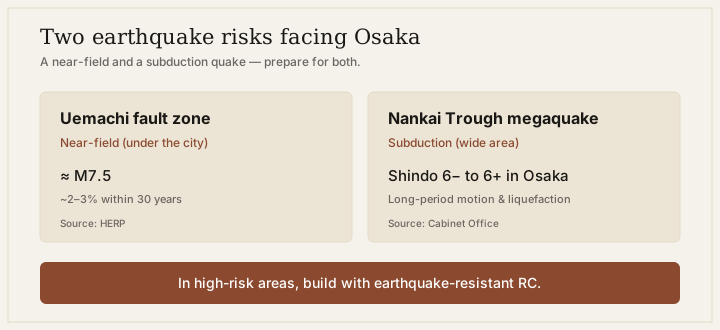
In high-risk areas where the Uemachi fault zone and a Nankai Trough megaquake are anticipated, Towa Construction recommends earthquake-resistant RC.
Part of the guide: RC homes in Osaka
1. The essence of the three structural systems
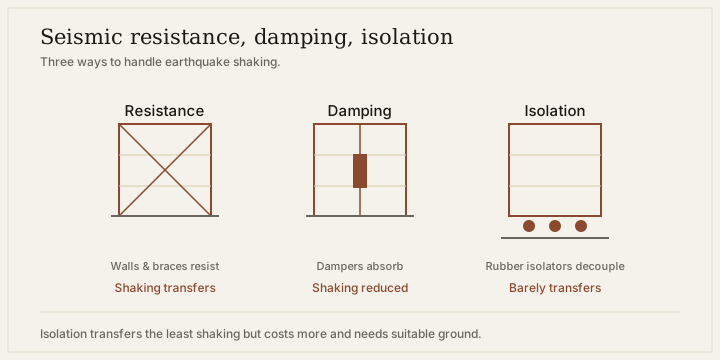
- Earthquake-resistant: "withstands" shaking through the building's own rigidity. Most common; the building is expected to shake.
- Base-isolated: rubber bearings at the foundation "decouple" the building from the ground, so motion is not transmitted.
- Vibration-damped: dampers inside the building "absorb" the shaking. The middle solution.
2. Performance comparison
| System | Shaking reduction | Furniture tip-over | Structural damage |
|---|---|---|---|
| Resistant (grade 1) | baseline | yes | light–moderate |
| Resistant (grade 3) | 1.5× baseline | yes | light |
| Damped | ~1/2 | few | minor |
| Isolated | 1/3–1/5 | almost none | none |
3. Why Japan's seismic code is strict by world standards
Japan has revised its code after repeated major quakes. The 1981 "new seismic standard" and the 2000 strengthening of wood-joint rules were major turning points. The current code sets "no collapse even at seismic intensity 6-upper to 7" as the minimum line, and grade 3 carries 1.5× that margin. For residences, taking grade 3 as the starting point is today's standard.
4. Added cost (standard housing basis)
- Seismic grade 3: +¥0.5–1.5M (3–5% of the building)
- Vibration dampers: +¥2–5M
- Base isolation: +¥5–15M
5. Selection guide for residences
Wood residence, 3 storeys or fewer: grade 3 + dampers offers the best cost-performance.
RC residence (2–3 storeys): grade 3 is sufficient; isolation tends to be over-investment.
High-rise / tower residence: isolation is advantageous and also curbs wind sway.
Soft ground: isolation needs careful judgment (soil survey essential).
6. Ground and seismic design are inseparable
However strong the building, performance fails on weak ground. Soft ground carries liquefaction and differential-settlement risk, making ground improvement or piling a prerequisite. Isolation can even backfire on ground prone to long-period motion, so the rule is to choose the system based on soil-survey results (boring / Swedish sounding).
7. Maintenance blind spots and inspection cycles
Isolation and damping are not "install and forget." The devices need inspection and renewal.
| Device | Inspection / renewal guide | Cost guide |
|---|---|---|
| Isolation (periodic check) | every 10 yrs (statutory) | ¥0.3–0.5M / time |
| Dampers | replace at 15–20 yrs | varies by product |
| Resistant (joint hardware) | inspect after a major quake | mainly visual |
8. Psychological and asset value
Since the 2011 Tōhoku earthquake, isolated condominiums trade 10–15% above comparable units. It is now valued as asset and resale value too. In the resale market, seismic grade and the presence of isolation have become important valuation axes.
9. How to choose a system
Decide in the order "budget → ground → building form → maintenance plan." First run the soil survey, then compare cost-performance of systems with a structural engineer. Confirm the effect on your own site and building by structural calculation, not catalog figures—that is the key to not failing. Avoid both over-investment and under-preparation, and find the optimum.
From "withstanding on the assumption of shaking" to "protecting on the idea of not shaking." Isolation and damping are not mere cost but insurance protecting family and assets.
We'll compare wood vs RC costs for your project.
Request a cost comparison