Why do building budgets overrun? Five causes dominate: spec changes, added ground improvement, under-indexed inflation, overlooked residual works and underestimated fees. The baseline defence is a 10–15% contingency held at contract.
The main causes of a budget overrun are almost always the same five: (1) spec changes, (2) added ground improvement, (3) under-accounting for price inflation, (4) overlooked ancillary and remaining work, and (5) underestimated incidental costs. Get ahead of these five and you can prevent an overrun. As a baseline, set aside a contingency of 10 to 15% when you sign.
1. Overruns come from "the usual five"
| Spec changes | +10 to 20% |
| Ground improvement | +1 to 4 million yen |
| Price inflation | +5 to 8% |
| Ancillary / remaining work | +3 to 9 million yen |
| Incidentals / tax | +1.5 to 3 million yen |
2. Spec changes (the biggest culprit)
"While we're at it, let's make the floor natural stone too"; "let's bump the kitchen up a grade." Mid-project additions like these — +10 to 20% — are not unusual. To prevent them, finish your showroom rounds during schematic design and freeze the specification once you enter detailed design.
3. Added ground improvement
Depending on the soil survey, +1 to 4 million yen. So always commission the soil survey before you sign and build improvement costs into your budget in advance. If soft ground is found, the foundation method itself should be reviewed.
4. Under-accounting for price inflation
In recent years, building materials have risen 5 to 10% a year in some periods. When 1.5 years pass from contract to completion, inflation alone adds 5 to 8%. Make sure a "price-fluctuation sliding clause" is written into your contract.
5. Overlooked ancillary and remaining work
If you think only of the main building, these are easy to forget:
- Curtains and blinds (0.8 to 2 million yen)
- Furniture and appliances (2 to 5 million yen)
- Moving and utility contracts (0.1 to 0.3 million yen)
- Exterior works and planting (0.5 to 3 million yen)
6. Underestimated incidentals and tax
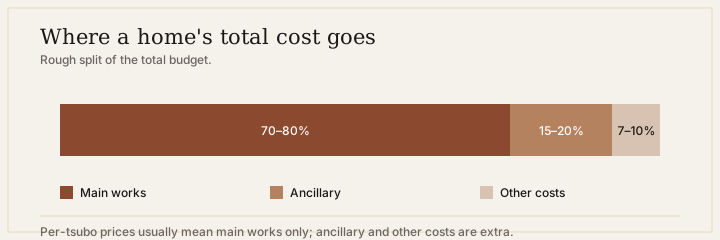
Registration fees, real-estate acquisition tax, fixed-asset tax, fire and earthquake insurance — 1.5 to 3 million yen in total. These are often excluded from the construction quote, so set them aside in a separate line of your budget.
7. A system for managing additions and changes
Most overruns are the "it grew before I noticed" kind. That is exactly why you should insist on one rule: every change is put in writing (a change quote), and work begins only after you have reviewed and approved the scope and price. We work this way as standard — before any verbal "while-we're-at-it" turns into a number, we put it in front of you in writing.
8. Designing the contingency
A contingency is not "leftover" but "a premise." Set aside 10 to 15% of the total budget separately and settle it at the end if unused. On land where the soil is hard to read, or plans involving demolition of an old building, plan toward the 15% side for peace of mind.
9. Contract devices that prevent overruns
| Sliding clause | Agree in advance how price fluctuation is handled |
| Spec-freeze date | State that changes after detailed design are chargeable |
| Contingency 10 to 15% | Written into the contract |
| Coordinating split orders | Clarify responsibility boundaries between trades |
"Always secure a contingency of 10%" is the iron rule of budget control. Not "lucky if we don't use it" — build it on the premise that you will.
Send us your drawings or plot info and we'll estimate the budget.
Get a free estimate