Where does Japanese build quality come from? Over 50 items are resolved at the design stage — corner radii, joinery fit, concealed pipe routes, drips and sealant work. The standard: the parts you don't notice are beautiful.
Part of the guide: RC homes in Osaka
1. 1:5 and 1:10 details
Working drawings are generally issued at 1:50 or 1:100; we draw the key junctions at 1:10, and at full size where it matters, and share them with the trades. Sash-to-cladding transitions, tile splits, skirting lines — all resolved on paper. The site builds the answer; it doesn't invent one.
2. Joinery — wood that locks itself
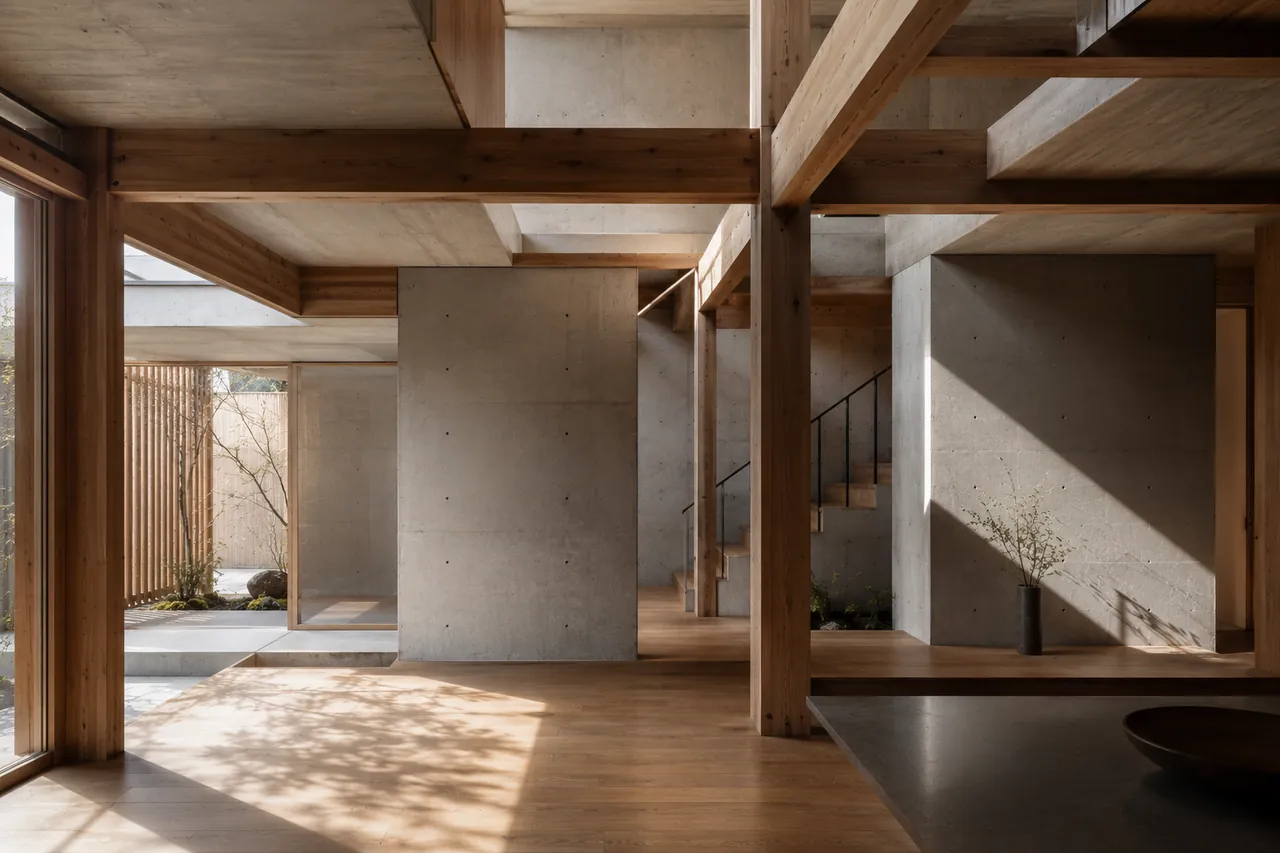
Traditional Japanese carpentry cuts the joint into the wood rather than relying on hardware. The tradition lives on today in CNC pre-cut factories. A single residence can carry several hundred joints and connections.
3. Layered waterproofing
A Japanese flat roof is a five-layer stack: substrate prep, primer, membrane, protective mortar, finish. A balcony sill seals water with five overlapping barriers: drip, flashing, tape, sealant, finish. Redundancy is the design language.
4. Tile coursing
Japanese practice splits the elevation so tiles do not need to be cut. Where the geometry resists, opening positions get adjusted at design stage. A single tile-layout drawing can take hours of careful work.
5. Independent site supervision
The architect's office sends a supervising architect to the site once or twice a week for rebar inspection, concrete pour witness, window installation check. A third-party eye separate from the contractor's interests.
6. The pride economy
Japanese trades carry genuine reputational stakes from project to project. The reputation that travels among foremen is more valuable than a single contract margin. The mechanism quietly suppresses shortcuts.
The 50+ detail items reviewed at design stage
The "50+ items" in the title means junctions and transitions like the ones below. The exact list grows or shrinks with the project, but for a luxury residence the design-and-supervision phase draws each of these and checks it before work starts.
Exterior & waterproofing
- Parapet coping–to–membrane junction
- Balcony / veranda waterproofing upstand height
- Sash-sill drip and back-up flashing
- Cladding joints and sealant break positions
- Eaves / hood fall and leading-edge drip
- Foundation and sill-plate flashing detail
- Pipe-penetration sealing and sleeves
- Drain (outlet) position vs. waterproofing layer
- Entrance porch / terrace floor fall
Openings & fittings
- Sash-to-cladding junction (reveal and margin)
- Entrance-door frame vs. cladding and floor
- Window casing / architrave detail
- Sliding-door pocket and top-hung track concealment
- Door stops and air-seal gaskets
- Internal door undercut vs. floor finish
- Insect-screen / grille fixing substrate
- Glazing face position and bead appearance
Interior finish junctions
- Wall-to-floor transition (skirting line, or none)
- Wall-to-ceiling transition (cornice, shadow gap, butt)
- Internal / external corner treatment (corner radii)
- Dissimilar-finish breaks (paper / paint / tile)
- Stair tread, riser and stringer detail
- Handrail / coping end treatment
- Floor-level change (barrier-free) trim
- Tatami border and threshold detail
- Built-in counter / shelf support and reveal
Concealing services
- Supply / drain routing vs. access-panel position
- AC condensate and refrigerant routing concealment
- Ventilation ducting and ceiling-void depth
- Switch / outlet position layout
- Downlight and indirect-lighting placement and backing
- Distribution / low-voltage board housing
- Underfloor and ceiling access panels
- Water heater / outdoor unit base and piping
Tile, stone & plaster coursing
- Exterior-tile coursing (joints with no off-cuts)
- Floor tile / stone coursing vs. openings and fixtures
- Trim / corner-piece selection
- Joint width and joint colour
- Bathroom / wet-area fall and drainage
- Plaster internal / external corners and breaks
- Stone edge and chamfer treatment
Structure, substrate & future upkeep
- Joint / connection positions and hardware visibility
- Substrate (furring / board layout) vs. finish joints
- Service openings / sleeves vs. structural impact
- Insulation continuity (thermal-bridge control)
- Air-barrier (vapour sheet) continuity
- Substrate reinforcement against squeak / deflection
- Backing for heavy items (piano, bookcase, stone)
- Joinery / storage vs. wall-substrate alignment
- External works (gate, wall, approach) vs. building
- Maintenance access (scaffold, cleaning) provision
- Access for future service / pipe replacement
How these add up to overall quality
- Water management — multiple membranes and drips overlap, leaving no weak point in the path
- Pre-handover correction — finished from the hidden parts outward, each issue closed one by one
- Ageing — material choice and detailing keep the façade from breaking down over the years
Strong details = design precision × site sequencing × independent supervision. Drop one factor and decay starts behind the finish, where no one will see it for years.
We'll compare wood vs RC costs for your project.
Request a cost comparison