
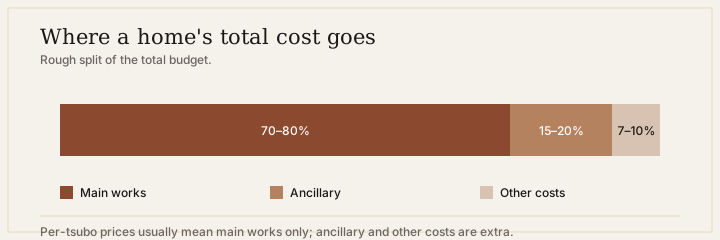
Why do quotes differ so much between firms? Even on identical briefs, the gap comes mainly from material grades and labour rates. Compare only on a unified spec — and always ask why the cheap one is cheap.
1. Why identical requirements yield different totals
Handing the same drawings to three contractors and getting totals that differ by 20–30% is common. It rarely means one firm is simply overpriced or cheap. The main cause is that each firm assumes a different scope, specification level, and risk buffer. The first step in any comparison is aligning "what the number is based on," not the number itself.
2. Specification precision — the biggest variable
A quote that says only "standard spec" with no detailed drawings will change later. The same requirement varies ±30% depending on spec precision. The correct approach is to issue 100+ detailed drawings first and then request pricing; a figure taken against vague drawings is only a rough estimate.
3. Differences in scope of work
What "50 million yen total" covers differs by contractor.
- Main building only vs. including exterior works and demolition
- Design supervision fees included vs. excluded
- How ground improvement, temporary works and neighbor measures are estimated
- Tax included vs. excluded
Without comparing "what is included" in a table, you cannot judge fairly.
4. A scope comparison checklist
Always re-sort the three quotes onto the same line items. Marking each item as "included / separate / unclear" for every firm reveals the true source of the gap.
| Item to check | Usually included | Often missing (verify) |
|---|---|---|
| Structure / shell | Yes | — |
| Ground improvement | Provisional | Often rough before survey |
| Exterior / landscaping | No | Usually quoted separately |
| Design supervision fee | Varies | Bundled or separate differs |
| Temporary works / neighbor care | Varies | Highly site-dependent |
| Contingency | No | Can flip the total ranking |
5. Contractor experience and specialty
Firms specializing in custom residences have headroom in their methods; volume-housing firms optimize for standard specs. Asking for the same spec costs more when it is outside a firm's specialty. Order an RC residence from a firm with little RC track record and the inexperience premium lands in the price.
6. Differences in risk and contingency
Ground, neighbors, labor scheduling. The "just-in-case" buffer can differ two-fold between firms. Experienced firms estimate precisely; newcomers price defensively high. Conversely, a firm that zeroes out contingency to look cheap tends to true up via change orders after work starts.
7. Where the price gap comes from
Break down the total gap and most of it collapses into the three factors below. Material grade and labor are the two largest; the rest is scope and risk.
| Source of gap | Contribution | How to spot it |
|---|---|---|
| Scope differences | Large (~half) | Vanishes once items align |
| Material grade | Medium–large | Demand maker/model numbers |
| Labor / man-hours | Medium | Check man-hour breakdown |
| Risk / contingency | Small–medium | Ask the basis for the buffer |
8. How to run a smart competitive bid
Give all three firms the same detailed drawings and spec, and ask each to answer in a unified comparison format. The rule is "the clearest explanation wins, not the lowest price." The speed and specificity of answers to your questions mirror their responsiveness during construction.
9. Warning signs of a too-cheap quote
An outlier-low quote has a reason: (1) contingency and ground improvement are missing, (2) material grades are unnamed, (3) many "lump-sum" lines hide the breakdown, (4) unit rates for changes are not stated. A quote with all four typically ends up more expensive via post-contract additions.
The goal of comparing quotes is to discover "what is not included," not the headline price. Half of any total gap is just scope.
Send us your drawings or plot info and we'll estimate the budget.
Get a free estimate