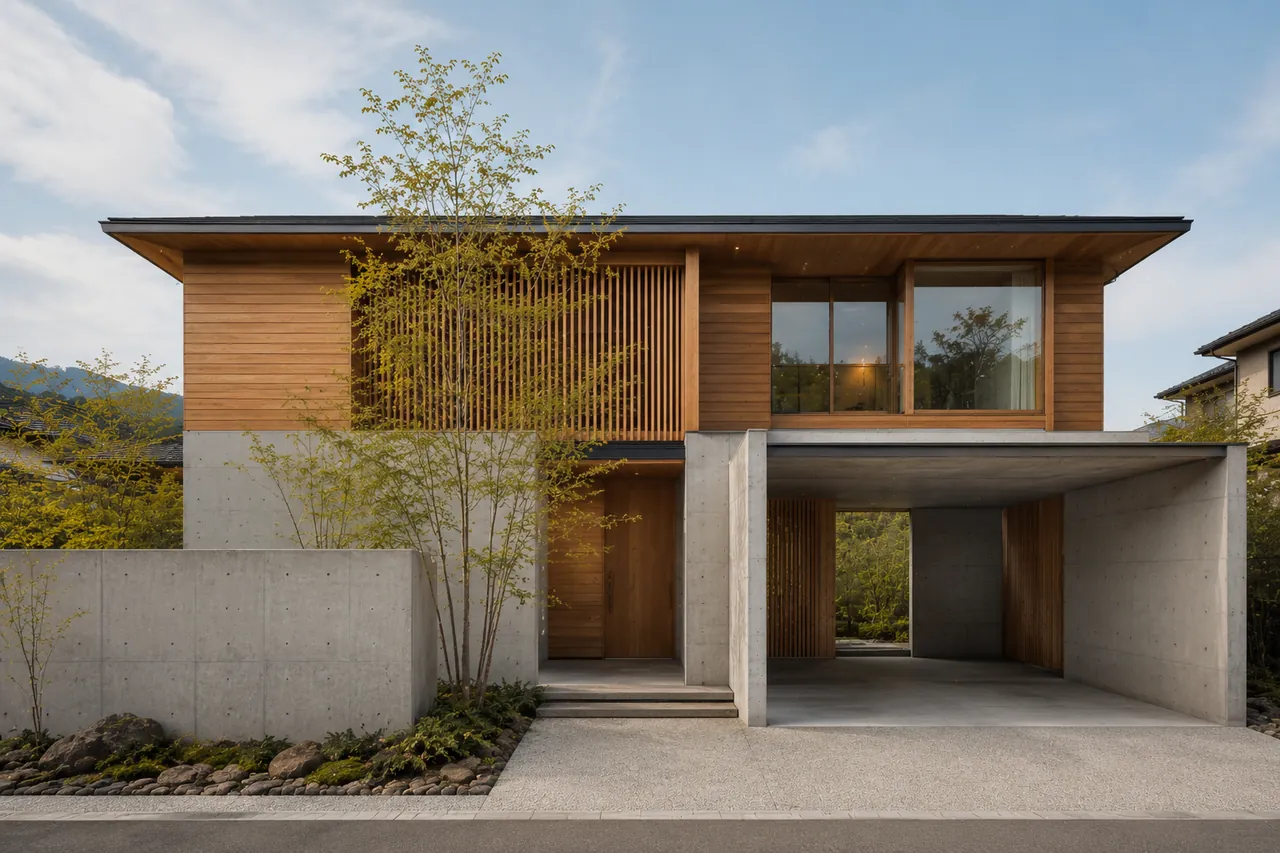
What does a villa build cost? Guide figures: 40–80 tsubo of floor area, ¥1.3–2.6M per tsubo, 12–18 months to build. Cold regions demand insulation and freeze protection; coastal sites, salt-damage measures.
Part of the guide: Building a custom home in Osaka
Case 1 — Ashiya wooden residence (two storeys + basement)
Site: Ashiya hillside / 220 m² / Category I low-rise residential / north-side setback strict
Structure: timber frame + RC basement / 180 m² GFA
Budget: JPY 120M / Timeline: 10 months
Design decisions
Faced with the north-side setback we chose between sacrificing second-floor volume or excavating. We chose the basement, creating a wine cellar / study. Water table at –3.5 m drove a double-layer waterproofing detail.
Notable details
- South-facing fixed glazing with deep eaves for solar control
- Charred-cedar exterior set against white plaster
- Basement humidity held below 70% with under-floor air supply
The point of this case is that a regulation was turned from "a constraint to surrender to" into "a prompt to design one level deeper." Floor area that couldn't be won above grade was secured below, and the basement's own qualities — stable temperature, quiet, no daylight — were turned to advantage as a wine cellar and study. The tighter the lot and the stricter the setback, the more a section-driven idea pays off.
Case 2 — Nishinomiya sea-view residence (three-storey RC)
Site: Nishinomiya Shukugawa / 330 m² / Category II mid-rise
Structure: RC wall-frame / 310 m² GFA
Budget: JPY 250M / Timeline: 18 months
Design decisions
The southwest sea view became the brief. We placed the living floor on level three — kitchen, lounge, guest suite, jacuzzi terrace. Ground floor held three cars and services.
Notable details
- 8 m column-free opening on level 3, achieved with prestressed beams
- Jet-finished granite envelope
- Inverted-beam roof for clean, leak-resistant waterproofing
To maximise a single asset — the view — the project deliberately broke the usual "living room on the ground floor" convention. Lifting the heart of the home to the top floor ripples through both structure (a long, column-free span) and circulation (separating guests from daily life). Identifying the site's greatest asset and concentrating the plan and section around it is the core of designing a view-led residence.
Case 3 — Hokusetsu two-generation residence (hybrid two-storey)
Site: Toyonaka Shinsenri / 280 m²
Structure: RC ground + timber upper / 240 m² GFA
Budget: JPY 90M / Timeline: 12 months
Design decisions
Parents on level 1, children on level 2. RC at ground for acoustic separation and fire safety, timber above to keep the structure light — also seismically favourable. A courtyard divides the circulation while preserving sightlines.
Notable details
- Shared 7 m² genkan wide enough for prams and wheelchairs
- Hand-trowelled mineral plaster paired with seam-folded galvalume cladding
- Independent hot-water and electricity meters per generation
In a two-generation home the hardest thing to design is not the services or the structure but the right sense of distance. Choosing RC below and timber above delivers acoustic and fire separation, and at the same time physically decouples the living sounds of the two households. Sightlines are joined across the courtyard while circulation is split — a relationship that is neither too close nor too far, made to work by the plan itself.
The shared logic across the three cases
The three look quite different, yet the same logic runs beneath them. First, start from the site's constraints and assets: setbacks, views and family makeup are treated as the starting point of design, not as defects. Second, choose structure to fit the goal: timber, RC and hybrid are not better or worse but means to the performance you want. Third, concentrate the added value in one place: rather than spreading budget evenly, weight it toward whatever matters most to that particular home.
Copying a case doesn't help. Copying the decision logic does. Site, family, budget, and climate combine differently each time.
Talk to us about your plan and a rough budget — free.
Book a free consultation