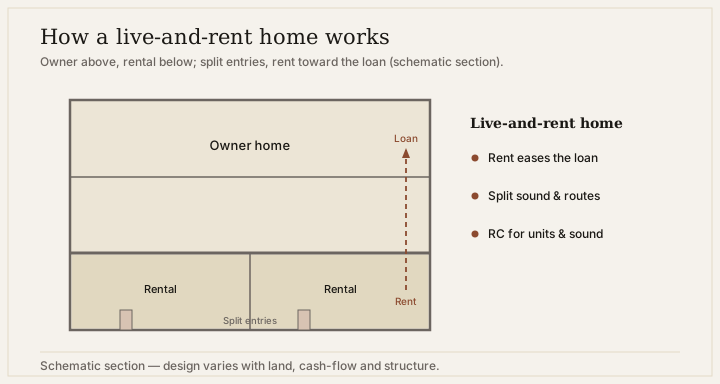
What is a live-and-rent home? A building that holds both your own residence and rental units. Tenant rent offsets the mortgage, and if your own part is 50%+ of the floor area you can usually use a (low-rate) home loan. In return it carries the “investment / landlord” side — vacancy and tenant management.
What is a live-and-rent home, and its benefits
- Rent eases the loan — tenant rent goes toward repayment, cutting your real burden.
- Easier home-loan access — at 50%+ own use, a low-rate home loan is usable.
- Future flexibility — for a child’s household, renting, or sale across life stages.
- Land made productive — a prime lot serves both “living” and “income.”
Who and which land suit it?
- Station-near, prime lots — rental demand in urban Osaka.
- Larger lots / wanting to use assets — sites too big for a home alone.
- Wanting to cut loan burden — combine home ownership with asset-building.
Do people regret it? Cons and pitfalls
Honestly: because it involves being a landlord, weak planning leads to regret.
- Vacancy risk — empty units break the repayment plan.
- Close to tenants — living noise, privacy and dispute handling.
- Harder to sell — few buyers, a tricky exit.
- Less freedom at home — plans tend to favour the rental side.
- Cash-flow shortfall — optimistic rents mean out-of-pocket costs.
| Aspect | Benefit | Drawback / caution |
|---|---|---|
| Funding | Rent eases the loan | Vacancy breaks the plan |
| Loan | Home loan usable | Under 50% own = business loan |
| Living | Income while living in a prime spot | Close to tenants, management load |
| Exit | Future flexibility | Hard to sell, limited exit |
The key to no regret: cash-flow plus acoustic and separation design
Success depends less on layout than on whether it works as a business, and how you separate own from rental.
- Honest cash-flow — judge it as an investment, including rent, vacancy, repairs and tax.
- Acoustic and circulation separation — cutting living noise and splitting entries/routes decides satisfaction.
- Structure for sound, fire and units — RC is strong on sound and fire, helping rental quality and unit count.
Towa Construction’s strength in RC and multi-unit design makes “live” and “rent” coexist.
Making it work in Osaka
- Judge demand near stations — plan on the area’s rental demand and rents.
- Use the floor-area ratio — optimise units and scale to FAR.
- RC for units and sound — yield and livability even on tight urban lots.
Common mistakes and how to prevent them
| Common mistake | Prevention |
|---|---|
| Optimistic rent, out of pocket | Model cash-flow on conservative rent/vacancy |
| Noise disputes | RC-grade sound + fully split entries/routes |
| Own home hard to live in | Set own-vs-rental priorities in design |
| Can’t use a home loan | Keep own part at 50%+ of floor area |
| Trouble selling | Design for an exit (keep renting / full rental) |
A live-and-rent home isn’t just “rent makes the loan easier” — it works only with both landlord economics and design. We recommend checking, from both the drawing and the cash-flow, whether the numbers work on your lot and how to split own from rental.
Send us your drawings or plot info and we'll estimate the budget.
Get a free estimate