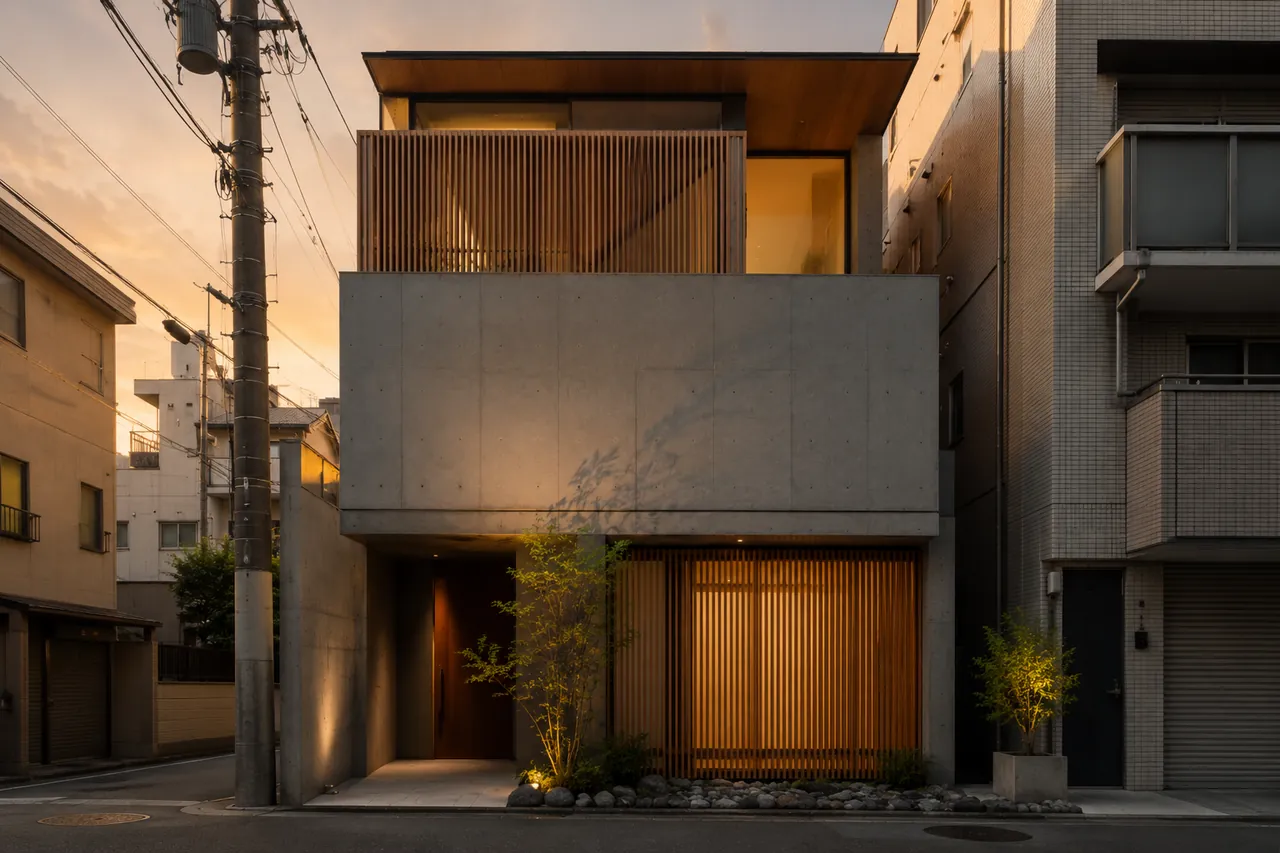
What are Osaka's construction rates? RC estate homes centre on ¥1.2–1.9M per tsubo; exposed-concrete estates run ¥1.8–3.8M. Hotel construction demand continues on the inbound recovery, and offices stay firm around Umeda and Hommachi.
Part of the guide: RC homes in Osaka
1. Per-tsubo price ranges (2026)
Building costs in Osaka vary widely by structural type and finish grade. The table below sets out the standard ranges as of 2026, distilled from recent estimates. Treat them as a guide only — site conditions, design difficulty and equipment specs all move the figure.
| Use × structure | Standard | High end |
|---|---|---|
| Wood-frame residence | ¥550K–1.3M / tsubo | ¥1.3M–1.6M / tsubo |
| RC residence | ¥1.1M–1.8M / tsubo | ¥1.8M–2.4M / tsubo |
| Exposed concrete residence | ¥1.8M–2.8M / tsubo | ¥2.8M–3.8M / tsubo |
| Business hotel | ¥1.3M–1.8M / tsubo | ¥1.8M–2.4M / tsubo |
| Class-A office | ¥1.8M–2.6M / tsubo | — |
* The table above shows market-wide ranges by grade. Our standard RC residence is ¥1.2–1.9M/tsubo (shell, ex-tax).
Osaka pricing typically runs 15–20% below Tokyo's 23 wards. Materials are identical; the gap is labour and land cost. Even within "RC residence," choosing exposed concrete as the primary finish raises the demands on formwork precision and pour control, pushing the per-tsubo figure into the next band up. Grade is set less by fittings than by the choice of structure and finish.
2. Three demand trends
① Hotel new-builds driven by inbound recovery. Namba, Tennoji and Shinsaibashi continue to absorb small-format hotels (30–80 keys, 7–10 floors). Within a 5-minute walk of a subway station is the key.
② Polarised residential market. Mid-range spec-builds are losing share to two ends: custom homes above ¥2M/tsubo and efficiency-focused builds under ¥800K/tsubo. Wealth demand concentrates in Nishinomiya, Ashiya and Tezukayama.
③ Office redevelopment. Mid-size 1970s–80s buildings in Honmachi, Kitahama and Umeda are being rebuilt. New seismic codes, energy-efficiency ratings and BCP capability are now table stakes.
What the three trends share is a focus on pairing location with performance. More clients now judge a project by its post-completion economics — occupancy, asset value, tenant satisfaction — rather than by headline price.
3. Contractor landscape: skilled labour shortage
Kansai's construction workforce is shrinking. Formwork carpenters, rebar workers and plasterers are particularly tight; busy seasons see 2–3 month schedule extensions. The right contract timing is "right after site acquisition."
Securing trades has become a procurement challenge more pressing than price negotiation. The best specialist firms book up early, so the major trades should be reserved roughly six months before breaking ground. Running design and construction in parallel (design-build), or bringing the contractor in at the cost-estimate stage, is a practical hedge against delay.
4. How Kansai differs from Kanto
Kansai signatures: land cost 50–70% of Tokyo; trade networks built on local relationships; smaller, often family-owned design firms; shorter distance to decision makers. The rational case for building in Kansai is "cost × decision speed."
Local networks are a quiet but decisive quality factor. A regional general contractor that has worked with the same trade teams for years can handle the details and sequencing that never appear on a drawing. At the same time, with so many narrow, dense and alley-fronting sites in Kansai, the skill of neighbour coordination and temporary-works planning often makes or breaks the schedule.
5. Three things to confirm before you sign
First, the scope behind the estimate. The same per-tsubo rate can hide a very different total depending on whether ground improvement, exterior works, design fees and overheads are included. Second, the delivery team — who the site manager and key trades actually running the job will be. Third, the rules for variations. Because spec changes are inevitable, agree the method for pricing additions and deductions before signing; it heads off most later disputes.
Osaka offers strong budget efficiency and good craftsman density. The flip side is site difficulty — narrow lots, dense neighbourhoods and roji (alley-fronting) plots are common. Choosing an experienced Kansai general contractor matters more here than elsewhere.
Send us your drawings or plot info and we'll estimate the budget.
Get a free estimate