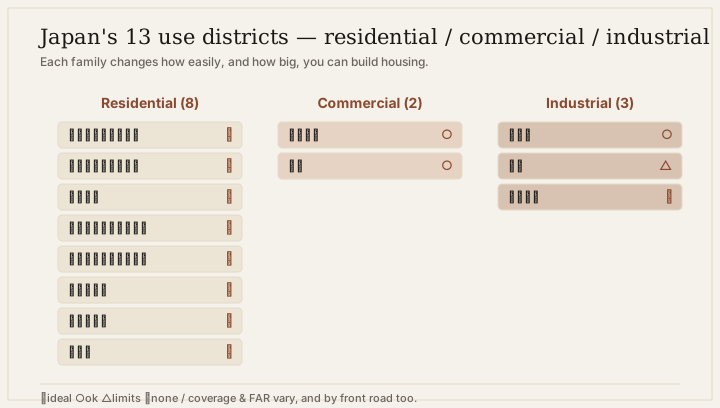
What is a use district? A use district (yōto chiiki) sorts land into 13 categories under the City Planning Act, fixing the permitted use, scale (coverage / floor-area ratio) and height you may build. Even within the same Osaka ward, a different zone changes what — and how big — you can build.
Part of the guide: Hotels & lodging investment in Osaka
The 13 use districts
Use districts are land categories under the City Planning Act — currently 13, split broadly into residential (8), commercial (2) and industrial (3). Each has its own coverage/FAR options, permitted uses and height controls (slant-plane, shadow rules, and an absolute height cap in low-rise zones).
The 13 use districts — table
| Use district (JP term) | Family | Housing | Coverage % | FAR % |
|---|---|---|---|---|
| 第一種低層住居専用 | Residential | ◎ | 30–60 | 50–200 |
| 第二種低層住居専用 | Residential | ◎ | 30–60 | 50–200 |
| 田園住居 | Residential | ◎ | 30–60 | 50–200 |
| 第一種中高層住居専用 | Residential | ◎ | 30–60 | 100–500 |
| 第二種中高層住居専用 | Residential | ◎ | 30–60 | 100–500 |
| 第一種住居 | Residential | ◎ | 50–80 | 100–500 |
| 第二種住居 | Residential | ◎ | 50–80 | 100–500 |
| 準住居 | Residential | ◎ | 50–80 | 100–500 |
| 近隣商業 | Commercial | ○ | 60–80 | 100–500 |
| 商業 | Commercial | ○ | 80 | 200–1300 |
| 準工業 | Industrial | ○ | 50–80 | 100–500 |
| 工業 | Industrial | △ | 50–60 | 100–400 |
| 工業専用 | Industrial | ✕ | 30–60 | 100–400 |
※Coverage and FAR are option menus set by the Building Standards Act; the actual designation is fixed by Osaka's city plan. Housing symbols are a guide (◎ideal / ○allowed / △allowed with limits / ✕not allowed). Zone names are kept in Japanese — that is how they appear on official maps.
How much it changes
- Buildable size — the coverage/FAR caps change, and the front-road FAR limit applies on top. Estimate the real buildable size with the land capacity simulator.
- Permitted use — low-rise residential is housing-centred, commercial is shops/offices, and an industrial-exclusive zone bars housing.
- Height & daylight — low-rise residential zones carry a 10/12 m absolute height cap plus slant-plane and shadow rules.
Checking your land's zone in Osaka
Osaka's city-planning map service or the ward office lets you look up the use district, coverage and FAR by address. Before buying land or designing, pin down "how many m² can I really build" by combining the zone + front road + other limits. See also choosing land.
The zone alone doesn't decide it — what changes your real size
The designated FAR/coverage are a starting point; the size you can actually build changes with the following. Estimate the final buildable size free with the land capacity simulator.
| Factor | What it does (guide) |
|---|---|
| Front-road FAR limit | If the front road is under 12 m, the FAR cap is the LOWER of the designated value and width(m)×0.4 (residential) / ×0.6 (other). E.g. residential + 4 m road → 160% cap |
| Corner-lot relaxation | Corner lots designated by the authority get +10% building-coverage ratio |
| Specified-road relaxation | A 6–12 m front road that connects within 70 m to a road ≥15 m wide gets an eased FAR limit |
| Road-slant and shadow rules | Cap a building's height and shape — spare FAR can be unbuildable due to height limits |
※These are guide values for the main Building Standards Act rules; the actual figures and application vary by site — confirm with the authority and your designer. The front-road calculation is explained in FAR and the front road.
Common misconceptions
| Common myth | The correct view |
|---|---|
| “The designated FAR is fully usable” | The front-road width can cut the real cap below it |
| “Any residential zone allows anything” | Low-rise residential is tightly limited on scale/use/height |
| “You can't live in an industrial zone” | Industrial allows housing; only Industrial-EXCLUSIVE bars it |
| “Zones never change” | A city-plan review can re-designate them |
The use district is the starting point for "what, and how much, you can build" on a plot. We read the zone, FAR, front road and other limits together, then assess your buildable size and rough cost — free.
Find out how many m² you can build on a plot — free check.
Ask about buildability