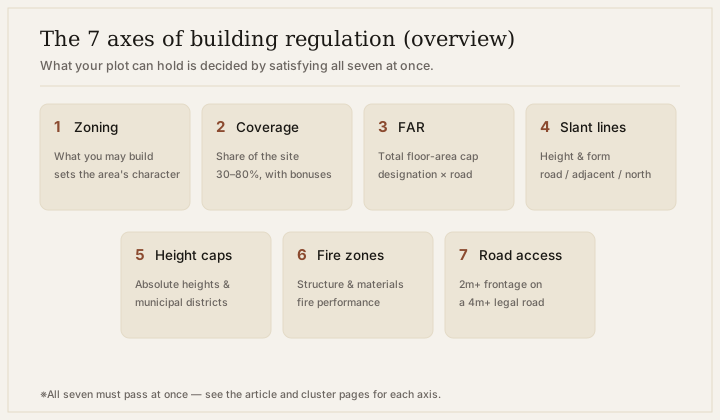
What do Japan's building regulations decide? Seven axes — zoning, building coverage, floor-area ratio, setback lines, height limits, fire zones and road-access duty — define what your plot can hold. Estate districts like Ashiya add stricter district plans and private covenants.
Part of the guide: Building a custom home in Osaka
→ Building coverage ratio (limits & bonuses) → Slant-line limits (height & form)
What ultimately decides "how large a building can stand on this land" is not the size of the plot but the law. The Building Standards Act and the City Planning Act stack limits on use, scale, height and shape, and any villa or hotel project has to read these constraints first. Below are the seven core axes to grasp before you buy land, plus the local "add-on" rules and how to run a volume check before purchase.
1. Use districts (13 types)
Every plot inside a city-planning area is assigned to one of 13 use districts, which frames the type, use and scale of building allowed: 8 residential, 2 commercial, 3 industrial. In a Category I Low-rise Exclusive Residential District the norm is up to two storeys (absolute height 10 m or 12 m), and shops or offices face tight floor-area limits. Most prestige residential land sits in these low-rise residential categories.
| Group | Use districts |
|---|---|
| Residential (8) | Cat. I / II Low-rise Exclusive, Agricultural Residential, Cat. I / II Mid/High-rise Exclusive, Cat. I / II Residential, Quasi-residential |
| Commercial (2) | Neighbourhood Commercial, Commercial |
| Industrial (3) | Quasi-industrial, Industrial, Exclusive Industrial |
2. Building coverage ratio (kenpeiritsu)
The cap on building footprint as a share of plot area. Typically 30–60% in Cat. I low-rise residential and 80% in commercial districts. A +10% relaxation applies on corner lots designated by the authority, and another +10% for fireproof buildings inside a fire-prevention district — up to +20% when both apply. For a villa that needs garden, daylight and ventilation, deliberately not maxing out coverage is a valid design choice.
3. Floor area ratio (yōsekiritsu)
The cap on total floor area as a share of plot area. From 50–200% in Cat. I low-rise residential up to 200–1300% in commercial districts. Watch the front-road-width reduction: where the fronting road is under 12 m, residential districts apply "road width × 0.4," which can be lower than the designated ratio. Basements, parking and shared corridors enjoy partial exemptions from the count.
Coverage and floor-area guide by district
Actual figures are set per district in the city plan; the representative designations are roughly as follows. Always confirm on the municipal zoning map before you buy.
| Use district | Coverage | Floor area |
|---|---|---|
| Cat. I Low-rise Exclusive Residential | 30–60% | 50–200% |
| Cat. I Mid/High-rise Exclusive Residential | 30–60% | 100–300% |
| Cat. I Residential | 50–80% | 200–400% |
| Neighbourhood Commercial | 60–80% | 200–400% |
| Commercial | 80% | 200–1300% |
4. Setback (diagonal) line limits
- Road diagonal: a sloped envelope rising from the far boundary of the front road (1:1.25 in residential districts)
- Adjacent-site diagonal: a height envelope rising from the neighbour's boundary (not applied in low-rise exclusive districts, which use absolute height instead)
- North-side diagonal: applied in Cat. I/II low-rise and mid/high-rise exclusive residential to protect the northern neighbour's sunlight
These diagonal lines are the usual reason a third storey, penthouse or loft has to be "given up." Whether a designer can use the sky-factor (tenkūritsu) relaxation — exceeding the diagonal where equivalent light and ventilation are secured — separates skilled practices from the rest.
5. Height limits (absolute height & sunlight regulation)
Cat. I/II Low-rise Exclusive Residential districts carry an absolute height cap of 10 m or 12 m, so the feasibility of a third storey is largely settled the moment the use district is known. Mid/high-rise residential districts add a shadow regulation limiting the hours of shadow cast onto neighbours at the winter solstice. Half-basements, sloped roofs and reduced eave heights are the usual tools for securing volume within a tight height envelope.
6. Fire-prevention & quasi-fire-prevention districts
Much of the city centre and arterial-road frontage is designated. Fire-prevention districts require fireproof buildings above a certain scale, and even quasi-fire districts demand fire performance in external walls, eave soffits and openings (windows, entrance). Fire-rated windows, fire doors and quasi-fireproof construction add roughly +5–10% to cost. Timber is still possible, but with more specification constraints.
7. Frontage (access) obligation
A buildable plot must, in principle, front a road at least 4 m wide for a length of at least 2 m. Flag-pole or land-locked plots that fail this are non-rebuildable, which sharply cuts their value. Where the plot fronts a sub-4 m "Article 42-2" road, a setback to 2 m from the road centreline is required, narrowing the buildable area accordingly.
What is a building covenant (kenchiku kyotei)?
A building covenant is a set of rules stricter than the Building Standards Act, agreed voluntarily by an area's residents or the original subdivider; once approved by the authority it binds the land even after it changes hands. The more prestigious the district, the stronger it is — in Ashiya's Rokurokuso-cho the covenant fixes the minimum plot size (barring subdivision), the height and material of walls, exterior colours, even commercial use.
Even if you clear every statutory limit (zoning, FAR and so on), you cannot build in breach of the covenant. Learning about it after you have fallen for the plot changes the plan from the ground up, so confirm whether a covenant exists and what it says before you buy. See area patterns in landscape ordinances and prestige districts.
What is a setback (road-boundary retreat)?
Under the Building Standards Act, you generally cannot build on land that does not front at least 2m onto a road at least 4m wide (the frontage obligation). Where the front road is under 4m (a "Article-42(2) road"), the boundary is deemed to sit 2m back from the road's centreline, and no building or wall may occupy that set-back strip.
Two practical effects: ① less buildable area — the set-back strip is excluded from the site area, so it drops out of the coverage and floor-area-ratio calculations; ② you must improve the strip — most municipalities require it to be paved and maintained. On narrow lots, flag-pole lots and old neighbourhoods, always confirm the front-road width and whether a setback applies before you sign.
The "add-on" rules that bite in prestige areas
In prestige areas such as Ashiya, Kobe and Kyoto, municipal add-on rules layer on top of the Building Standards Act: district plans and building agreements restricting height, wall setback and colour; scenic-district and landscape ordinances setting greenery ratios and roof/wall rules; and cliff ordinances governing retaining-wall structure. Ashiya in particular has some of Japan's strictest landscape and height controls, so the buildable volume can differ greatly even within the same use district.
Always run a "volume check" before buying land
Because these rules apply cumulatively, plot size alone never tells you how large a house can be built. Before committing to a purchase we strongly recommend a volume check by an architect — the study of the maximum shape the law permits. Overlaying use district, coverage, floor area, every diagonal line, height and shadow to confirm "how many storeys and how many m² are possible" on a drawing, before fixing land, budget and design, is the safe sequence.
A villa's sense of scale is set less by plot size than by the product of use district × coverage × floor area × diagonal lines × height. Skip the pre-purchase volume check and you risk the most painful miscalculation of all: buying the land, then finding far less can be built than you imagined.
→ Check how many m² you can build on a plot
Find out how many m² you can build on a plot — free check.
Ask about buildability