What should you check when choosing land? Twelve items, on site: zoning, road access, ground, hazard maps, level differences/retaining walls, boundaries, utility connections, encroachments, legal limits, surroundings, market price and the disclosure statement. A professional site visit runs about ¥50–80k per day.
Part of the guide: Building a custom home in Osaka
1. Zoning and Whether the Volume Fits
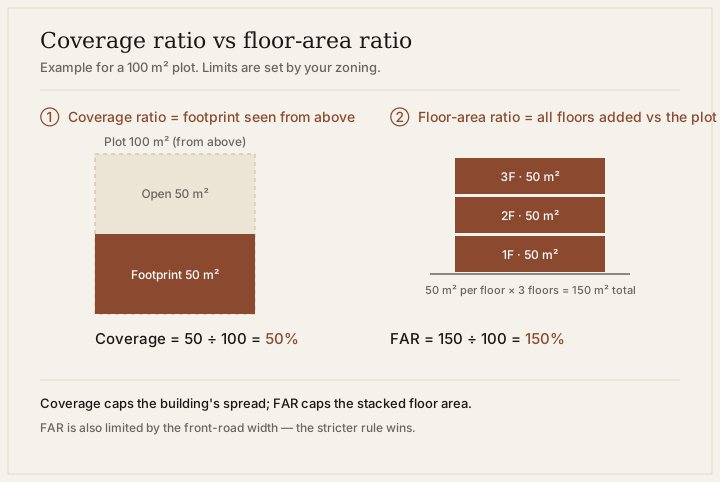
What and how much you can build on a plot is decided first by its zoning (use district). Reading the building-coverage ratio, floor-area ratio, height limits, and setback (diagonal) limits, you verify at the outset whether the floor area and storeys you want actually fit. A Category 1 Low-Rise Residential zone, for instance, has strict height and volume limits, and the residence you envisioned may not be buildable. Not "can I buy it" but "can the house I want be built" — land hunting should start here.
Coverage and floor-area ratios by zoning are covered in building coverage ratio and the building-regulations guide.
2. Road Frontage
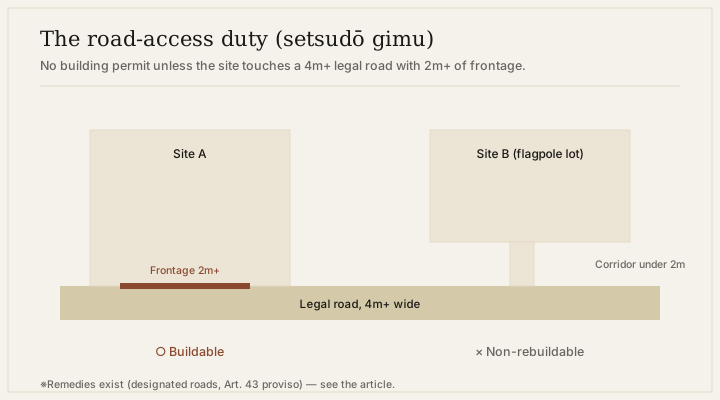
Under the Building Standards Act, the premise for building is, in principle, frontage of at least 2m onto a road at least 4m wide (the frontage obligation). If the front is a private road, a position-designated road, or an Article 43 proviso road, always confirm whether rebuilding is allowed, plus shares and excavation consent. A plot failing the frontage rule may look cheap but carries the risk of being "non-rebuildable," greatly harming asset value and exit.
3. Ground
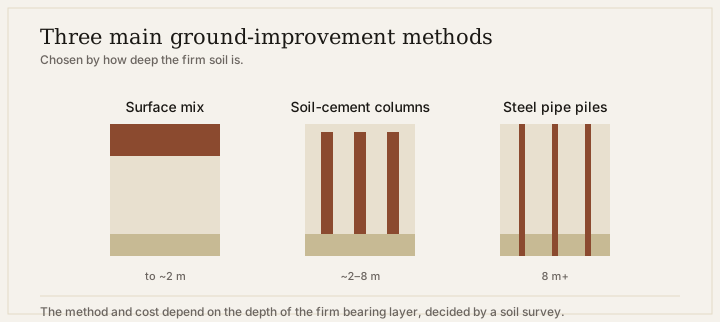
The ground's strength governs the building's safety and unseen added cost. Soft ground requires ground improvement or piling, an outlay of hundreds of thousands to millions of yen depending on scale. Old place names (marsh, paddy), fill versus cut, and cracks in nearby retaining walls or fences give hints, but ultimately a ground survey before the main contract is the sure way to judge. The ground is a condition you cannot change later.
Ground-improvement methods and costs are covered in ground improvement — cost & methods.
4. Hazard Maps
What disaster risks a plot carries must always be checked on the local government's hazard map. The main risks to look at are:
| Type | What to check |
|---|---|
| Flood / inland water | Assumed depth and frequency |
| Landslide | Warning and special-warning zones |
| Tsunami / storm surge | Coastal inundation assumptions |
| Liquefaction | Risk on reclaimed land, old river courses |
Risk can be guarded against by design, but buying without grasping it should be avoided.
5. Level Differences and Retaining Walls
A level difference from road or neighbour bears directly on the cost of grading, retaining walls, stairs, and parking. Where an existing retaining wall exists, confirm whether it has an inspection certificate and is structurally safe. An old wall or an illegal two-tier wall, if it must be rebuilt, can mean additions on the scale of millions of yen. A level difference can be a charm of view and light, yet brings the reality of grading cost, so evaluate both sides.
6. Boundaries with Neighbours
The key to preventing later trouble is clarity of boundaries. Confirm whether boundary markers exist and whether a confirmed survey is complete. Buying with boundaries unsettled can lead to disputes with neighbours over ownership and encroachment of fences and blocks. Including which side owns a fence, settling the boundary before purchase is the premise for building with peace of mind and for a future sale.
7. Infrastructure Connections
Confirm whether water, sewer, gas, and electricity are connected to the site, and whether the diameter and capacity suffice. Where the main is far down the front road, or a private pipe is involved, connection work can cost hundreds of thousands of yen or more. Especially in old subdivisions and historic quarters, the sewer may be unbuilt (septic tank), which also affects running cost. The key is not to assume infrastructure is "naturally there."
8. Encroachments
Confirm whether a neighbour's trees, eaves, pipes, or block wall cross the boundary, and whether there is encroachment from your own side. Encroachment hinders future rebuilding or sale. Where it cannot be corrected at once, the practice is to exchange a memorandum stating "to be removed in future" and put it in order. Leaving a small encroachment unaddressed becomes the seed of a large dispute years later.
9. Legal Restrictions
Beyond zoning, multiple regulations overlap on land. A fire-prevention or quasi-fire-prevention district governs the specification and cost of exterior walls and windows, and a height district, scenic district, landscape ordinance, shadow regulation, or district plan can bind height, design, and even external works. These are not apparent at a glance and only emerge fully through an inquiry at the city office. The sum of regulations decides the outline of the house you can build.
10. Surrounding Environment
The quality of living not shown in drawings or figures is verified by walking the site. Sunlight, ventilation, noise, and odour, of course — and because the face changes by day and night, weekday and weekend, visit at varied times. Checking nearby undesirable facilities, past flood history, and future development plans (whether tall buildings may rise) also brings reassurance. Land is bought not as a "point" but together with its surrounding environment.
11. A Sense of the Market
Whether the asking price is reasonable is judged against nearby transaction cases, published land prices, and roadside values. Land far cheaper than the market always has a reason — non-rebuildable, poor frontage, ground, or psychological defect. Before leaping at cheapness, pinning down "why is it cheap" is, in the end, the shortcut to avoiding an expensive mistake. Conversely, even above market, a rare location can be rational.
12. Reading Through the Important Matters Statement
The Important Matters explanation, given just before contract, is where all the checks so far receive a final review. From a licensed real-estate transaction agent you receive explanation of legal restrictions, infrastructure, private-road burden, existing nonconformity, boundaries, and hazards, and confirm you understand each one. Resolve any doubt before the contract, without fail. Once signed and sealed, later withdrawal is difficult. The Important Matters statement is the final gate of choosing land.
Good land is not land that is cheap, but land where the house you want can be built, safely and for the long term. The effort of verifying each of the twelve viewpoints on site is what quietly decides the success of the whole project.
Regulation terms to check before buying land or an old building
Is it safe to buy an "existing-nonconforming" (既存不適格) property?
An existing-nonconforming building was legal when built but no longer meets today's standards after later law changes. Unlike an illegal building, using it as-is is fine. But when you rebuild or do a major renovation you must comply with current law, and the usable floor area or height may shrink. When buying a second-hand property or land with an old building, always confirm whether the same scale could be rebuilt under today's rules.
When is a "change of use" (用途変更) required?
When you change a building's use (e.g. office or home to hotel or shop), a change of use over 200㎡ requires a building-confirmation application (relaxed from 100㎡ in 2019). If you plan a minpaku, a shop-combined or a rental conversion, whether the change of use is permitted — and its cost — decides the project.
Does a missing "inspection certificate" (検査済証) cause problems?
The inspection certificate proves the building passed the completion inspection under the Building Standards Act. The problem is not only that it is hard to sell without one — without it, even a renovation can require a building-confirmation application. In particular, work touching escape routes, such as removing or moving a staircase, is treated as a change to the building's structure and needs an application, which first requires a legal-conformity survey to show the current building meets today's law. This is where many contractors refuse to start — they cannot predict how much must be fixed to make it legal — and you end up unable to find anyone willing to take the job. The way out is to commission a first-class architect for that legal-conformity survey before you look for a builder, so the required scope and cost become visible. On land with a second-hand building, always confirm the certificate before the sale contract.
What to watch for with land on an "Article-42(2) road" (2項道路)?
An Article-42(2) road is under 4m wide but deemed a road under the Act; land fronting it must set back 2m from the road centreline. The set-back strip is excluded from the site area, reducing what you can build. On old neighbourhoods and narrow lots, first confirm whether the front road is a 2-kō road.
What is a "wall setback" (壁面後退)?
A wall setback is a required minimum distance from the site boundary to the building's outer wall, sometimes set in Category-1/2 low-rise zones or by a district plan or building covenant (e.g. 1–1.5m from the boundary). On narrow lots it directly limits design freedom, so confirm any district plan or covenant before buying.
Find out how many m² you can build on a plot — free check.
Ask about buildability