What does hotel construction in Osaka cost? A guide of ¥1.5–2.8M per tsubo of guest room. Versus housing, five factors drive cost and schedule: plumbing/equipment density, soundproofing, evacuation routes, licensing (Hotel Business Act & fire code) and BCP.
Part of the guide: Hotels & lodging investment in Osaka
1. Three hotel types and location
City hotels (near stations / commercial zones), resort hotels (tourist / villa areas) and boutique hotels (small, high-rate, central). Each assumes a different zoning category, floor-area ratio and room rate. Location decides 80% of the business plan. With inbound demand recovering, room rates in Osaka and Kyoto remain elevated, so reading the location and guest profile is the foundation of revenue.
2. Three categories under the Inns and Hotels Act
- Hotel/inn business: rooms 33㎡+, bedroom and living space separated
- Simple lodging business: rooms under 33㎡ allowed (incl. dormitories)
- Boarding business: stays of one month or more
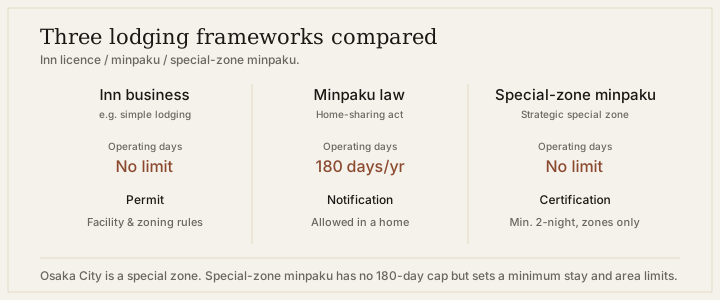
The 2018 amendment eased requirements, but fire-code and Building Standards Act compliance remain strict. This is separate from the Private Lodging Business Act (minpaku); permits depend on the operating format.
3. Structure and schedule
| Scale | Typical structure | Schedule |
|---|---|---|
| 10–30 rooms, boutique | RC / steel | 12–18 mo |
| 50–100 rooms, city | Steel / SRC | 18–24 mo |
| 100+ rooms / high-rise | SRC / CFT | 24–36 mo |
4. Room planning and zoning
A hotel is organized in three layers: guest-room floors, public floors (lobby, banquet) and back-of-house (kitchen, linen, plant). Fixing the typical guest-room floor plan early aligns piping and ducts across floors, stabilizing cost and schedule. Too many room types hurts build efficiency, so consolidating to 3–4 types is standard.
5. Sound isolation — the critical issue
Guest satisfaction hinges on quiet more than luxury finishes. Securing the sound-isolation grade against neighbors, corridors and floors above/below is the design core. Double party walls, floating floors, vibration-isolated piping and airtight doors are combined. Since this cannot be fixed later, it must be built in at the shell stage.
6. Egress and fire code
Automatic fire alarms, sprinklers and emergency lighting (Fire Service Act), two-way egress, fire compartmentation and smoke exhaust are required. Requirements tighten in steps with room count and storeys, so the egress plan dictates the building form itself. Accessibility law is also folded in from the earliest planning.
7. Essential systems and cost mix
On top of 24-hour ventilation, sound isolation and redundant 24/7 plumbing, HVAC, electrical and life-safety make systems about 30% of construction cost. The table is a rough breakdown for a mid-grade city hotel.
| Category | Approx. cost share |
|---|---|
| Shell / structure | ~30% |
| Interior / room finishes | ~25% |
| Systems (HVAC/plumbing/electrical/safety) | ~30% |
| Facade / common areas | ~15% |
8. Budget benchmarks
- Mid-grade city hotel: ¥1.5–2.0M per tsubo
- Luxury boutique: ¥2.5–4.0M per tsubo
- Resort (incl. interior/landscape): ¥2.0–3.5M per tsubo
Land acquisition is separate. A 5–8% project yield is the break-even guide.
9. Designing for operations
For a hotel, completion is not the goal—opening is the start. Folding cleaning routes, linen transport, maintainability and future room renewal into the design greatly changes operating cost over a 20-year span. Incorporating the operator's input at the design stage is what creates the gap in earning power.
Hotel construction is a triangle of "room quality × operating cost × location." Building operating cost into the design decides the success rate.
Our hotel projects
Real hotels we've built in Osaka (size and cost are published estimates).
| Project | Size | Type | Est. cost |
|---|---|---|---|
| Kujo Hotel | 238 m² / 3F | Renovation | approx. ¥50M |
| Ikutamacho Hotel | 650 m² / 7F | Renovation | approx. ¥150M |
| Daikokucho Hotel | 1,050 m² / 10F | New build | approx. ¥650M |
| Shiokusa Hotel | 1,130 m² / 10F | New build | approx. ¥680M |
Two new-builds and two conversions — all designed and built in-house. So we can advise "build new, or reuse the existing structure?" from hands-on experience with both, not a brochure. The Kujo Hotel in particular was a change-of-use conversion of an existing building.
See each case in detail on its project page.
Critical risks in hotel construction
Unlike housing, licensing and fire compliance decide whether a hotel can open. Typical risks and fixes:
| Risk | Fix |
|---|---|
| Inn-licence non-compliance (zoning, structure, area rules unmet — can't open) | Pre-consult the public health centre / building authority early |
| Missed fire-code compliance (sprinklers, smoke exhaust, escape routes) | Confirm fire consent at design stage; bring in a specialist |
| Neighbour / noise disputes (post-opening complaints, guidance) | Design acoustics and brief neighbours in advance |
| 2026 minpaku tightening (stricter enforcement of the lodging law) | Choose the licence scheme (ryokan-gyo: simple lodging or hotel) early |
Feasibility: Osaka lodging investment; licensing: hotel permits & design.
Get advice on the inn licence and buildability together.
Ask about feasibility