What does a hotel need in permits and design? Beyond the Hotel Business Act licence, the building must satisfy the Building Standard Act (zoning, use change, evacuation) and the Fire Service Act (auto fire alarm, exit lighting). For conversions, the use-change permit and the inspection certificate decide feasibility.
Part of the guide: Hotels & lodging investment in Osaka
1. First, the Hotel Business Act licence
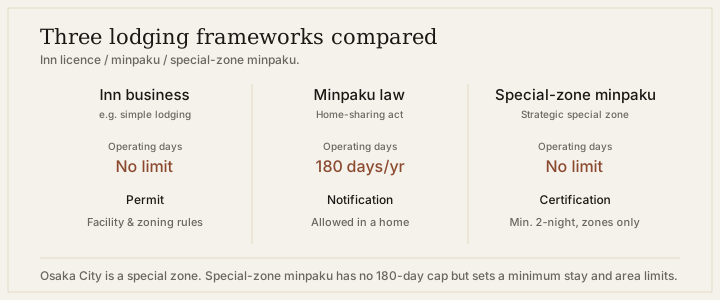
Operating a hotel requires an operating licence under the Hotel Business Act, issued by the public-health centre. A 2018 reform merged the old "hotel operation" and "ryokan operation" into a single "hotel/ryokan operation" category and abolished the former minimum-room rules (10 rooms for hotels, 5 for ryokan). The main choice is now between this category and "simple lodging," which has lighter standards such as a 33 m² minimum total guest-room floor area. Either way you must satisfy structural and equipment standards — front desk, ventilation and daylight, bathing and toilet facilities. Crucially, unlike minpaku (private lodging) with its 180-day annual cap, hotel-business licensing allows year-round operation, which is essential for a serious revenue property.
2. Building Standards Act requirements
Hotels and ryokan are "special buildings" under the Building Standards Act and face stricter rules than ordinary houses. Zoning is the starting point: they are barred from low-rise and mid/high-rise exclusive-residential zones, and even in Category I residential zones are capped at 3,000 m² (neighbourhood-commercial, commercial and quasi-industrial zones are generally fine). Design review then covers guest-room daylight, ventilation and smoke exhaust, two-direction escape (two independent ways out), corridor widths (1.6 m where rooms line both sides), area / vertical-shaft / mixed-use fire compartments, and interior-finish limits. After completion you face a completion inspection plus ongoing periodic investigation and reporting as a designated building.
3. Fire Service Act requirements
Because guests sleep on site, lodging is one of the most heavily fire-regulated uses (item (5)-i of the enforcement schedule). An automatic fire-alarm system is required regardless of size, along with guide lights, emergency lighting, extinguishers and indoor hydrants. Sprinklers are the rule above roughly 6,000 m² of total floor area, but smaller buildings can also trigger them depending on storeys, structure and escape layout. Curtains and carpets must be flame-retardant items. You must obtain fire-department consent at the building-confirmation stage, and twice-yearly inspection reports continue after opening. Consulting the fire department from the earliest design stage — and budgeting the equipment space and cost — is indispensable.
4. Issues specific to conversions
When converting an office or apartment building into a hotel, a use change over 200 m² requires a confirmation application (eased from 100 m² in the 2019 reform). The first decisive factor is whether a completion certificate exists: without one, you cannot file until a "legal-conformity status survey" proves the building meets current law. The second is how existing non-conformity is treated — you must gauge early how far retrofitting must go for retroactively applied rules on seismic resistance, fire compartments, escape and accessibility. Leave this vague and unforeseen reinforcement and remodelling costs surface after work starts, wrecking the budget. Reconciling the existing drawings against actual conditions is the top priority.
5. Design points
Once the permits are cleared, the design decisions that maximise both revenue and guest satisfaction come to the fore. Five priorities stand out:
- Room efficiency: the typical-floor layout and gross-to-net ratio directly drive profitability; column grids and service shafts change how many rooms you can carve out
- Circulation separation: split guest flow from back-of-house (cleaning, service, linen delivery, waste) to protect both service quality and safety
- Sound insulation: the acoustic rating of party walls and floors, plus corridor and equipment noise, drives your reviews
- Maintainability: equipment plans and durable finishes that let you renew and clean without closing rooms
- Brand expression: a consistent identity across facade, lobby and rooms underpins room rates and repeat bookings
6. How to proceed and choosing a partner
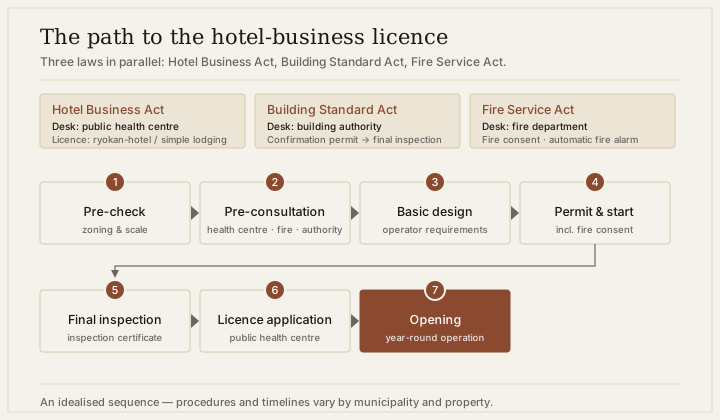
A hotel works as a trinity of "permits × building × operation." The ideal sequence runs: (1) confirm zoning and scale, (2) pre-consult the health centre, fire department and building authority, (3) basic design reflecting the operator's requirements, (4) confirmation application and start of work, (5) completion inspection, (6) hotel-business licence application, (7) opening. Where an operator is already chosen, whether you can fold their requirements — room specs, back-of-house, PMS and card-key systems — into early design decides success. Choose a partner who can bundle not just the building but permits and operation across all three. For the investment angle see Osaka accommodation investment, and for cost see hotel construction per-tsubo cost.
A hotel is not "build first, license later" but "design with the license in view." Bundling the hotel-business, building and fire requirements at the early stage protects both the opening date and profitability.
Get advice on the inn licence and buildability together.
Ask about feasibility