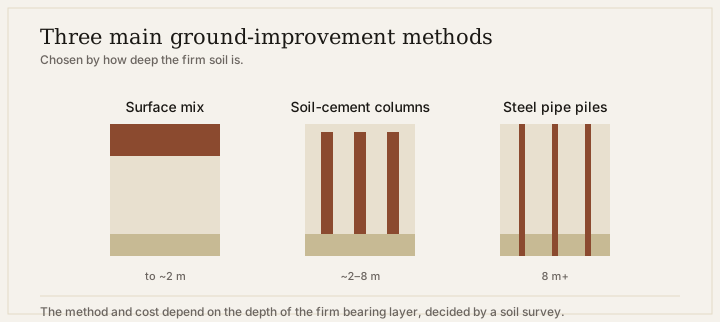
What does ground improvement cost? A soil survey (SWS or boring) decides the need; methods run from surface treatment to columnar mixing to steel piles. Detached-home guide: several hundred thousand to over ¥2M. Osaka's soft alluvial ground makes heavy RC homes the most exposed.
Part of the guide: RC homes in Osaka
1. Why a soil survey matters
Weak ground causes differential settlement — the building sinks unevenly, leading to tilt, cracks and jammed fittings. To prevent it, a soil survey before design decides whether improvement is needed. Detached homes use Swedish-weight sounding (SWS); larger residences, RC and hotels use boring.
2. When improvement is needed
Judged by the depth and firmness (N-value) of the soft layer — a guide only; the survey data is decisive.
| Ground condition | Typical response |
|---|---|
| Good bearing layer near surface | No improvement (raft foundation, etc.) |
| Shallow soft layer (~2 m) | Surface improvement |
| Mid soft layer (~8 m) | Column improvement |
| Deep soft layer / deep bearing | Steel piles |
3. Methods and cost guideline
Rough detached-home guideline (varies widely by site, area and depth).
| Method | Use (guide) | Cost (detached, guide) |
|---|---|---|
| Surface improvement (cement-stabilised topsoil) | Soft layer ~2 m | approx. ¥0.3–0.8M |
| Column improvement (in-ground columns) | Soft layer ~8 m | approx. ¥0.8–1.5M |
| Steel piles (driven to bearing layer) | Deep / deep bearing | approx. ¥1.0–2.0M+ |
RC homes are heavy, so improvement costs rise faster — budget it alongside the RC cost structure.
4. Osaka's ground characteristics
Osaka varies a lot by area. The Uemachi plateau has relatively good ground, favouring basements and RC homes. The western and southern alluvial lowlands are often soft, raise improvement cost and carry liquefaction risk. Read the ground from the land-selection stage (land selection).
5. Schedule and budget impact
Improvement precedes the foundation and adds about 1–2 weeks. Discovered late, it disrupts both schedule and budget — so the rule is to fix cost and timing with a survey up front. See how to prevent budget overruns.
Common pitfalls
| Risk | Prevention |
|---|---|
| Skipping the survey; improvement found needed after start | Survey around the land contract and budget for it |
| Hidden soft layer from neighbouring fill/grading | Check grading history and nearby data too |
| Underrating liquefaction (alluvial lowland) | Assess early with hazard maps and ground data |
| Improvement omitted from the estimate → overrun | Hold a contingency until survey results are in |
The ground is the "invisible foundation." A cheap-looking plot can change the total once improvement is added. Read the ground while choosing land, fix cost and timing with a survey, then proceed.
Talk to us about your plan and a rough budget — free.
Book a free consultation