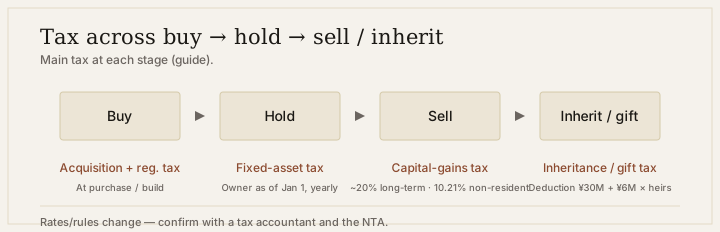
How much tax to sell or pass on Japanese property? A gain on sale is taxed (capital-gains tax: ~20.315% long-term over 5 years, ~39.63% short-term); passing it to children or family triggers inheritance / gift tax. Property located in Japan is taxed in Japan even if the owner or heirs live abroad.
Part of the guide: Building in Japan from overseas
1. Selling — capital-gains tax
If a sale produces a gain (sale price − acquisition cost − selling costs), it is taxed at a rate that depends on how long you held it.
| Category | Holding period (guide) | Rate (guide) |
|---|---|---|
| Long-term | Over 5 years as of Jan 1 of the sale year | ~20.315% (income 15% + reconstruction surtax + resident 5%) |
| Short-term | 5 years or less | ~39.63% (income 30% + reconstruction surtax + resident 9%) |
※Resident tax applies only to those domiciled in Japan on Jan 1, so a non-resident pays no resident-tax portion — roughly 15.315% (long-term) / 30.63% (short-term) as a guide. Whether special deductions (e.g. for a former home) apply varies by situation; confirm the final position with a tax accountant and the National Tax Agency.
2. The 10.21% withholding when a non-resident sells
When the seller is a non-resident, the buyer generally withholds 10.21% of the sale price and remits it, paying the rest to the seller. It is essentially a prepayment that the seller squares up later via a tax return. Exception: no withholding is required if the buyer is an individual acquiring the property as a home for themselves or a relative and the price is ¥100 million or less.
3. Tax while you hold it
While you own it, fixed-asset tax and city-planning tax fall on the owner as of Jan 1 each year. For the depreciation angle see building depreciation and tax; for purchase-time taxes see tax for foreign buyers.
4. Passing it to children / family — inheritance & gift tax
Real estate located in Japan is subject to Japanese inheritance tax even when the owner or heirs live abroad (tax on Japan-situs assets). Inheritance tax has a basic deduction; only the amount above it is taxed.
- Inheritance basic deduction = ¥30 million + ¥6 million × number of statutory heirs.
- Lifetime gifts attract gift tax. The annual system gives a ¥1.1 million yearly exclusion; for larger transfers the "settlement-at-inheritance" election is an option.
Valuation (land by roadside-land value etc., buildings by their fixed-asset value as a guide) and the deductions/special rules are technical. We recommend consulting a tax accountant, including on procedures and documents where an heir lives overseas.
5. What overseas owners should arrange
- Appoint & register a tax agent — a non-resident designates a nōzei-kanrinin to handle tax matters and registers them with the tax office.
- File the year after a sale — capital gains are settled by a tax return the year after sale (the withholding is reconciled here too).
- Keep acquisition-cost evidence — if acquisition cost is unknown, a deemed 5% of the sale price applies, raising the tax. Keep the purchase contract and build-cost records.
- Specialists — work with a tax accountant (tax) and judicial scrivener (registration), and build without flying in via remote construction management.
- Remittance — for transferring/receiving sale proceeds see overseas-owner support.
Towa's role, and common myths
Tax is a specialist's domain. As a builder, we help create the records that pay off at sale or inheritance — build-cost evidence that supports acquisition cost, and safekeeping of drawings and specifications. Confirm the tax itself with a tax accountant and the National Tax Agency.
| Common myth | The correct view / fix |
|---|---|
| “I live abroad, so no Japanese tax” | Japan-situs property is taxed in Japan for both sale and inheritance |
| “Sell and the proceeds are all mine” | Non-residents face 10.21% withholding plus capital-gains tax |
| “Inheritance tax is only for residents” | Japan-situs assets are taxed even for overseas heirs |
| “No need to keep acquisition papers” | Unknown cost = deemed 5%, more tax. Keep contract & build cost |
| “I can just file it myself” | Non-residents must appoint and register a tax agent |
Japanese property is not a "tax-free because I'm abroad" asset. Planning for the exit (sale) and the handover (inheritance) — starting with acquisition-cost records at the build stage — genuinely pays off. This article is general information and rates/rules change; always confirm your specific tax and procedures with a tax accountant / CPA and the National Tax Agency. Planning and rough costing of a building are free to discuss.
Consult online in English, Chinese and more.
Book an online consultation