Can foreigners build a home in Japan? Yes. Owning land and buildings requires no residence status, and property taxes are the same as for residents. Mortgage terms depend heavily on your residence status: permanent residents borrow on much the same terms as Japanese nationals (Flat 35 included), work-visa holders face fewer lenders and higher down payments, and non-residents living abroad generally cannot use a domestic mortgage, so cash or home-country financing is the realistic route.
Part of the guide: Building a custom home in Osaka
Q1. Can a foreigner build a house in Japan?
Yes. Japan is one of the few countries that places no nationality requirement on land or building ownership: you can buy land, build a house or commercial building and register the title while still living abroad. There is no cap on how long you may hold the property, and resale is unrestricted. In practice the only difference from a Japanese buyer is that you use a signature certificate (affidavit) from your home country in place of a registered personal seal, and you file a payment report under the Foreign Exchange Act when wiring the purchase money. In other words there is no barrier on the rights side; the hurdles are purely the language and format of the paperwork, all of which can be prepared before you travel.
Q2. Can a foreigner get a mortgage?
Most Japanese banks require permanent residency, or stable domestic income plus the ability to communicate in Japanese. If you build while living abroad, paying in cash or with a loan from your home country is the realistic route. A handful of foreigner-friendly lenders do offer non-resident loans, but typically with a 30-50% down payment, a rate premium and a Japan-based guarantor or asset collateral. By residence status, the picture is roughly this. Permanent and special permanent residents: much the same terms as a Japanese national, and Flat 35 is open to you (its eligibility rule is Japanese nationality, permanent residency or special permanent residency). Spouse of a Japanese national: comparatively easy, but many banks require the spouse as joint guarantor or combine incomes. Work visa without permanent residency: possible, but fewer lenders, and they weigh years in Japan, years with your employer and the down-payment ratio. Business Manager visa: the hardest for a personal mortgage, since banks assess director's remuneration and company accounts; in practice a company-name purchase or business loan is combined. For how rates and repayment ratios work, see the basics of housing loans.
Q3. Can the project run remotely?
Yes. Towa Construction standardises a remote workflow so an overseas owner can go from design sign-off to handover with the fewest possible trips to Japan. We calendar the decision milestones (plan freeze, specification choices, change approvals) in advance and share the supporting material ahead of time, so decisions never stall despite the time difference.
- Weekly Zoom/Teams meetings (multilingual; minutes shared within 24 hours)
- A single cloud store for drawings, photos and video
- Monthly site reports (progress photos + percent complete + next-month plan + concerns)
- Live streaming and recording of key stages (foundation pour, framing, handover)
The mechanics are detailed in remote construction management.
Q4. What paperwork is required?
For a non-resident the documents are broadly: your passport (identity), a residence card if you have one, proof of overseas address, a signature certificate in place of a personal seal (obtained from a notary at home or your embassy in Japan), and the filing of a tax agent (nozei kanrinin) who becomes your tax contact point. To buy land you also file a payment report under the Foreign Exchange Act for the wire from your home account. A design office or affiliated judicial scrivener can walk you through how to obtain each, so plan backwards from your travel dates. Because the forms are in Japanese, keeping an English summary alongside is advisable.
Q5. What taxes apply?
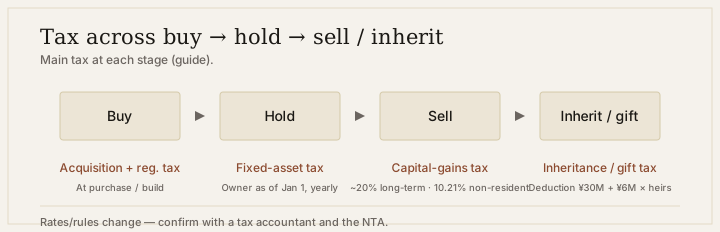
Tax arises at three stages: acquisition, holding and exit. On acquisition: consumption tax (10% on the building), real-estate acquisition tax (3-4% of assessed value), registration and licence tax (0.4% for a first registration, 2% on transfer) and stamp duty. While holding: fixed-asset tax (1.4%) plus city-planning tax (up to 0.3%) every year. On exit (sale): capital-gains tax (39.63% short-term, 20.315% long-term), and for a non-resident the buyer withholds a further 10.21%. A non-resident must appoint a tax agent. For how to structure the numbers see tax planning for foreign owners and depreciation and tax.
Q6. Can I rent the house out later?
Yes. Rental income is taxable in Japan, and for a non-resident owner a corporate tenant withholds 20.42% at the time of payment; the tax treaty with your home country then generally resolves any double taxation. The point to watch is short-term lettings (minpaku): they require a check of the zoning and the local ordinance. They are essentially prohibited in residential-only zones, and the national Private Lodging Business Act caps operation at 180 nights a year. If you intend to run it as an investment, hotel and lodging investment in Osaka is a useful companion piece.
Q7. Payment milestones during construction?
For a residence the usual pattern is three instalments: 30% on contract, 30% at framing, 40% on completion. Splitting payment against progress limits the risk for both owner and builder. Overseas transfers take several days to clear, and exchange rates and wire fees (a few thousand to tens of thousands of yen per transfer) are not trivial, so we strongly recommend using a Japan-based trust or escrow account and funding it in larger blocks when the exchange rate is favourable. Before each instalment we share progress photos and a report, so you release funds only once satisfied.
The three things that trip up foreign owners most are contracts in Japanese only, the personal-seal culture, and bank identity checks. A design office can prepare an English summary, a signature-certificate scheme and an agent procedure for all three in advance, so rather than worrying about rights or tax, start by discussing the logistics. Distance and language are gaps that process can close.
Consult online in English, Chinese and more.
Book an online consultation