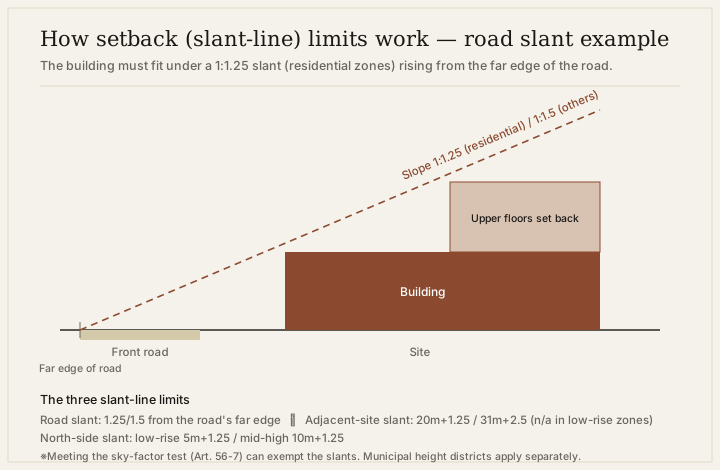
What are slant-line limits? Rules that keep buildings inside sloping planes to protect neighbours' light and airflow. There are three — road, adjacent-site and north-side — with statutory slopes (1.25 residential / 1.5 others), and the sky-factor test can exempt them (Art. 56).
The three slant lines
| Type | Origin & slope (statutory) | Where it applies |
|---|---|---|
| Road slant | From the far edge of the front road, slope 1.25 (residential) / 1.5 (others) | All zones (reach 20–35m) |
| Adjacent-site slant | 20m + 1.25 (residential) / 31m + 2.5 (others) above the boundary | All except low-rise zones (which use 10/12m absolute heights) |
| North-side slant | 5m + 1.25 (low-rise) / 10m + 1.25 (mid-high) toward true north | Low-rise & mid-high residential zones |
Where several apply, the building must satisfy all of them; which ones bite depends on the zoning.
How they shape the building (worked example, guide)
Example: 6m front road, residential zone (slope 1.25). The road slant rises from the road's far edge, so setting the building 2m back from the boundary allows roughly (6m+2m)×1.25 ≈ 10m of height at that line. Sloped top floors and stepped-back penthouses exist because of this plane.
- Setback relief — pull the building back and the slant's origin is deemed to shift back equally, letting you build higher.
- Roof form — where the north-side slant bites, roofs falling toward the north are the standard answer.
The sky-factor "alternate route"
The sky factor (Art. 56-7) exempts a design from the slant lines if calculations show equal-or-better sky visibility (light and airflow) than a compliant massing. It's the breakthrough for tight or irregular plots — but the calculation and review are specialist work, so plan it with your architect.
Osaka practice notes
- Many municipalities, including Osaka City, layer their own height districts on top of the slant lines — always check the planning map (Map Navi Osaka).
- On Osaka's tight urban lots, the buildable volume only emerges once slants, coverage and FAR are solved together (buildable-scale simulator).
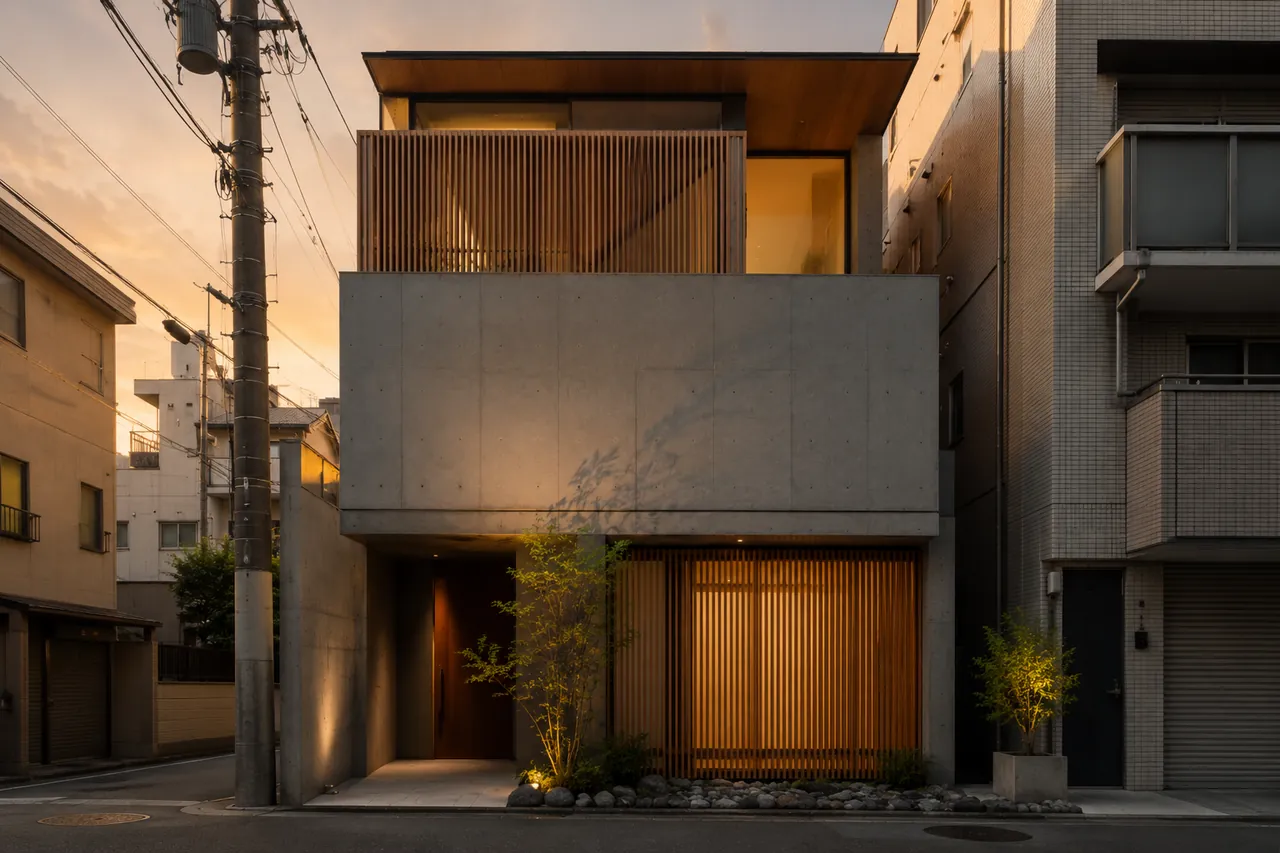
- For 3-storey urban homes with roof terraces, section design around the slants is where an architect earns their keep.
Common misconceptions
| Misconception | Reality |
|---|---|
| "Height limits are just the absolute cap" | Three slants + height districts + absolute caps apply together |
| "Slants can't be worked around" | Setback relief and the sky factor widen design freedom |
| "The north-side slant applies everywhere" | Only low-rise & mid-high residential zones |
| "The adjacent slant bites in low-rise zones" | No — those zones use 10/12m absolute heights instead |
Slant lines are among the first constraints to read when choosing land — they set the height and shape you can build. We assess the buildable volume and rough cost for free in Osaka; confirm your plot's specifics with the municipality and an architect.
Find out how many m² you can build on a plot — free check.
Ask about buildability