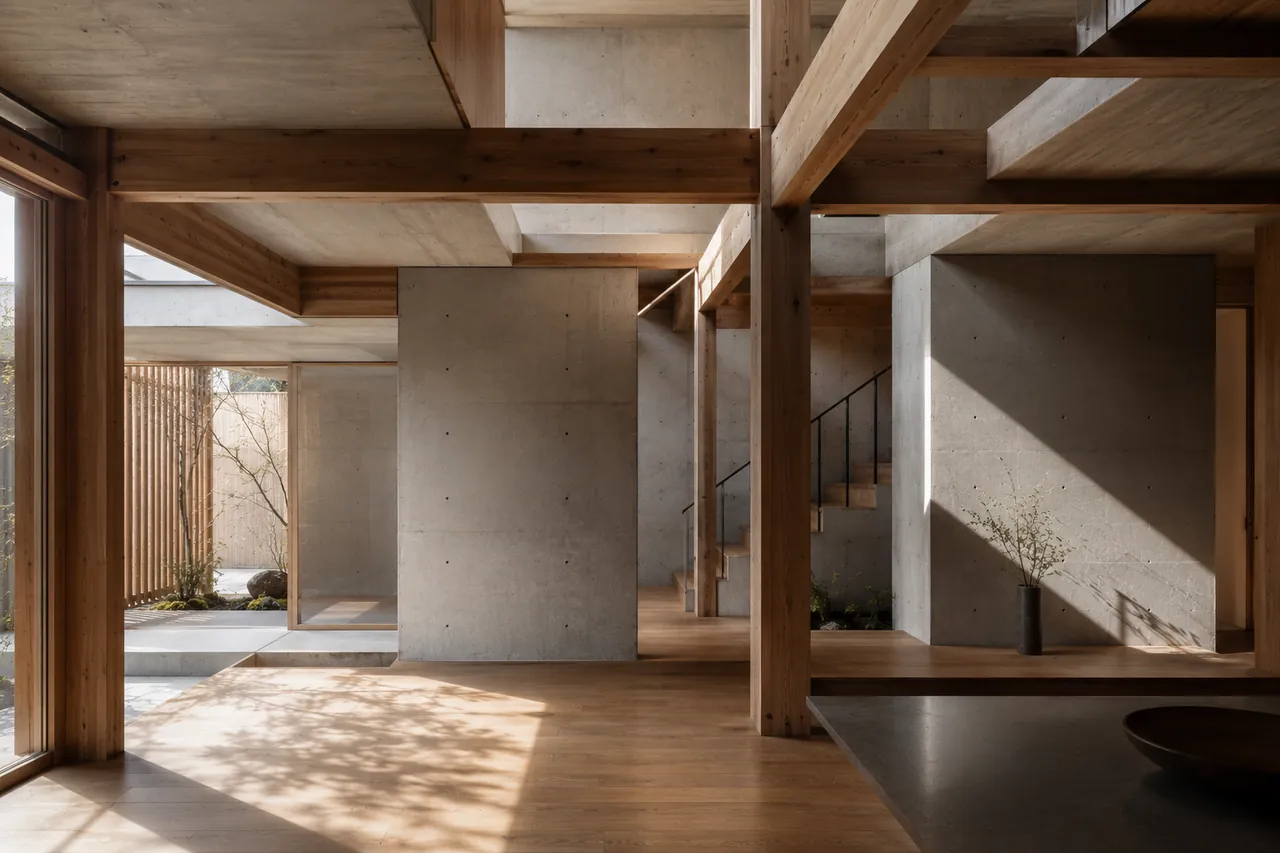
Why do Japanese builds take so long? An RC estate runs a guide 14–24 months: 5–8 design iterations, 2–3 months of permitting, concrete curing and specialist-trade estimating. Note the trade-off — faster usually means compromised spec.
1. Permit rigour — everything decided before site
Japanese construction is built on a culture of "fixing the design completely before breaking ground." The building-confirmation application requires a full set of detailed drawings including structural calculations; for larger RC buildings a structural peer review is added, and screening alone takes several weeks to over a month. Because any design change after submission triggers re-application, the layout, structure and services are thrashed out exhaustively in advance. This "decide it all up front" effort makes the schedule look long, but it eliminates on-site rework and false starts, stabilising both quality and total cost.
2. Shinto rituals shape the calendar
The ground-breaking ceremony before work begins and the roof-raising ceremony when the frame tops out are customarily set on auspicious days from the rokuyō calendar (taian, tomobiki, etc.). Because these milestones are tied to ritual timing, the start and topping-out can shift by a few days. They are also the moments when client, neighbours and trades meet face to face — a sense of "ma" (deliberate interval) woven into the Japanese building process that pure efficiency cannot explain. It is time that could be compressed, yet it is respected as a cultural step that secures the owner's confidence and site morale.
3. Concrete curing
In RC work, curing governs the schedule more than anything. After placement, concrete hardens slowly until it reaches its design strength. Typically allow a few days before stripping forms and two to four weeks per floor to confirm adequate strength — then stack that up for every storey. In winter, hardening slows and curing stretches further. Stripping forms early hits strength and durability directly, so this is "time you must wait" that can never be compressed. The table below gives indicative phase durations for an RC residence.
| Phase | Indicative duration |
|---|---|
| Permit & peer review | 1–2 months |
| Foundation | 1–1.5 months |
| Frame (incl. per-floor curing) | 3–5 months |
| Interior/exterior & services | 3–4 months |
| Inspection, rectification, handover | 1 month |
4. Rainy season, typhoons, winter
Japan's climate bears directly on the programme. During the rainy season and typhoon months, concrete pours and roof/waterproofing work cannot proceed in the rain, so weather waits occur. Around September the typhoon season forces crane and high-level work to pause. In winter, low temperatures slow curing and lengthen the drying of plaster and paint. The better the house, the more readily the team chooses to wait for a proper weather window rather than force work in poor conditions. Reading the seasons and planning around them is itself a precondition for protecting finish quality.
5. The trades' "dandori" set-up culture
A Japanese site runs on dandori — the ordered set-up by which specialist trades (foundation, formwork, rebar, carpenter, plasterer, joinery, services…) enter in sequence. To guarantee the precision of each stage, the next trade waits for the previous one to finish and be inspected — careful hand-over is preferred over efficiency-first overlapping. It looks like a detour, but the precision of the junctions and the beauty of the finish rest on this set-up culture. Because trades verify each other's upstream quality, final rework drops sharply.
6. The defects-list ritual
At completion, beyond the statutory inspection by the authority (or a designated inspection body), the contractor runs its own in-house inspection, draws up a defects (snag) list and clears every item one by one. Door alignment, wallpaper seams, the operation of every fixture — all are corrected before handover as standard. Spending several weeks on this "final tightening" is what makes post-handover trouble so rare. A refusal to compromise on finish quality shows up, in the last phase, as time.
Conclusion — duration is quality insurance
A Japanese residence takes long not because it is inefficient. Deciding the design, waiting out the curing, choosing the weather, honouring the set-up, and finally tightening up through rectification — each is an "investment in time" that secures quality. Reading the length of the schedule as a "quality-assurance period" that underpins decades of peace of mind and asset value is the essence of how Japan builds homes.
The length of the schedule is not a compromise but an investment in quality. The very choice "not to rush" underpins the value of the Japanese luxury residence.
Talk to us about your plan and a rough budget — free.
Book a free consultation