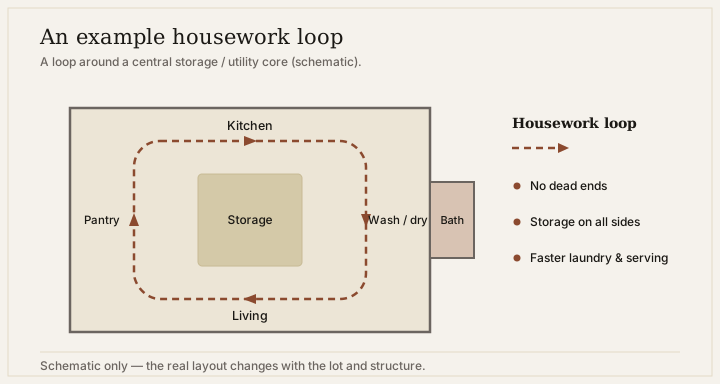
What is a circular-flow plan? A layout with no dead ends, where kitchen, washroom, entry and storage are linked by two or more routes so you can loop around them. It cuts back-and-forth, eases the morning rush and separates guest from family routes — but because it adds passage, it must be balanced against floor area, storage and cost.
What is a circular-flow plan, and why is it popular?
People love it because it deletes wasted back-and-forth from daily life. The main benefits:
- Easier housework — loop kitchen ⇄ washroom ⇄ drying ⇄ storage in one stroke; fewer steps for laundry, serving and tidying.
- No morning bottleneck — two-way access to washroom, toilet and entry lets the family move at once without jams.
- Guest and family routes split — separate entry→guest room from entry→kitchen/utilities, so you welcome guests without exposing daily life.
- Feels more open — looping pairs well with removing walls, creating a sense of space beyond the actual area.
Who does a circular-flow plan suit?
It is not essential for every home. It pays off most for:
- Dual-income, time-pressed households — lots of parallel chores; step savings matter.
- Families with children — naturally guides the “home → wash hands → living room” path.
- Two-generation or guest-heavy homes — you want family and guest flows kept apart.
- Future accessibility — a dead-end-free plan is easy to circulate in an age-friendly home, too.
Do people regret a circular-flow plan? Cons and pitfalls
Honestly: because it carries a double set of passages, adopting it without thought leads to regret. The common complaints:
- Lost floor area — extra pass-throughs mean rooms and storage get squeezed for the same total area.
- Fragmented storage — fewer walls make large, continuous storage and wall surfaces hard to get.
- Harder to place furniture — more doorways limit where sofas and beds can sit against a wall.
- Higher cost — more doors, openings and floor area all push up the build price.
| Aspect | Benefit | Drawback / caution |
|---|---|---|
| Housework | Fewer trips and steps | Extra passage costs floor area |
| Openness | Sightlines feel more spacious | Fewer walls limit storage & furniture |
| Privacy | Splits guest and family routes | More doorways — mind room quiet |
| Cost | — | More doors/openings/floor raise the price |
The key to no regret: which walls you remove + structural design
Success depends less on layout taste than on whether the walls you want to open up can coexist with the structure. Looping adds openings in walls, which clashes with the load-bearing walls and wall quantity earthquakes demand. This is where your choice of structure matters.
- Wood (conventional) — walls carry the load, so there is a limit to what you can remove. Combining looping with seismic safety needs wall-quantity calculation and design skill.
- RC / steel rigid frame — columns and beams carry the load, so walls open freely, making it easier to combine big openings with looping and seismic strength.
Towa Construction’s strength is RC and structural design — we translate “I want a loop” into a plan that does not fight your seismic safety or your budget.
Can a small or irregular lot still have a loop?
Before giving up on “it’s too small”: even tight, irregular Osaka lots can loop, with the right conditions.
- Cluster the wet rooms — keep kitchen, washroom and bath close, looping in a small ring.
- A “half loop” still works — even a small loop around the wet rooms transforms housework.
- Loop vertically — position the stairs cleverly to circulate between floors.
- Open up in 3D — with RC, a void or large opening lets you loop without feeling cramped.
Common circular-flow mistakes and how to prevent them
| Common mistake | Prevention |
|---|---|
| Looping everywhere, ending up all corridor | Map the day’s movement; keep only loops that actually help |
| Loop wins, storage collapses | Design loop and storage together (pantry, wall storage) |
| Too many walls removed, seismic worry | Decide structure (RC/rigid frame) and wall quantity together |
| Plan that won’t fit furniture | Back-calculate doorway positions from the furniture layout |
| Cost over budget | Allow for the added floor area and check a rough budget early |
Looping for its own sake is not the goal. Draw your family’s day, connect only the spots that matter by the shortest route — that editing is what turns a loop into one you won’t regret. We recommend testing “will it really help in our home?” together at the drawing stage.
We'll check — free — whether your ideal layout and spaces work on your lot.
Get a free plan review