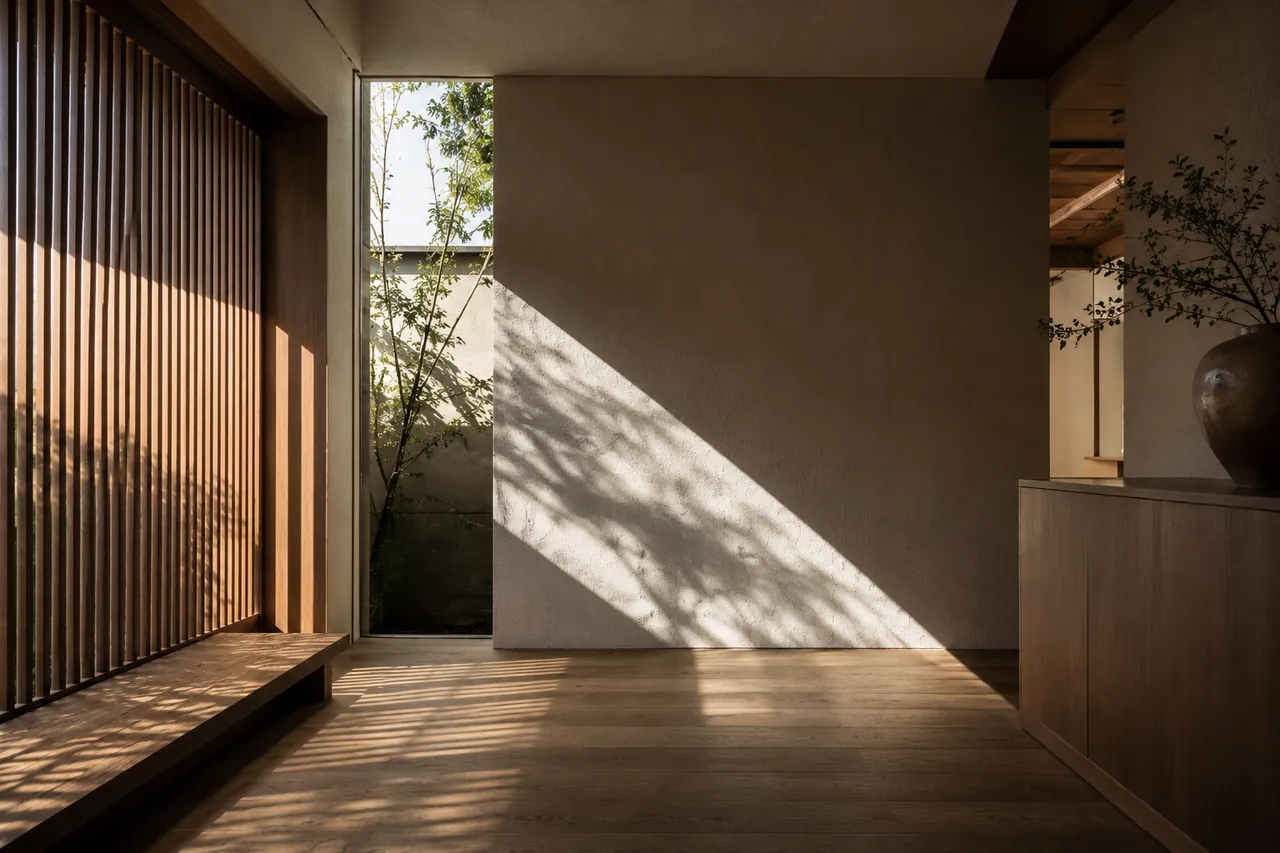
What is designing with light and shadow? Exposed concrete, slit windows and toplights make shadow the protagonist. The material palette is simple; the light design is not — it belongs to estates in the ¥2M–3.8M-per-tsubo class.
Part of the guide: RC homes in Osaka
Exposed concrete, slit windows, a rooflight — the materials may be plain, yet designing light and shadow is advanced work. In a Japanese luxury home we decide "where to cast shadow" before "where to make light." Cost is roughly 2 to 3.8 million yen per tsubo. This article explains how to design light with shadow as the lead.
1. Shadow, not light, is the lead
Light every room uniformly and the space turns flat. A gradient of light and dark is what creates depth and dignity. We first decide where shadow falls — under the eaves, the tokonoma alcove, the stair landing — and lead light toward it.
2. "In Praise of Shadows," translated for today
In his essay In Praise of Shadows, Tanizaki argued that Japanese beauty lives in "not being too bright." Even in a modern home, flooding every room with even, blazing light is the root of cheapness. Do not fear shadow; make it an ally.
3. Controlling natural light
Deep eaves (1.5 to 2 m) cut the direct sun while paper screens and lattices diffuse it. Designing with reflected light rather than direct light as the lead gives a space depth. A large south opening is the star in winter; in summer the eaves block the sun.
4. Designing openings by orientation
| South | The main daylight / lets winter sun reach deep, eaves shade it in summer |
| East | Soft morning light / suited to bedrooms and breakfast rooms |
| West | Afternoon sun is too harsh / keep openings small, control with louvers |
| North | Steady diffuse light all day / ideal for an atelier or study |
5. A recipe for artificial light
- Color temperature: unify on warm white, 2700 to 3000K (5000K white reads like an office)
- Fixtures: avoid relying on downlights alone; combine indirect light, brackets, and floor lamps
- Illuminance: walls 100 lux, work surfaces 300 lux, bedrooms down to 50 lux or less
6. Many lights to a room
Rather than one central fixture lighting everything evenly, place several small lights by purpose: a reading lamp, a floor-level light, display-shelf lighting. Dimming and color tuning let you switch scenes — "dining," "togetherness," "before sleep" — so the same room changes face through the day.
7. Reflective versus light-absorbing materials
Polished stone and glass (reflective) versus plaster, solid wood, and fabric (absorbing). 20% reflective, 80% absorbing is the golden ratio for richness. Too much reflection unsettles; too little feels heavy.
8. Shaping light by function
Make the entrance deliberately dim to stage the "ritual of entering." Keep the living-dining bright; dim the bedroom in stages. In the bathroom, light grazing down the wall from the ceiling evokes the texture of an onsen inn.
9. Light that shifts with hour and season
Morning sun comes low from the east, noon from the zenith, evening to the west. The summer sun rides high, the winter sun low. Eave depth and window height are calculated to block summer sun and invite winter sun. A house whose face shifts across the day and year is one you never tire of living in.
Deciding "where shadow falls" before "where light lands" is the Japanese way of designing a luxury space.
Talk to us about your plan and a rough budget — free.
Book a free consultation