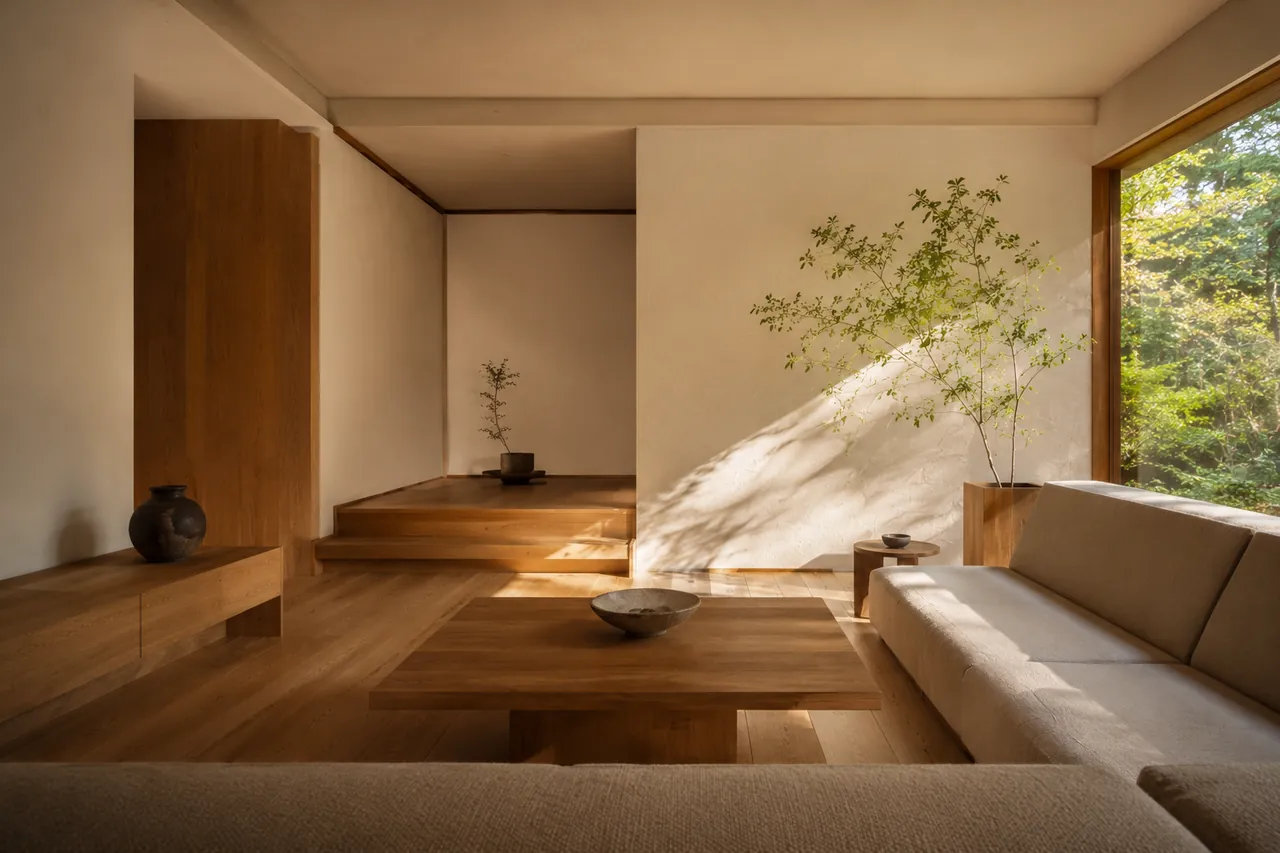
What makes a good genkan? Six points: a doma of 1.5–3 tsubo, the agari-kamachi step, a walk-in shoe closet, separate guest and family flows, daylight and materials. Together they set the home's first impression.
1. The threshold as a device
The Japanese genkan is not a mere doorway but a device that switches between "uchi" (inside) and "soto" (outside). Through the act of removing one's shoes, a person sheds the dirt and tension of outside and enters the home as a realm of rest. This character as a "boundary" is the decisive difference from a Western entrance. It is also the "face of the house" that welcomes guests, swaying the first impression and dignity of a home far beyond its floor area. That is exactly why the genkan deserves investment in quality even on a limited footprint.
2. The doma and agari-kamachi step
The heart of the genkan lies in the level difference between the doma and the agari-kamachi step. The doma is the shod realm; above the step is the bare-foot realm — and this step physically divides in from out. The step is generally 15–25 cm. Too high and going up and down is a burden; too low and sand from the doma rides up into the interior, and it becomes harder to sit and put on shoes. For elderly use, keep the step lower and add a handrail or bench beside it for safety.
3. Shoes-in cloakroom (doma storage)
The shoes-in cloakroom (doma storage) stores shoes, strollers, outdoor gear and coats with shoes on, keeping the entrance area permanently clear. Make it walk-through, running from the entrance hall into the interior, and the flow "arrive → set down coat and bags → wash hands" becomes the shortest possible. At 1.6–3.3 m² it comfortably holds a family of four's shoes and seasonal gear, preserving a refined genkan where daily clutter is unseen even when guests call.
4. Guest vs family circulation
A high-quality genkan separates the guest flow from the family flow. Guests are led straight from the hall to the reception room or living room; the family passes through the doma store to the washroom and interior — splitting the two lines means family life does not intrude even while guests are present, and shoes and bags never pile up. Even on a narrow frontage, running a single "back route" through storage transforms how the genkan works and looks.
5. Light and the changing seasons
Because the genkan sets the first impression, staging light and a sense of season pays off. Drawing daylight from a low window, a high window or a framed tsuboniwa (courtyard garden) turns an otherwise dim genkan bright and elegant. A niche above the shoe cabinet, with seasonal flowers, a hanging scroll or a small arrangement, conveys the turning of the seasons to every visitor. Rather than a single ceiling light, layering floor lights and indirect light yields a calmer face with depth and shadow.
6. Dimensional guide
The standard dimensions of genkan design. Master these and you can judge usability at the drawing stage.
| Item | Standard dimension |
|---|---|
| Genkan doma width | ≥1,365 mm (two can pass) |
| Agari-kamachi height | 15–25 cm |
| Doma depth | ≥1,200 mm (door swing + putting on shoes) |
| Shoes-in cloakroom | 1.6–3.3 m² |
| Clear space before the step | ≥1,200 mm |
7. Material philosophy
For genkan materials, the key is uniting durability with texture. The doma floor is typically stone, tile, mortar or tataki (packed earth) — strong against water and sand and not slippery — and natural stone gains character with age. Solid timber on the step or platform raises the comfort of arriving home with its touch and the scent of wood. Ease of cleaning matters in practice too: large-format tiles with few joints, or mid-tones that hide dirt, keep the beauty lasting.
The genkan is the home's "boundary" and its "face." The step between doma and kamachi, the two circulation lines, the texture of the materials — in this small space resides the dignity of the home.
Talk to us about your plan and a rough budget — free.
Book a free consultation