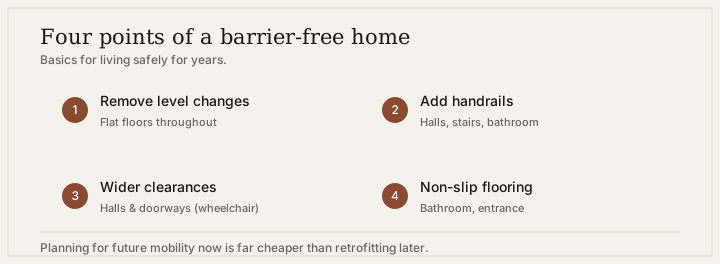
How do you build a home that ages with you? Seven pillars: step-free floors, handrails, a home elevator, safe bathroom dimensions, toilet flow, a ground-floor bedroom and an emergency call line. Building them in from day one costs less than retrofitting, and long-term-care insurance subsidies can help.
1. Design Philosophy — Comfort Now, Security Later
Preparing for old age cannot be reduced to retrofitted handrails and removed thresholds. What truly works is building future physical change into the design from the new-construction stage. You may be healthy now, but in twenty years your knees, back, eyesight, and gait will change. Designing generous corridor widths, door openings, a ground-floor bedroom, and a well-placed wet zone in advance dramatically reduces later renovation costs. In a luxury residence the goal is not "a house like a care facility" but safety woven invisibly into beauty. The key lies in unseen preparation: installing backing for future handrails, eliminating thresholds from the start.
2. Threshold and Dimension Standards
The single biggest cause of falls is the slight threshold. Interiors should be flat in principle; where a step is unavoidable, keep it under 5mm. Corridors and doorways should provide clear widths that anticipate wheelchair passage. The table below shows the standard dimensions Towa Construction recommends for aging-friendly homes.
| Element | Standard | Wheelchair |
|---|---|---|
| Clear corridor width | 780mm+ | 850–900mm |
| Clear door width | 750mm+ | 800mm+ |
| Interior threshold | under 5mm | 0mm (flat) |
| Handrail height | 750–800mm from floor | |
3. Handrail Placement and Backing
Adding handrails "once they become necessary" is too late; the correct approach is to install wall backing (reinforcement) at the new-construction stage. With backing in place, you can later choose a handrail to match the interior and add it easily. Priority locations are:
- The entry step (agari-kamachi) — a vertical rail to support sitting and standing
- Stairs — ideally on both sides, at minimum a continuous rail on the descending side
- Corridors — continuous rails along long circulation routes
- Toilet and bathroom — L-shaped rails to aid standing and movement
4. Home Elevators
In two- and three-storey residences, a home elevator can decisively shape future life. Residential units typically carry two or three people, and some models accept a wheelchair. Even if you do not install one at construction, reserving a "future shaft space" on both floors and using it as storage makes later installation far easier. Drive types include rope and hydraulic systems; compare footprint, pit depth, and maintenance cost when choosing.
5. Bathroom Safety Dimensions
The bathroom is where home accidents occur most. Safety rests on cutting off three things: slipping, thresholds, and temperature shock (heat shock). Provide at least a 1616 (one-tsubo) size, with handrails at the washing area and tub entry. Eliminate the threshold at the doorway and use a sliding door. To prevent winter accidents, always plan insulation and heating for the changing room and bathroom so the temperature gap with living spaces stays small. Choose a quick-drying, slip-resistant floor finish.
6. Toilet Safety Dimensions
Anticipating the day assistance is needed, give the toilet generous clear width and depth. Allowing for a future caregiver, a width of about 1100mm including handrails brings peace of mind. Use a sliding door and remove the threshold. An L-shaped rail supports standing and turning, and a motion-sensor foot light prepares for night use. Placing the toilet near a ground-floor bedroom reduces the burden of night-time movement.
7. The Ground-Floor Bedroom
The heaviest burden in old age is climbing stairs. Provide from the outset a room on the ground floor that can become a bedroom (or a guest room / Japanese room), with toilet and bathroom grouped nearby, so that even with weakened legs life can be completed on the ground floor alone. Use it as a guest room or study while young, convert it to a bedroom later — weaving this "convertibility" into the original plan is the condition for a residence you can live in for generations.
8. Emergency Call and Monitoring Systems
The final layer of safety is emergency calling and monitoring. Place call buttons in the bathroom, toilet, and bedroom, able to alert family phones or a security company. A monitoring system that notifies when no movement is detected for a set time, and auto-illuminating night foot lights, are also effective. The top priority is that equipment is easy for the resident to use and reassuring for the family, with care taken not to become excessive surveillance — that consideration, too, is part of the design.
Aging-friendly design does not mean turning a home into a "care specification." It means quietly anticipating future physical change while preserving beauty — that is the condition of a residence loved for a lifetime.
Talk to us about your plan and a rough budget — free.
Book a free consultation