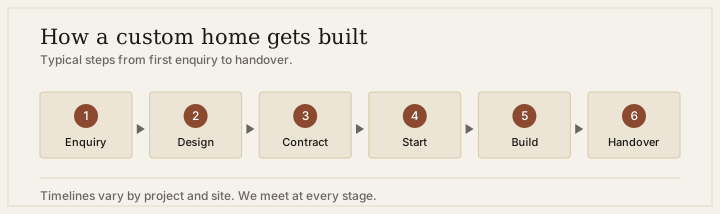
What are the steps to build in Japan? Land survey → basic design (1–2 months) → detailed design (2–4) → confirmation permit (1–2) → construction (8–18) → final inspection → handover. Overall guide: 14–24 months.
Part of the guide: Building a custom home in Osaka
From "land secured to handover," building a home takes roughly 14–24 months in total. That time has a clear shape: design and the building permit take the longest, while construction itself is fast and precise. Knowing, at each stage, "what gets decided and how leaving it undecided echoes later" clarifies what to prioritise in meetings. Here is the whole picture in seven stages.
1. Site survey & brief (2–4 weeks)
The first task is the on-site and legal survey of the land. We measure the topography, the frontage road, neighbouring plots and the entry points of electricity, gas and water, and confirm the zoning, building-coverage and floor-area ratios, setback limits and fire-zone designation at the legal-affairs bureau and city office. At this stage the "maximum buildable volume" and the "parts you cannot build" are fixed, setting the frame for all design that follows.
In parallel we organise your requirements: family makeup, lifestyle, number of cars, storage needed, target budget and schedule, and preferred taste. Proceed to design with this left vague and you face large rework later. Compiling it into a single sheet (the schematic-design brief), so designer and owner share the same premises, becomes the foundation for the entire process.
2. Schematic design (1.5–3 months)
From the brief we study the plan, elevation, layout and section. The outputs are outline drawings, a model and a rough construction cost. Here the hard-to-change fundamentals are decided — the structure (RC / wood / steel), the number of storeys and the rough budget scale.
The trick is not to narrow to one scheme at once but to converge on a final scheme while comparing 3–5 options. Elements that "shape comfort but read poorly on drawings" — window orientation, whether there is a void — are confirmed by feel through models and sunlight studies. Because decisions here set the broad outline of total cost, this is also where the budget is reconciled.
3. Detailed design (2–4 months)
We produce detailed drawings usable for construction — design, structure and services in three sets, 100–200 sheets in all. Every finish is fixed down to maker, product number and grade, brought to a level the builder can price accurately.
Anything not fully decided by this point will turn into trouble on site. The more "decide later" you leave, the greater the risk of spec changes, extra cost and schedule slip after construction starts. Conversely, the more precise the detailed design, the more accurate the estimate and the more fairly you can compare multiple bids. It takes time, but the density here decides the stability of the whole project.
4. Building permit (1–2 months)
The detailed drawings are submitted to a designated confirmation-inspection body, checked for conformity with the Building Standards Act, and a confirmation certificate is obtained. Construction cannot start until this is in hand.
Note that for for buildings that need advanced structural calculation (routes 2 and 3) — RC over 20 m tall, for example — a separate "structural-calculation conformity assessment" is required, adding about a month. Overlook this on a residence or building and the whole schedule slips back. Tightening the drawings' consistency before applying (no clashes among design, structure and services) cuts the correction exchanges during review and, in the end, is the fastest route.
5. Contractor selection & contract (1–2 months)
We invite competitive bids from 2–4 firms. Price is not the only thing compared. We judge on past track record of similar work, the experience of the site agent, and the soundness of the schedule. The cheapest is not always best; an extremely low bid can be a sign of later extra charges or a drop in quality.
The contract is a construction agreement plus the full set of design documents. Confirm that the estimate's itemised breakdown matches the documents and that the rules for additions and changes are explicit before sealing. The more carefully this is done, the less the "he said / she said" after construction starts.
6. Groundbreaking to completion (6–18 months)
After the ground-breaking ceremony, work proceeds in order: ground improvement, foundation, frame, roof, exterior, interior and services. The schedule is typically 14–18 months for an RC residence and 6–10 for wood. Because weather, ground and added works move it, confirm the handling of delay at contract time.
What underpins quality here is supervision. The supervising architect visits the site at least once a fortnight, checking that work follows the drawings and that parts that will be hidden (rebar, waterproofing, insulation) meet the standard — before they are concealed. If the owner also visits at the framing, mid-point and finishing milestones, gaps in understanding can be corrected early.
7. Inspection & handover (2–3 weeks)
After completion, the inspection body carries out the completion inspection and the owner a final inspection. In the owner's inspection, you list any concerns (a snagging list) and ask the builder to correct them. Look closely with a living person's eye — scratches, fit of doors, operation of equipment.
Once corrections are done, the inspection certificate, the registration identification and the various warranty documents are handed over together. Only when you receive the keys is the home truly "finished." Keep the warranties, manuals and maintenance plan received at handover — they matter for post-move-in issues and for a future sale.
In Japan's building flow, design and the permit take the longest, while construction itself is precise and fast. "Design 4 months, permit 2, construction 12, inspection 1" is the standard model for a residence. What you should never skimp on is not the site, but nailing down the design.
Talk to us about your plan and a rough budget — free.
Book a free consultation