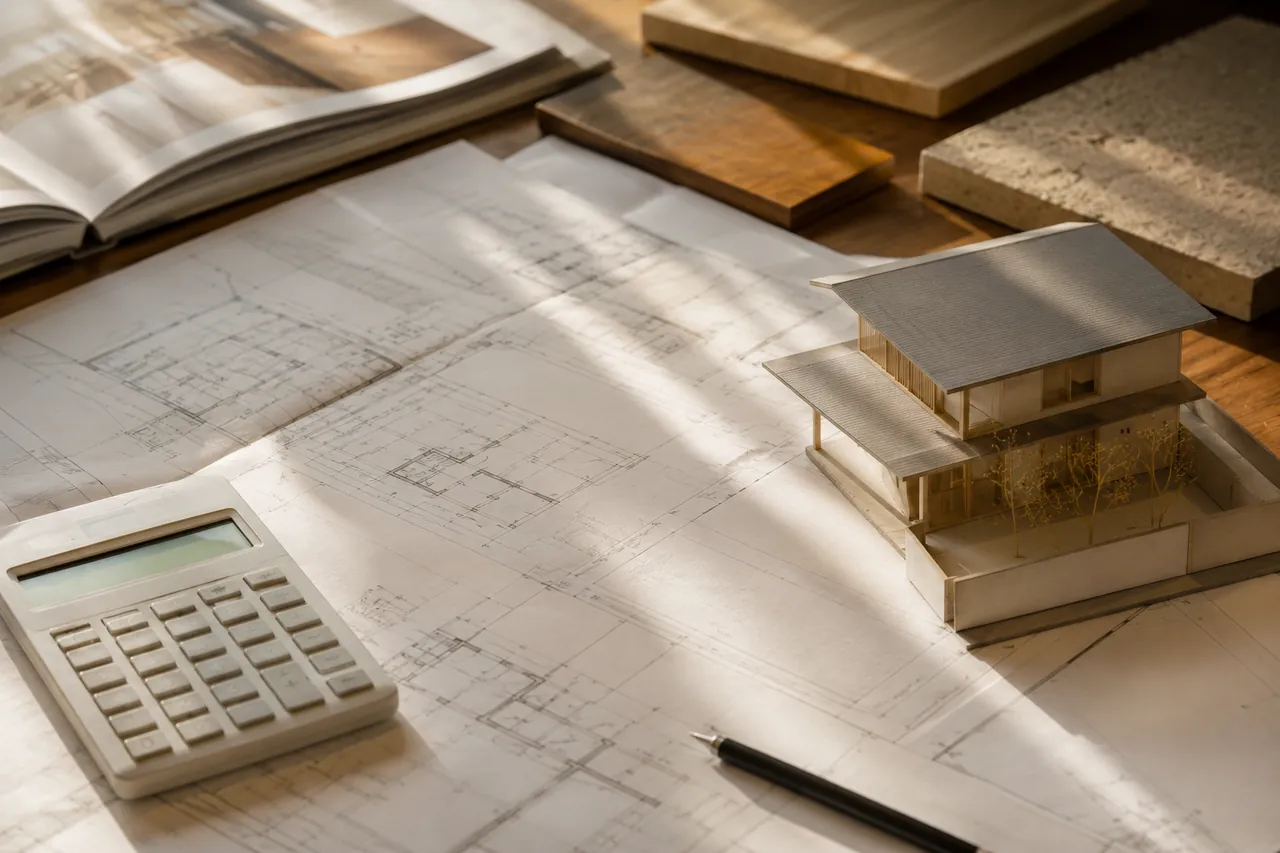
How are Japanese homes appraised? Land and building are valued separately; the building depreciates against statutory life (wood 22, steel 34, RC 47 years). Wood tends toward zero after ~20 years, while RC holds value — supported by location, maintenance, kept drawings and performance certification.
1. Thinking about "selling" before you build
Most people who build a house plan to "live there for life." That is natural, but in reality a transfer, an inheritance, a parent's care, divorce, a reshuffling of assets — the possibility of letting a house go can come to anyone. And the key point is that whether a house will sell, and whether it holds value, is largely decided at the land-choosing and design stage before you build. A house built with the exit in mind becomes an asset that protects the household and the family when the time comes. To know the exit even while "meaning not to sell" — that is wise house-building.
2. Japan's appraisal method — valuing land and building separately
Japanese second-hand property is, in essence, valued by appraising land and building separately and summing them.
- Land valuation: set by location (station distance, convenience, environment), shape (is it a regular plot), access (frontage, road width) and use zone. As a rule, land does not depreciate.
- Building valuation: depreciated year by year from the new-build value along the statutory service life for each structure. The older the building, the lower the value.
A trait peculiar to Japan is that building value falls sharply right after completion and erodes with the years, while land value, depending on location, is held for a long time. That property in a prestige district is strong as an asset is owed precisely to this "power of the land."
3. Residual building value — statutory service life by structure
The tax statutory service life is an important basis for building valuation.
| Structure | Statutory service life (housing) | Tendency in appraisal |
|---|---|---|
| Timber | 22 years | building value tends toward near-zero in just over 20 years |
| Light-gauge steel | 19–27 years | lasts slightly longer than timber |
| Heavy steel | 34 years | tends to hold value over the medium term |
| RC / SRC | 47 years | building value tends to remain over the long term |
Note that the statutory service life is only a tax and appraisal basis — a building does not become uninhabitable at that age. A well-maintained RC residence serves 60 or 80 years. But in the appraised value for second-hand sale, this figure bites mechanically, so RC is rated as "holding value" better than timber. This is why, if you will live long and also weigh the possibility of letting go, RC is at an advantage.
4. Conditions of a house that holds value — location, maintenance, drawings, performance evaluation
At the same age, factors still create gaps in appraised value.
- Location: the largest factor. Good land supports value even as the building ages.
- Proper maintenance: a house with a record of periodic inspection and repair is in good condition and rates highly. Surviving records build trust.
- Retained drawings: with structural and services drawings in hand, a buyer can purchase and remodel with confidence. A house without drawings is shunned.
- Third-party certification such as a housing-performance evaluation or long-life quality housing: with seismic, insulation and durability measures publicly evaluated, it differentiates even second-hand and underpins price.
A "good house" can be proven not by feel but in the form of location, records and certification. A house that can be proven is exactly the house that holds value in the second-hand market.
5. The sale process for foreign and remote owners
Even those living abroad or owners at a distance can sell Japanese property. The basic flow is as follows.
- Appraisal: ask several agencies to appraise, and compare price and sales approach.
- Brokerage contract: contract with an agency. At a distance, you can entrust the procedure to an agent by power of attorney.
- Marketing and negotiation: finding a buyer, handling viewings, price negotiation.
- Contract and settlement: explanation of important matters, sale contract, balance settlement and handover. Overseas residents may need a certificate of residence or signature certificate in place of a seal certificate.
- Tax: gains are taxed. A non-resident's sale may be subject to withholding, settled through a tax return.
Professional support (agency, tax accountant, judicial scrivener) is pivotal on language, tax and procedure. If the company that built the house keeps the drawings and records, preparing the materials for sale is far smoother.
6. House-building with the exit in view
Some will feel it bleak to build a house on the premise of "selling." But keeping the exit in view is to protect the family's options. Choose good land, choose a long-life structure, maintain it properly, keep drawings and performance on record. That accumulation raises both peace of mind while you live there and value when you let it go. In the end, a "house that holds value" is nothing other than a good, long-lasting house that is comfortable for those who live in it.
To think about the exit is not to wish to sell but to be able to protect the family whatever future comes. A little effort before building decides the asset value decades ahead.
Send us your drawings or plot info and we'll estimate the budget.
Get a free estimate