How does a foreigner build in Japan? Five stages: land acquisition → design & quote → building permit → construction → final inspection & handover. Funds move in JPY via SWIFT, contracts can be signed with a signature certificate instead of a registered seal, and interpreting plus remote site management let you run it from abroad.
Part of the guide: Hotels & lodging investment in Osaka
1. Foreigners can build in Japan
Japan places no nationality restriction on owning or building real estate. Permanent residency and living in Japan are not required either; you can acquire land and build a house or building while resident abroad. We have owners who ran design, contract and construction without ever flying in. That said, the contract, registration, funding and tax do involve procedures specific to Japan — a signature certificate in place of a personal seal, a Foreign Exchange Act report on inbound transfers, and the appointment of a tax agent — steps a Japanese buyer never faces. Understand the flow first and the whole thing turns from a "barrier of rights" into a simple matter of "order of procedures," which dissolves most of the anxiety.
2. The overall flow
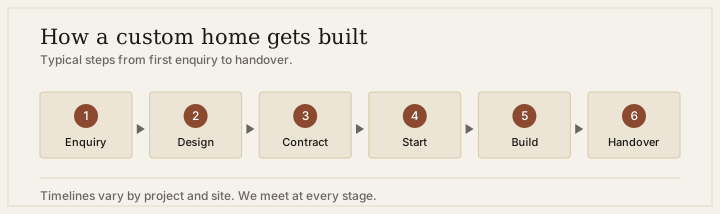
From land acquisition to handover there are broadly five stages. For an overseas owner, each stage has moments where a visit is desirable and moments where remote is enough; separating these in advance minimises trips. As a guide, once the land is settled, allow 6-12 months for design and 6-18 months for construction.
| Stage | Main content |
|---|---|
| 1. Land acquisition | Zoning and building-condition checks, purchase contract, registration |
| 2. Design & estimate | Brief, schematic and detailed design, fixed estimate |
| 3. Building permit | Building confirmation, plus any required permits |
| 4. Construction | Start, framing, interior; regular reporting |
| 5. Inspection & handover | Inspection certificate, key handover, aftercare |
For land-selection checks see here, and for the full schedule see how to build a house in Japan. Stage 1 matters most, because zoning, road frontage and ground conditions determine what can be built — so survey before you sign.
3. Funding and transfers
Costs are denominated in Japanese yen, and we accept SWIFT transfers from abroad. Transfers take several days to clear, and exchange swings and wire fees (a few thousand to tens of thousands of yen each) add up, so the practical approach is to remit in blocks aligned to the payment schedule and pool the funds in a Japan-based account (ideally a trust or escrow). A mortgage for a non-resident or foreign national depends on residence status, income and banking history, and conditions can be steeper (a 30-50% down payment, for instance). Fixing the funding plan early is key; for budget structure see the three-layer building budget.
4. Contract, residence status and agents
A non-resident without a registered seal can contract and register using a signature certificate from home plus a residence card if held. The certificate is obtained from a notary at home or a Japanese embassy/consulate. If visiting is hard, an agent under power of attorney can carry out purchase, registration and handover, and a judicial scrivener will design the agency scheme. Residence status does not affect ownership or building itself, though it does bear on mortgages and long stays. The single biggest hurdle is that contracts are in Japanese only, so always ask for an English summary alongside. For more, see the FAQ for foreign owners.
5. Running it remotely from abroad
Construction can be completed with the fewest possible trips. The key is to calendar the decision milestones in advance and share the material each decision needs ahead of time. Combining an interpreter present, weekly online meetings, photo/video reports and electronic signing, we handle everything from design sign-off through construction progress to handover remotely. Key stages (rebar, concrete pour, framing, final inspection) are covered by live streaming and recording in lieu of attendance. Our site is in six languages and we set call times around the time difference. The full picture is detailed in remote construction management.
6. Tax and after handover
Japanese tax applies to foreigners and non-residents too: acquisition tax (3-4% of assessed value) and registration tax at acquisition, fixed-asset tax (1.4%) and city-planning tax (up to 0.3%) while holding, and income tax on rental or sale. A non-resident must file a tax agent, and note that rent is withheld at 20.42% and sale proceeds at 10.21%. A tax treaty generally resolves double taxation with your home country, but application is complex, so assume a tax accountant is involved. For depreciation and saving see here, and for the whole tax design see tax planning for foreign owners. Post-handover management and inspection also continue remotely or by agent.
For a foreign owner the only walls are "language" and "distance." Understand the flow, pair an interpreter and a remote setup with professionals (tax accountant, judicial scrivener), and you can build your ideal building in Japan from abroad. The first step is simply to share the land, the budget and when you can travel.
Consult online in English, Chinese and more.
Book an online consultation