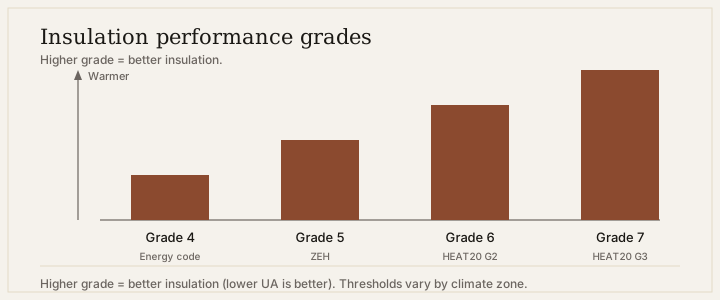
What makes a home stand up to Japan's climate? Against humid summers and dry winters (Kansai baseline), four measures anchor the design: eaves, heat shielding, insulation and ventilation. Reaching energy grade 6 adds a guide ¥200–500k per tsubo.
1. The 24-Hour Ventilation Mandate (2003)
A 2003 amendment to Japan's Building Standards Act made 24-hour ventilation mandatory, in principle, for every habitable room. The aim was to prevent sick-building syndrome from chemicals released by new materials; homes are required to ventilate at least 0.5 air changes per hour (the whole interior air exchanged every two hours). In today's increasingly airtight homes, a system that exchanges air by design bears directly on health. Ventilation comes in the three types below; in residences the heat-loss-reducing Type 1 is the mainstream.
| Type | Supply | Exhaust | Character |
|---|---|---|---|
| Type 1 | Mechanical | Mechanical | Energy-saving via heat exchange; higher cost |
| Type 2 | Mechanical | Natural | Mainly for clean rooms |
| Type 3 | Natural | Mechanical | Inexpensive; common in homes |
2. Circulation for the Rainy Season
The rainy season (tsuyu) before Japan's summer is hot and humid, drying laundry poorly and breeding mould. What design can do is weave humidity countermeasures into the housework circulation itself. Give the laundry room ventilation, dehumidification, and drying space so clothes dry indoors even in rain. Combine this with the following:
- Humidity-buffering interior materials such as diatomaceous earth and plaster
- Consolidating the wet zones to group the sources of moisture
- Underfloor and roof-space ventilation to release moisture from the whole building
3. Typhoon Countermeasures
Against the typhoons that strike every year, a residence needs design that not only "won't break" but "won't leak, won't fly off." More than the wind itself, window damage from flying debris tends to be the origin of harm. The priorities are:
- Shutters and storm doors on windows, or high-impact laminated glass
- Firm fixing of roofing and measures against eaves uplift
- Generous drainage and gutter capacity ready for torrential rain
In recent years, short, intense downpours from linear rain bands have increased, making site drainage planning more important than before.
4. The Condensation-Prevention Trio
What damages Japanese homes from within is condensation. Beyond the "surface condensation" on window glass, interstitial condensation inside walls rots structural timber and robs insulation of its performance. The key to prevention is designing the "insulation, airtightness, ventilation" trio as one. Insulation reduces the temperature gap, airtightness keeps humid air from entering the wall, and ventilation expels indoor moisture — if even one is missing the effect collapses. The point is to continue a correct vapour-barrier layer within the wall.
5. The Multi-Layer Waterproofing Build-up
In rainy Japan, waterproofing is, in principle, "guarding in many layers" rather than "guarding with one sheet." An exterior wall, for instance, takes a two-stage build: a ventilation cavity behind the finish, with a breathable waterproof sheet on its inner side, so that any rain getting past the finish is drained through the cavity. A roof layers waterproofing + slope + flashing; a balcony, FRP waterproofing + ample slope and upstand; a foundation, damp-proofing and a drainage fall — layers stacked part by part. The quality of this rain management governs a home's lifespan more than anything.
6. Target Indoor Humidity
For both comfort and health, the target indoor relative humidity is 40–60%. Lower than this dries the throat and skin and activates viruses; higher breeds mould and mites. Because Japan swings to both extremes — high humidity in summer, dryness in winter — it needs opposite adjustments by season: dehumidify in summer, humidify in winter. Combine Type 1 heat exchange, humidity-buffering materials, and the air conditioner's dehumidify mode to keep within this band year-round. Humidity control is an invisible yet decisive element of comfort.
Building a home in Japan is a dialogue with the four seasons. The damp of the rainy season, the muggy heat of summer, the wind and rain of typhoons, the dryness of winter — design that reads this country's climate fully is what makes a residence one can live in, long and healthily.
Talk to us about your plan and a rough budget — free.
Book a free consultation