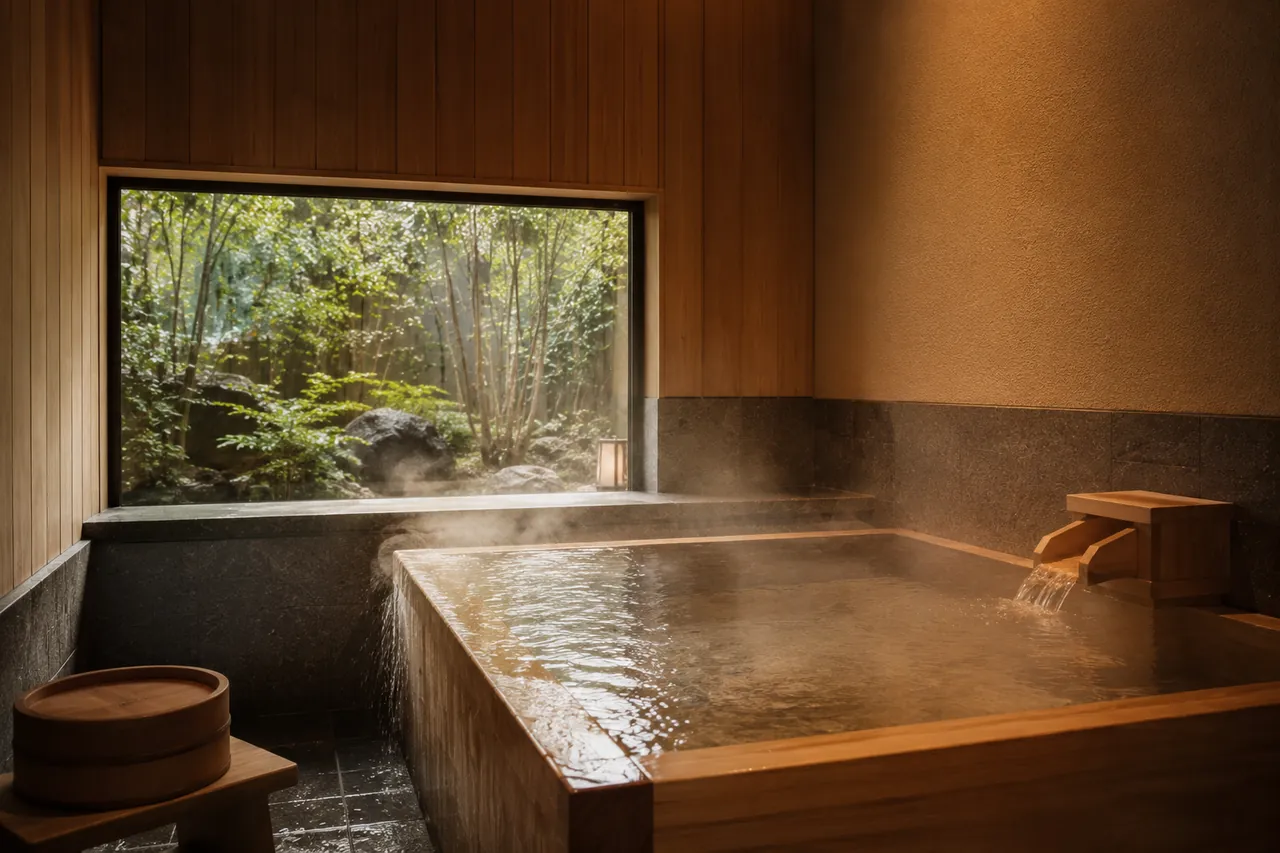
Can you just drill for onsen — and at what cost? Drilling, pumping and use each need the governor's permit under the Hot Springs Act. Wells run ~1,000 m deep and can cost tens of millions of yen — with no guarantee of flow or temperature. Given heavy upkeep, piped supply or land with an existing source is often the realistic route.
Part of the guide: Hotels & lodging investment in Osaka
1. Three ways to have a hot spring at home
There are broadly three routes to an onsen at home or at a villa: (1) drilling a well on your own land, (2) piping water in from a hot-spring source, and (3) buying land that comes with a source or spring rights. Drilling offers the most freedom but carries the highest hurdles and cost; piping-in or buying land with rights is often more realistic.
2. Hot Springs Act permits — drilling, pumping, use
Hot springs are a finite resource protected under the Hot Springs Act (administered by the Ministry of the Environment). Drilling (and deepening), installing power pumps, and using a hot spring all require a permit from the prefectural governor. Where drilling could affect the discharge, temperature or composition of nearby springs, the permit may be refused. Supplying water for public bathing or drinking needs a separate use permit. You cannot “drill first and sort it out later” — plan around the application and review.
3. The reality of drilling: depth, success rate, cost
Under the Act, a “hot spring” means water at 25°C or above, or containing specified minerals above set levels. Reaching one in an urban area often means drilling around 1,000 m (a few hundred to ~1,500 m depending on the area). Crucially, there is no guarantee of adequate flow or temperature even after drilling. Drilling alone can run into the tens of millions of yen (depending on depth and geology), with monthly pump power, water and maintenance on top. Treat it as an asset or a passion, not an investment to recoup.
4. Water quality and equipment design
A raw source is often too hot or too concentrated, so equipment — dilution, heating, heat exchange, filtration and circulation — conditions it for use. “Free-flowing source water” (kakenagashi) is a luxury that assumes ample flow and good water management; in practice a circulating system is often combined. Equipment choices change greatly with the spring type (chloride, bicarbonate, sulphur, and so on).
5. Why it clogs when unused — yunohana and scale
This is the most common question we get. Hot-spring water carries dissolved calcium (calcium carbonate), silica, iron and manganese; when the water cools or sits still, these precipitate and harden as “yunohana” and scale. The deposits build up in the riser pipe, plumbing, heat exchanger and tub, narrow the flow path and eventually block it. That is exactly why pipes seize up when left unused for a while — and the hotter and more concentrated the water, the faster it happens.
6. Maintenance that prevents clogging
- Flush regularly: keep hot water (or fresh water) moving even during idle periods to prevent stagnation and hardening
- Acid cleaning: deposits dissolve in acid, but because it risks corroding the pipes it should be done by specialists who control the chemical and its concentration
- Mechanical cleaning: brushing or pigging, and pipe replacement in severe cases
- Pipe material and routing: scale-resistant materials, fewer bends, and inspection ports
- Before a long idle period: displace the system with fresh water to purge the hot-spring minerals
- A maintenance contract: servicing the source, pump and pipes together gives peace of mind
7. Hygiene and Legionella
Standing water and circulating tubs readily grow Legionella, and neglect becomes a health risk. The basics are chlorine disinfection, regular cleaning, water changes and water testing; for inns and public baths this is mandated by ordinance. At home too, apply the same hygiene discipline to circulating systems and standing water.
8. Piping-in or land with spring rights — the realistic option
When drilling is too high a hurdle, a piping (hikiyu) contract in a hot-spring area or buying land with a source or spring rights is realistic. With piping, distance from the source drives temperature loss and pipe cost; with rights-attached land, you must check the rights structure (spring rights, the local association, usage fees). For the bathroom itself, see hinoki and onsen-style baths: cost and maintenance.
A hot spring is not “drill and done” — it is a system you keep flowing and keep maintaining. See the whole picture — permits, discharge risk and upkeep — and calmly choose whether drilling, piping-in or rights-attached land suits you. That is the shortest path to enjoying it for years.
Talk to us about your plan and a rough budget — free.
Book a free consultation