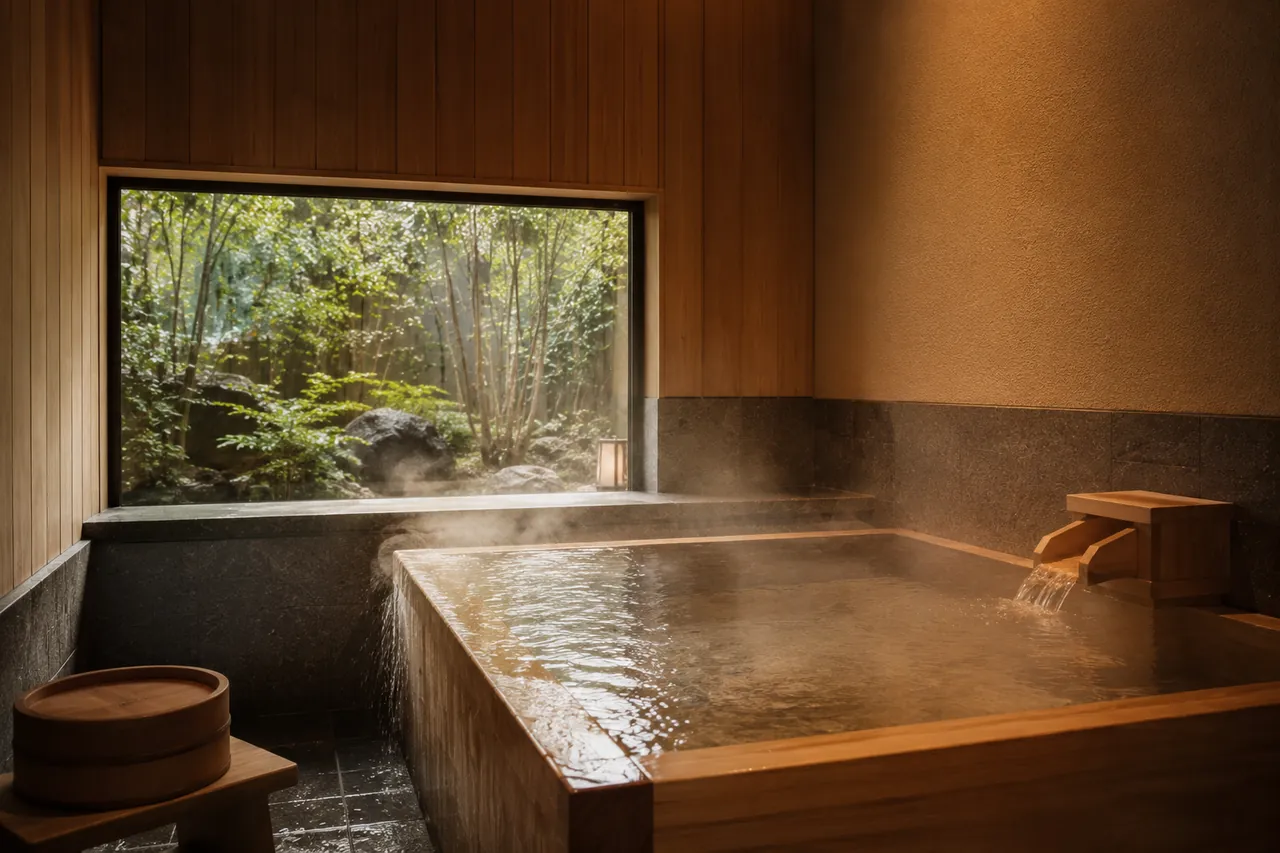
Can you have a hinoki bath or onsen at home? A hinoki bath runs ¥2–5M upfront and needs maintenance roughly every 10 years. Piping in onsen water is permit-controlled under the Hot Springs Act; home use runs a guide ¥500k–2M plus monthly upkeep.
1. Choosing Among Three Methods
A residence bathroom is chosen, broadly, from three methods. A system bath (unit bath) assembles a factory-made waterproof unit on site — waterproofing is certain, the schedule short, the cost predictable. Conventional construction builds floor, walls, and tub from scratch, free in material and dimension, but its waterproofing depends on workmanship. Between them lies the half-unit. The basic choice is by what you prioritise — the assurance of waterproofing, or the freedom of design. In residences, many wish to combine "quality" with "low leak risk," so the half-unit described below is chosen more and more often.
2. The Strength of the Half-Unit
The half-unit is a compromise that makes the lower half — tub and floor surround — a waterproof unit while building the upper walls and ceiling freely. It locks the highest-leak-risk "lower part where water pools" in factory-quality waterproofing, while the visible wall faces can be finished freely in cypress, tile, or plaster. It lacks the full design freedom of conventional work, but excels in the balance of waterproof certainty and design, with high maintainability too. For owners who "want conventional atmosphere but fear leaks," it is often the realistic optimum.
3. The Reality of a Cypress Bath
A hinoki (cypress) bath holds irreplaceable value in fragrance, touch, and humidity buffering — but in reality it takes effort to maintain. Left wet, wood develops mould, darkening, and rot, so after bathing the habit of wiping off water and drying thoroughly is indispensable. Chlorine cleaners harm wood and cannot be used; expect periodic maintenance and, over the years, replacement of parts. For those who cherish the fragrance and the rituals of living, it is a supreme luxury — but on the premise of a resolve to keep tending it. Good drainage design and ample ventilation are the keys to longevity.
4. Natural-Stone Tubs
A tub hollowed from granite or marble brings overwhelming weight of presence and ownership. Stone also has high heat storage, so once warmed the water cools slowly. Each material carries cautions, though. Marble is weak to acids and soap scum and needs care to prevent deterioration. Granite is hard and durable; but as both are considerably heavy, reinforcement of floor and beams is a premise, and the delivery route must be studied. The texture is one of a kind, but it is a material to choose only after settling the three points of structure, budget, and maintenance first.
5. Open-Air Baths (Including Semi-Open)
An open-air bath, soaking while touched by outside air, is a luxury only a residence affords. Where a full open-air bath is hard in the city, a semi-open bath enclosed by eaves or lattice becomes the realistic answer. The design points are screening from neighbours, the hot-water capacity and reheating to use it comfortably even in winter, and reliable drainage and waterproofing. Attention to fallen leaves, rain intrusion, and pipe freezing in cold seasons is essential. Designed as one with a courtyard or planting, it lets you savour at home an openness and seasonality no indoor bath offers.
6. A Bathroom Dimension Guide
Bathroom size is conventionally called by inner dimensions (cm/10), as in "1616." The first two digits are the short side, the latter two the long side. The table below gives representative sizes.
| Name | Inner (mm) | Guide |
|---|---|---|
| 1216 | 1200×1600 | Compact |
| 1616 | 1600×1600 | Standard (1 tsubo) |
| 1620 | 1600×2000 | Spacious |
| 1818 | 1800×1800 | For residences |
Residences favour a wide washing area and 1620 or larger, leaving room for seated bathing assistance and future handrails.
7. Insulation and Ventilation
The bathroom is where temperature gaps arise most easily in a home, a chief cause of winter heat shock. The basic measure is to insulate the bathroom and changing room with the structure so the gap from living spaces stays small. Add a bathroom heater-dryer and one unit handles pre-bath warming, laundry drying on rainy days, and mould suppression. 24-hour ventilation to avoid trapping moisture is also essential, expelling humidity by planned ventilation rather than relying on a window. Only when insulation, heating, and ventilation are all in place does a bathroom become safe and long-lasting.
8. The Importance of Waterproofing in Conventional Work
The more built-up area there is in conventional work or a half-unit, the more the quality of waterproofing decides the bathroom's lifespan. Water reaching beneath the floor or behind walls leads to structural rot and termite damage, with large-scale repair. What matters is to continue FRP or asphalt waterproofing up the upstands and to detail the junctions — drains, pipe penetrations, doorways — with care. Because the waterproof layer is hidden by the finish, inspection during construction tells. It is in the unseen parts that a builder's true ability shows.
The bathroom is the most private place to release body and mind at day's end. We are easily captivated by the beauty of materials, but what sustains that luxury for long is unseen waterproofing and insulation, and daily care — the balance of beauty and practicality is what makes a true bathroom.
Talk to us about your plan and a rough budget — free.
Book a free consultation