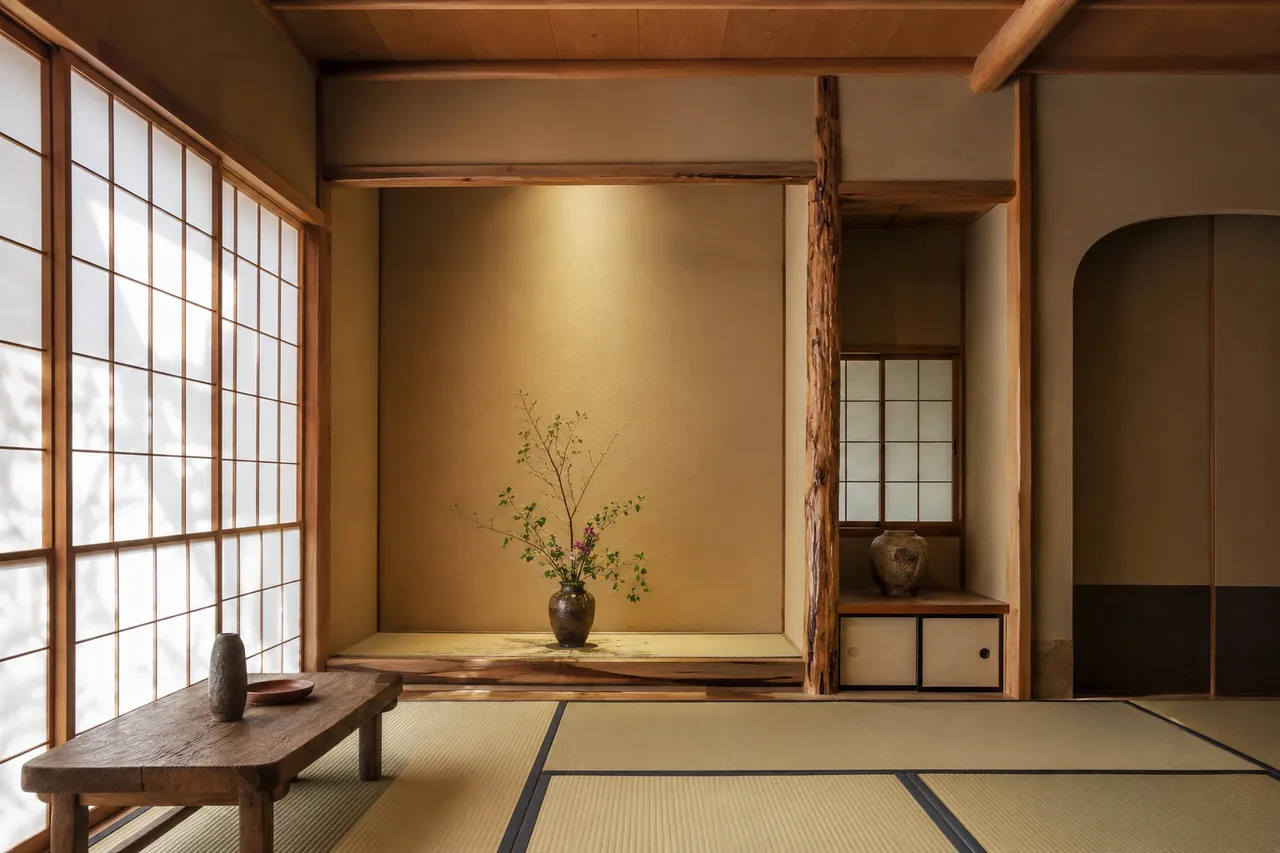
What does a true washitsu or sukiya room cost? A full Japanese room runs 20–50% above a Western room of the same size; a proper tea room starts at several million yen even at small scale. Against shoin formality, sukiya carries the tea ceremony's light, delicate spirit.
1. The elements of a washitsu
A washitsu is not just “a tatami room” — it is a composition. Tatami (traditional rice-straw core with rush facing, or modern engineered cores), the tokonoma alcove (the room's spiritual focus, for a scroll and flowers), shoji (paper screens that diffuse light), fusuma sliding panels, the ranma transom for airflow and ornament, and the engawa veranda mediating inside and out. How many elements you include sets both the room's formality and its cost.
2. Sukiya style — and how it differs from shoin
Sukiya-zukuri grew out of the tea ceremony. Where the formal shoin style prizes hierarchy, symmetry and grandeur, sukiya values lightness, asymmetry and the character of materials: posts with softened corners (menkawa-bashira), earthen plaster walls, slender exposed rafters, and restrained, precise joinery. Most of what is sold today as “Japanese modern” design draws its vocabulary from sukiya.
3. The tea room — nijiriguchi, hearth, mizuya
The tea room is the most codified washitsu. Guests enter bowing through the low nijiriguchi hatch; a ro hearth is cut into the tatami for winter service; the host prepares in the mizuya pantry; lattice and under-plaster windows meter the light. Rooms of 4.5 mats and under are koma, larger ones hiroma. Whether it will host formal tea gatherings or mainly practice and entertaining sets the required rigor — clarifying the use is where design starts.
4. Tsubo-niwa — a tiny garden that changes the house
The tsubo-niwa is a courtyard garden of just a few square meters, perfected in Kyoto townhouses. It does three jobs: daylight for deep rooms, cross-ventilation, and a framed view — a living picture seen from a corridor, bath or entry. It works hardest on dense urban plots, and paired with a washitsu or bathroom it creates depth far beyond its area. Shade-tolerant maples, ferns and moss are the classic planting.
5. Bringing wa into a modern home
You do not need a full-spec room to live with Japanese elements: a raised tatami corner off the living room (with storage in the step), borderless half-size Ryukyu tatami for a modern look, tear-resistant laminated shoji paper for practicality, or a tokonoma simplified into a display niche. If you do want the real thing, securing the right craftsmen — plasterer, joiner, tatami maker — is what decides quality.
6. What it costs
Specifications vary widely, but as a guide: a simple tatami room with engineered tatami and standard fittings costs little more than a Western room. A full washitsu — traditional tatami, solid-wood joinery, earthen walls, tokonoma — runs roughly 20–50% above a Western room of the same size. A purpose-built tea room starts from several million yen even at koma size, and a freestanding sukiya building can exceed ¥1.5M per tsubo. Tatami, plaster, joinery and fine timber are the four cost drivers. Try the build-cost estimator for the overall budget.
7. Maintenance — a room you tend
Tatami facings are flipped at 3–5 years and replaced at 5–10; shoji and fusuma are re-papered every few years; earthen walls age and want occasional repair. A washitsu rewards care — plan for it, and check the weathering and timber protection around the engawa and tsubo-niwa regularly.
Washitsu, sukiya and the tea room are not period reproduction — they are accumulated design intelligence about light, material and interval. From one full room to a tatami corner plus courtyard garden, finding the right “dosage of wa” for your life is where good Japanese design begins.
Talk to us about your plan and a rough budget — free.
Book a free consultation