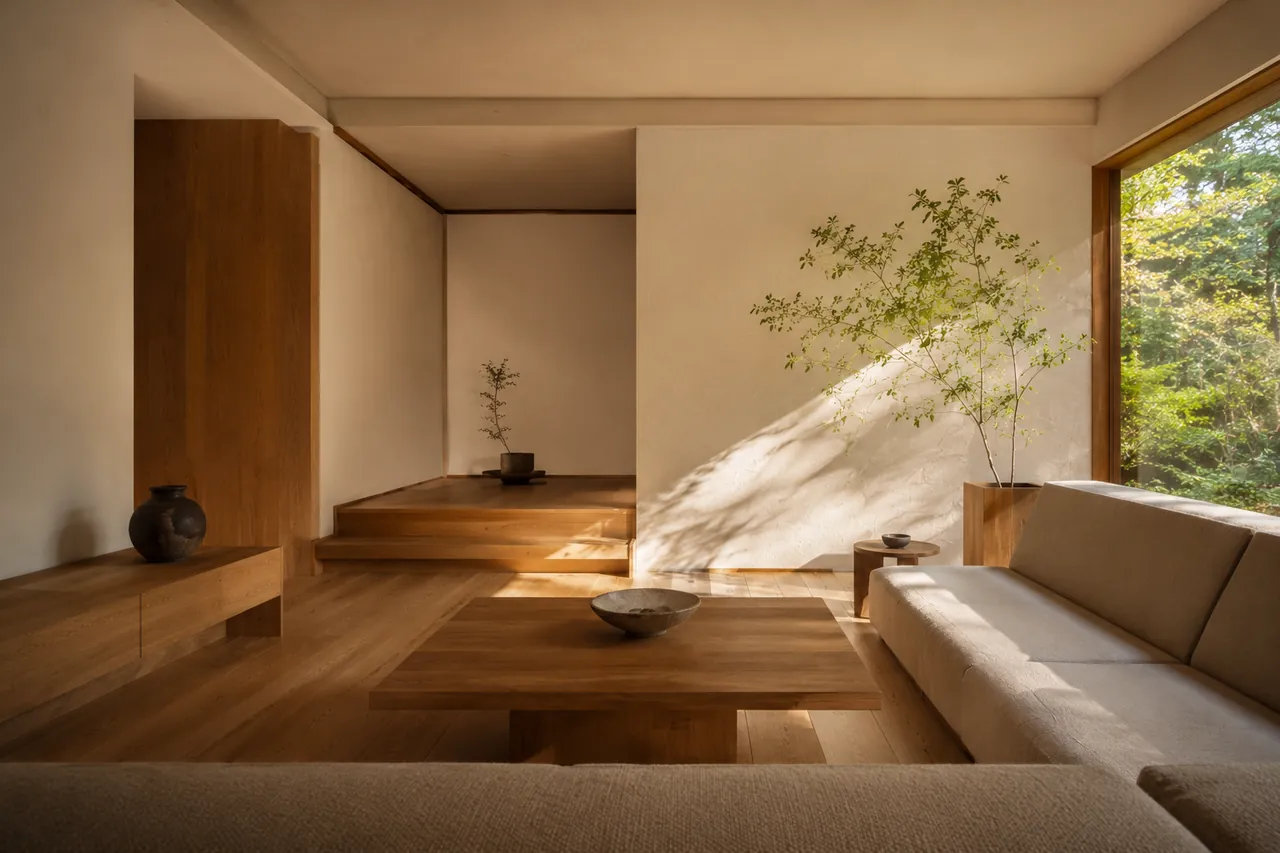
What does a washitsu (Japanese room) cost? The three essentials are tatami, shoji and a tokonoma alcove. A full sukiya-style build adds ¥300–800k per tsubo, a simpler washitsu ¥100–200k — and book the craftsmen about six months ahead.
1. Reinterpreting the washitsu
The washitsu was once an independent "guest room," but in the modern home it is redefined as a multipurpose space adjoining the living room. Slide the doors open and it merges with the living room; close them and it becomes a guest room, bedroom, children's play space or home-office study — this convertibility is the washitsu's greatest value. The low, seated viewpoint makes the ceiling feel higher and creates generous spaciousness even on a small footprint. The modern approach plans it not as "a tatami room" but as "a room whose use can change."
2. Modernising tatami
Tatami too has evolved greatly. Border-less tatami (Ryukyu tatami) suits modern interiors, and laying half-mats in a checkerboard brings out expression through shadow. Alongside rush (igusa), washi-paper and resin tatami now offer colour variety and high durability — resistant to fading and mites, and easy to maintain. Tatami size differs by region, so confirm the regional standard at the design stage. The table below lists representative tatami modules.
| Tatami module | Size (mm) | Main region |
|---|---|---|
| Kyoma (honma) | 955 × 1,910 | Kansai, Chugoku, Shikoku |
| Chukyoma | 910 × 1,820 | Tokai, Nagoya |
| Edoma | 880 × 1,760 | Kanto, Tohoku |
| Danchima | 850 × 1,700 | Apartments |
3. Using the oshiire
The washitsu's oshiire is deep (about 75–90 cm), a high-capacity store that gathers futons, seasonal appliances and guest bedding. Remove the middle shelf and it converts to a desk space or display shelf; use it in two tiers for different purposes — it is highly adaptable. Thrown open it reads as part of the room; closed, it hides daily clutter — completing "unseen storage" within a single room is another of the washitsu's strengths.
4. The tokonoma, scaled down
A formal tokonoma is a "spiritual margin" dressed with a hanging scroll and flowers to mark the season, but modern homes simplify it. A simple tokonoma of just a base board and a drop-lintel, or a "display corner" recessed into a wall and lit indirectly, is popular. Keeping a formal dignity while blending naturally into daily life — dressing by subtraction rather than addition — is the modern answer to the tokonoma.
5. As a child-friendly space
Tatami has cushioning; a fall lands softly, making it ideal for a child's nap, play and nappy changes. A washitsu beside the living room lets you keep an eye on children while doing chores and turns instantly into a guest room when visitors come. As children grow, its use shifts to a study or hobby room. Higher in insulation and humidity-buffering than flooring — cooler in summer and less cold underfoot in winter — it suits households with small children.
6. Building a tea room
For an authentic tea room, base it on four-and-a-half mats, with the nijiri-guchi (crawl-in entrance), tokonoma, host's seat and mizuya (preparation area) carefully placed. If you cut a sunken hearth (ro), the under-floor structure, insulation and plumbing routes must be woven in from the early design stage. If a full tea room is difficult, equip a "washitsu where tea can be served" with a portable hearth or electric substitute. Involving a specialist sukiya carpenter raises the grade of dimensions and materials a notch.
7. Design tips
Three tips for making the most of a washitsu. ①Step or no step — a raised koagari becomes a place to perch and bench storage and adds variety, but go flat if barrier-free access comes first. ②Divide with fittings — sliding doors and fusuma open and close freely, maximising convertibility. ③Lighting and window height — set lighting a little lower for the seated position, and a low window framing the garden creates a view to enjoy while seated. The key is to size everything around a life lived close to the floor.
The modern washitsu is not a "closed guest room" but an "opening multipurpose room." Convertibility, storage, dressing — the craft of a single tatami's worth decides the depth of a home.
Talk to us about your plan and a rough budget — free.
Book a free consultation