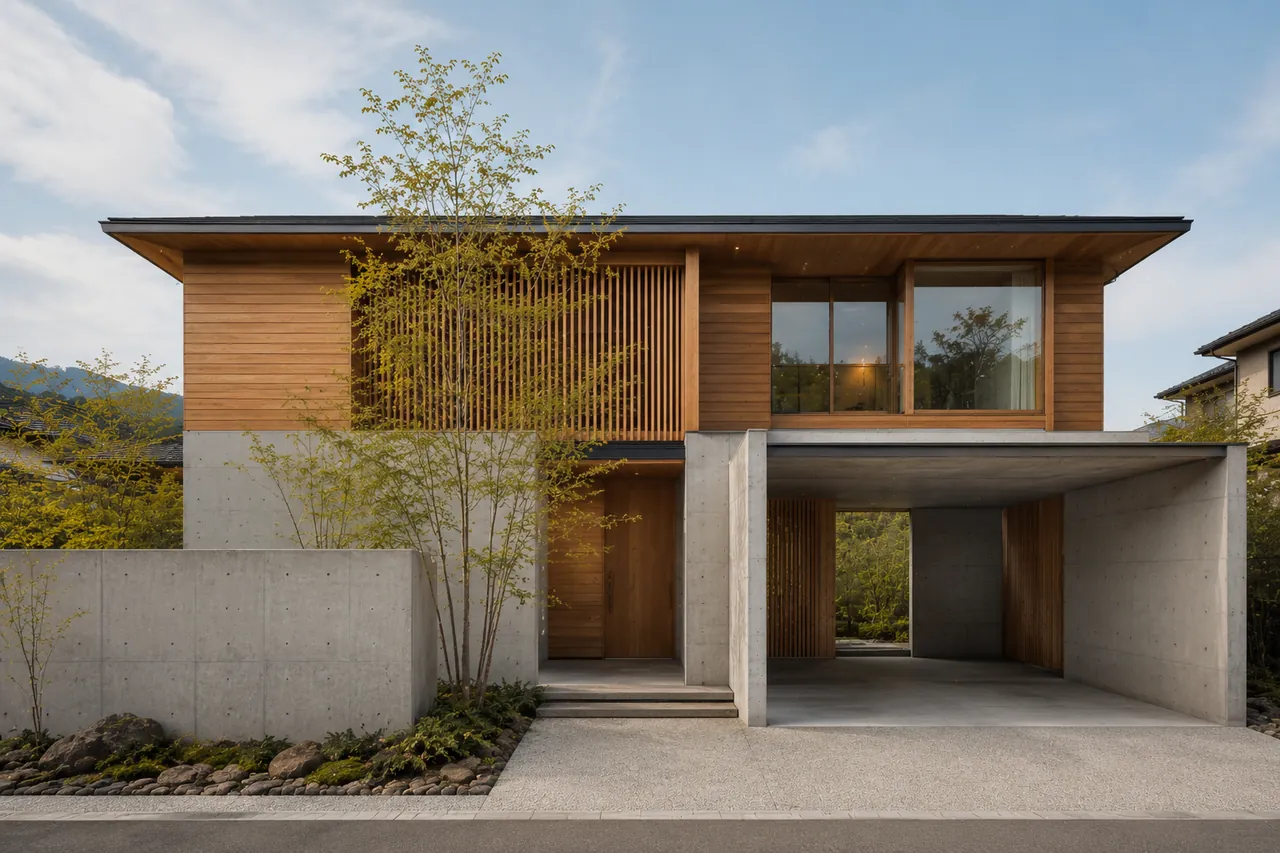
Even on a tight 15- or 20-tsubo lot in central Osaka, a three-storey RC build can deliver open, spacious interiors.
1. How to win "space" on a tight urban lot
In central districts of Osaka, where land is dear and plots run a mere 50–80 m², you cannot spread out horizontally. The realistic way to secure floor area is to stack upward — to go three stories. From the same footprint, three levels yield nearly triple the floor area, letting you stack parking, wet areas, living rooms and a roof terrace into a dense, urban residence. Two things are decisive: designing away the sense of confinement, and reading the city-specific regulations to the letter.
2. Timber, steel or RC — which to choose for an urban three-story
Three structures are realistic for an urban three-story. Choose by site, budget and the performance you want.
| Structure | Strengths | Watch-outs |
|---|---|---|
| Timber (W) | Light and inexpensive; lighter foundation load | Three-story timber is tightly constrained; fire and sound need extra work |
| Steel (S) | Large openings and spans; relatively short build | Rust-proofing and fire-protective covering; sway and sound to address |
| Reinforced concrete (RC) | Excellent fire-, sound- and durability performance; weighty presence — ideal for a residence | High cost and weight; affects ground works and schedule |
Along arterial roads or in dense neighbourhoods, where sound insulation, fire resistance and a solid presence matter, RC is the strong candidate. RC also rates well on assessed value and service life, and has long been chosen for affluent urban residences.
3. Quasi-fire-zone constraints
Much of central Osaka is designated a quasi-fire or fire zone. Here, depending on building scale, fire-rated specifications are required for exterior walls, eave soffits and openings (windows and entrance) — fire doors, wire glass or certified fire-rated sashes, and fire-resistant wall construction. RC, inherently fire-resistant, fares well even in a fire zone. Confirming early whether the site sits in a "fire" or "quasi-fire" zone sets the premise for spec and budget.
4. Setback limits and structural calculation — the walls of height and safety
Two things are unavoidable when building three stories: the vertical regulations and the verification of structure.
- Road, north-side and adjacent-lot setbacks: building height is limited diagonally relative to the front road and neighbours. If the top of the third floor hits the diagonal line, the roof or wall must be cut back, so the section plan becomes critical.
- Height districts and absolute height: some areas cap height, affecting floor-to-floor heights across three levels.
- Structural calculation is mandatory: even in timber, a three-story requires structural calculation; RC and steel assume it. The 2025 Building Standards reform tightened timber review too, so bringing the structural engineer in early is essential.
5. The cost drivers unique to narrow sites
At equal floor area, an urban narrow lot turns "hard to build on" straight into cost.
- No crane access: a narrow front road bars large machinery, raising labour and time through hand work or small equipment.
- Scaffold constraints: a tiny gap to the neighbour makes scaffolding itself hard, calling for special temporary works.
- Material delivery: poor road access forces short-haul carrying, adding to transport cost.
- Ground and foundation: three stories weigh more, so ground survey results may require improvement or piling.
These ancillary costs rarely show in the "per-tsubo" rate. For a narrow site, compare the total including temporary works, delivery and ground, not the building price alone.
6. Design moves that create openness even when tight
Proven, high-impact moves so a narrow-lot three-story is not merely a "small house".
- Light well and void: drop light through the centre or from upper floors to keep brightness and a vertical sense of release even in a dense area.
- Skip floors: stagger levels by half a story to link spaces, creating diagonal sightlines, a three-dimensional sense of room, and storage under the stairs.
- Built-in garage: make the ground floor double as parking, consolidating car, storage and entrance on a tight site. A garage house to admire one's car is a favourite of urban residences.
- Roof terrace and roof balcony: where no garden fits, turn the roof into a "second garden" — an outdoor space for views, barbecue and greenery on the top level.
- Clerestory and low windows: the narrow-lot staple — daylight and ventilation while dodging the neighbours' line of sight.
An urban RC three-story is not about "giving up because it's tight" but about "stacking upward and designing in light and release". It is precisely in a dense city like Osaka that aligning the five points — structure choice, fire rules, setbacks and structural calculation, narrow-site cost, and spatial design — with an experienced design-build team early decides both satisfaction and asset value.
Talk to us about your plan and a rough budget — free.
Book a free consultation