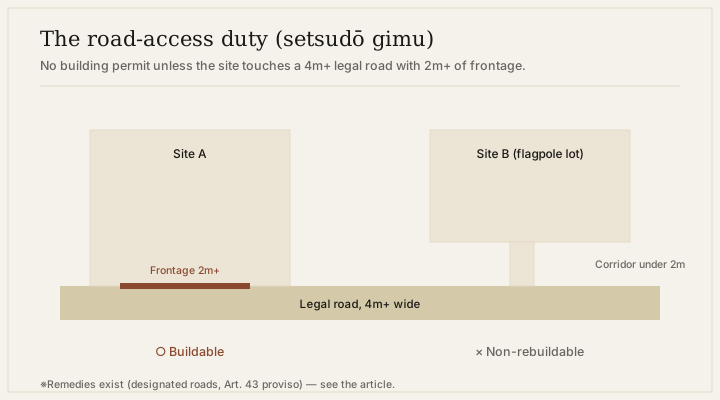
What is a non-rebuildable lot? Land where, once the current building is demolished, no new permit will be granted. The usual cause is failing the road-access duty (2m+ frontage on a 4m+ legal road); remedies include a designated road, the Art. 43 proviso, buying adjoining land, or a setback. Cheap to buy — but hard to finance and to resell.
1. What a non-rebuildable lot is
A "non-rebuildable lot" is land on which, once the existing building is demolished, no new building may be erected. You can live in or rent out the existing house, but because building confirmation will not be granted for replacement or new construction, in effect "the building's lifespan is the land's usable lifespan." Land and second-hand houses offered far below market sometimes carry this status, and buying without knowing exposes you to serious risk.
2. Why you cannot build — the access rule
The cause is almost always a failure to meet the Building Standards Act "access rule". Article 43 provides that a building lot must, in principle, front for at least 2 m a "Building Standards Act road" of at least 4 m width. This exists to secure firefighting and evacuation in a fire, and everyday safety. Land that does not meet it generally cannot carry a new building.
3. The common patterns
| Pattern | Detail |
|---|---|
| No frontage | The lot does not touch any road at all (a landlocked parcel) |
| Insufficient frontage | It touches a road, but for less than 2 m |
| Sub-width road | The abutting way is under 4 m wide and not recognised as a Building Standards Act road |
| Not legally a road | It looks like a road but is not a "road" in law (a passage, private lane, etc.) |
| Flagpole's pole | A thin pole-shaped access where the pole is under 2 m wide |
4. Possible remedies — making it buildable
Even a non-rebuildable lot can sometimes become "buildable," depending on conditions.
- Setback (Article 42-2 road): if the abutting way is under 4 m but is a "deemed road" under Article 42-2, building can become possible by setting back 2 m from the road centreline.
- Article 43 proviso (43-2 approval/permission): an exception allowing construction even without road frontage, where the lot abuts open space or a wide passage and the authority finds no safety concern; the building review board's consent may be required.
- Creating a designated-position road: building a private road meeting set standards and having it certified as a "designated-position road" — needs cost and the consent of stakeholders.
- Buying adjoining land / land swap: acquiring part of a neighbouring lot to secure 2 m of frontage — the most certain route, but it presupposes the neighbour's cooperation.
Whether these work depends heavily on the lot, the road and the municipality's practice. Buying on the assumption "it must be fixable" is dangerous. Always confirm with experts and the city office first.
5. Pre-purchase checklist
- Confirm at the building-guidance desk: the "road classification" of the abutting way (which clause of Article 42) and the lot's frontage length.
- Measure the road width on site: not from the register or drawings alone.
- Mortgage availability: non-rebuildable lots appraise low and are hard to mortgage — a cash purchase is often the premise.
- Resale: buyers are limited on future sale; factor in the low liquidity.
- Expert involvement: have an architect or licensed real-estate agent judge "buildability" before contract.
6. Renovation and use as an option
A non-rebuildable lot is not all downside. Because it is inexpensive, one approach is not to assume rebuilding but to regenerate it through major renovation (a skeleton remodel) to live in or let. Note, though, that "large-scale repair or alteration" requiring confirmation, and extensions, are restricted, so mind the scope of work. In a good location, rental demand can be expected, and there is an investment approach of acquiring in cash for yield. The key to dealing with a non-rebuildable lot is to decide at the outset whether your premise is rebuilding or using the property as-is.
A non-rebuildable lot is the classic case of "cheap for a reason." Before the low price tempts you, confirm frontage, road classification, remedy options and financing with an expert — that one extra step prevents great regret later.
Find out how many m² you can build on a plot — free check.
Ask about buildability