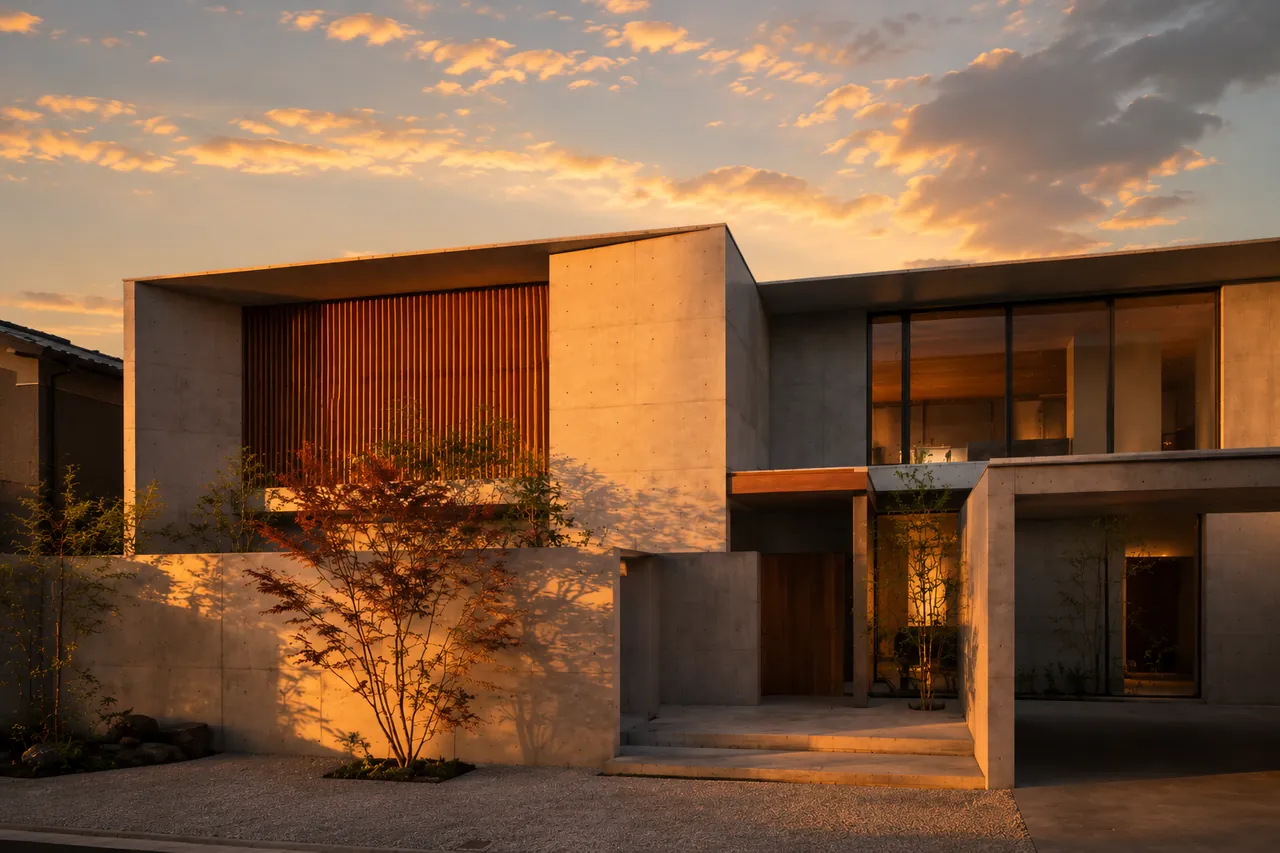
How do you merge house and garden? A continuous line from living room to veranda to garden, courtyard and tsubo-niwa pockets, and species chosen for the four seasons. Planting budget: a guide 5–15% of the build cost.
1. The garden is designed first, not added last
In most houses the garden is tacked on at the very end as "landscaping." In a fine residence the order is reversed. Window positions, eave depth, floor levels, drainage and waterproofing, and how the foundation meets the ground are all decided in relation to the garden. Only by fixing "from which room, at what height, you see what" during schematic design do interior and garden become a single picture. Leave the garden for later and you invite irreversible problems — a carefully placed opening that ends up facing the neighbour's wall, or tree roots that lift and damage the foundation and pipes.
2. Shakkei — turning the view beyond your land into an asset
Distant mountains, a park's greenery, a neighbour's handsome tree, the open sky. Consciously framing the "visible resources" beyond your boundary is the starting point of the Japanese garden. By choosing the position and height of openings — and screening noise (utility poles, AC condensers, a neighbour's window) with foreground planting or a fence — the view is transformed at almost no cost. Equally, quietly concealing what you would rather not see with evergreens or a lattice fence is part of the craft. Decide what to reveal and what to hide at the floor-plan stage.
3. Tsuboniwa & nakaniwa — light and air for tight urban lots
Even on a narrow, deep "eel's-bed" lot, a 3–5 m² courtyard beside the entrance or at the centre of the plan brings light, greenery and a path for breezes into the heart of the house. Wrapping it in glass on three sides and treating it as an extension of the interior is the modern solution; it can also help satisfy the Building Standards Act's daylight and ventilation requirements. In design, never forget the courtyard floor's waterproofing and rainwater drainage, plus an access route for cleaning and care.
4. Karesansui — the near-zero-maintenance choice
White sand, moss, arranged stones. With almost no planting it needs little watering or pruning — ideal for overseas owners and holiday homes. A weed-control sheet under the gravel suppresses weeds, and simply re-raking the sand patterns once a month renews the scene. Stones symbolise "islands" and sand "water" — an abstraction that creates real depth even in a small area. The rule is to avoid a large deciduous tree nearby, since falling leaves soil the sand.
5. Indoor–outdoor continuity — engawa, deep eaves, full-open sashes
The engawa (veranda), deep eaves and full-open sliding sashes: throw the doors open and the garden becomes an extension of the living room — the essence of the Japanese house. The keys are to keep the floor-level difference within 10 mm and to run the same flooring inside and out. Deep eaves are a climate-tuned, multi-purpose device: they block the high summer sun, admit the low winter sun, and shield the openings from rain. Because the sash sill is prone to condensation and heat loss, resolve the detail early.
6. Choosing trees to capture the four seasons
The true subject of a Japanese garden is change. How you combine deciduous and evergreen trees decides both the garden's character and the amount of upkeep.
| Role | Typical species | Character |
|---|---|---|
| Autumn colour | Japanese maple, enkianthus | Deciduous — summer shade, winter light |
| Spring blossom | Flowering & kousa dogwood | Seasonal star; deciduous |
| Light, airy green | Japanese ash (aodamo), tropical ash | Multi-stem, cool and delicate |
| Screening / evergreen | Longstalk holly, evergreen dogwood | Leaves year-round; blocks sightlines |
| Ground cover | Moss, mondo grass, low planting | Hides bare soil, suppresses weeds |
Place deciduous trees to the south and they become a "green curtain" — cool in summer, light-admitting in winter; place evergreens along the boundary for year-round screening. The amount of upkeep is largely set by species choice, so select to match your lifestyle.
7. Water and light — making the night garden a picture
Water elements — a tsukubai (stone basin), a water dish, a shishi-odoshi — bring stillness and depth through sound and reflection. At night, uplights that wash the trees from below and low andon-style lights at foot level turn the garden into a framed picture seen from indoors. Low-voltage LEDs on a timer keep power use down and let even a frequently empty holiday home stage its night view automatically. Lighting conduit is laid before the hardscaping, so this too belongs in the early design.
8. Drainage, waterproofing, roots — the garden's technical backstage
The most beautiful gardens are carried by what you cannot see. As builders we pay particular attention to three things:
- Rainwater drainage: courtyards, inner gardens and decks must give water somewhere to go, or every rain brings pooling and water ingress into the building. Plan soakaways and drainage falls.
- Waterproofing junctions: where garden meets building, the membrane is turned up to stop water tracking back indoors.
- Root control: the roots of tall trees can lift and damage foundations and pipes. We install root barriers and secure adequate soil depth (60 cm+ for tall trees).
None of this is finished by a landscaper alone; it resolves cleanly only because architecture and exterior works are designed and built as one.
9. The reality of upkeep, and "low-maintenance" design
A garden is never "build it and forget it." Typical annual maintenance budgets run roughly as follows:
| Type | Approx. annual upkeep | Main work |
|---|---|---|
| Full garden | ¥300,000–500,000 | Several rounds of pruning, feeding, spraying, weeding |
| Tsuboniwa | ¥50,000–100,000 | Light pruning, cleaning |
| Karesansui | ¥10,000–30,000 | Re-raking sand, weeding |
To keep upkeep low, build "low-maintenance" choices into the design: evergreen-led planting, gravel over weed sheet, automatic irrigation, and stone-edged zoning. For overseas owners and villas, an annual maintenance contract with a landscaper plus seasonal photo reports makes the difference.
What decides a garden's quality is how the eye travels through it, not its area. A 3 m² courtyard is often richer than a vague 30 m² garden. And a good garden is not added at the end — it is drawn together with the architecture from the very start.
Talk to us about your plan and a rough budget — free.
Book a free consultation