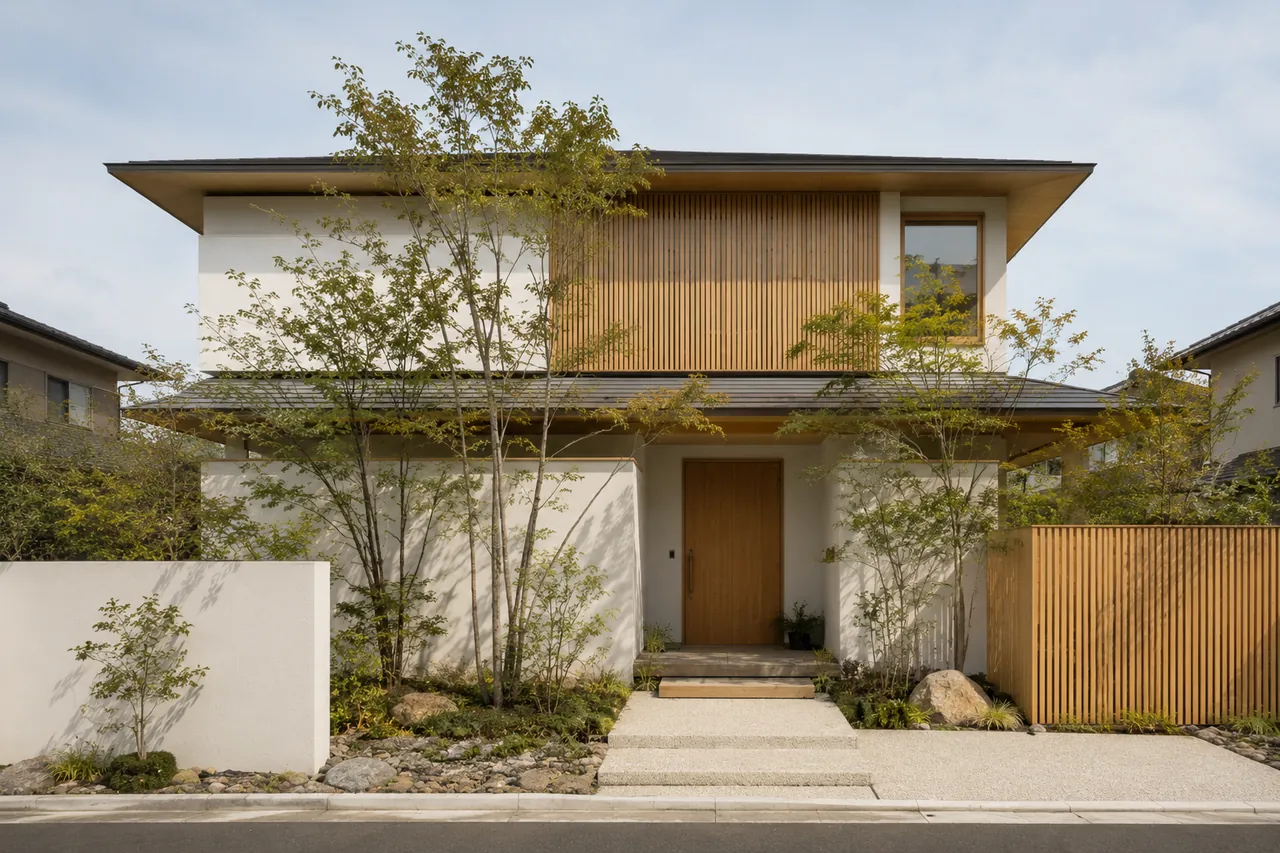
How do you choose a contractor for residential construction in Japan? Match the firm type to your goal: large housing makers for speed and standardisation, design offices (atelier) for bespoke quality, and local builders for cost. For a high-end or RC home, a design office with independent site supervision usually wins. Whichever you pick, verify the firm's 建設業許可 (construction-business licence), check completed projects in the same structure (RC or timber), and confirm the contract lists the Construction Business Act's mandatory items. Overseas owners should also confirm English/Chinese support, remote progress reporting, and who carries liability and warranty.
Part of the guide: Building a custom home in Osaka
1. The three business models, honestly
Whoever you build with in Japan falls into one of three models: the large house-maker, the design office (atelier), or the local builder (komuten). The difference is not only price but the structure itself — who designs, who supervises quality, and how much freedom you get. A house-maker sells a productised standard; a design office acts as the owner's agent for both design and site supervision; a builder is the one who actually puts up the building. Once you grasp this division of roles, it becomes clear which fits your budget and brief.
| Model | Strengths | Weaknesses |
|---|---|---|
| Large house-maker | Standardised, short schedule, strong warranty | Low flexibility, higher per-tsubo cost, generic |
| Design office | Bespoke, design quality, independent supervision | Longer schedule, early budget harder to read |
| Local builder | Local, lower price, construction skill | Variable design ability and responsiveness |
For a one-off residence or building, separating design from construction — with the design office standing on the owner's side to supervise the builder — is the stronger setup for quality. Conversely, if you want to build fast and cheap with a narrow specification, a standardised house-maker is rational. The question is not "which is best" but "which meshes with your goal."
2. Per-tsubo benchmarks
Per-tsubo cost swings widely with specification, structure and location, so treat it only as a first rough gauge. The same "1 million yen" can include different scopes (ancillary works, design fee, consumption tax) from one office to the next, so always compare on total cost and a line-item breakdown.
- Large house-maker: 800,000-1,800,000 yen/tsubo (depending on grade)
- Design office + builder: 1,000,000-2,500,000 yen/tsubo (free specification)
- Builder alone: 600,000-1,300,000 yen/tsubo (standard specification)
At the residence level, structure (RC or timber), insulation and equipment grade, and the volume of bespoke joinery can nearly double the per-tsubo figure. Be wary of anyone who cannot clearly explain the basis of their number. See also the three-layer structure of a building budget.
3. Why luxury favours design firms
For a one-off residence the advantages of starting from a design office stand out, for four reasons. (1) Supervision is independent — the designer checks the builder as the owner's agent, which keeps the builder honest and prevents corner-cutting and spec downgrades. (2) The specification is fully bespoke — layout, materials and dimensions are designed from scratch, free of standardised constraints. (3) Deep experience with third-party inspectors — external checks can be built into critical stages such as structure and waterproofing. (4) Bargaining power on materials and trades — putting builders out to competitive tender achieves the same quality at a fairer price. With a house-maker, design and construction are one entity, so this check-and-balance rarely operates.
4. Five axes for selecting an atelier
Design offices are many and their specialities vary. Ask specifically along these five axes and judge by the substance of the answers.
- Track-record genre: is the speciality clear — residences, commercial, or apartments? Confirm several real examples close to your use.
- Supervision regime: weekly site visits or not, and the quantity and quality of site photos. Get specific on "who, how often."
- Past-client references: an office that can arrange a visit to a finished home of a former client is more trustworthy. Can you hear about post-move comfort?
- Overseas experience: minutes in English or Chinese, and a track record of live streaming and electronic signing.
- Firm size: 5-15 people suits residences best. Too small and the setup feels risky; too large and your project gets thin attention.
5. Five questions to ask in the first meeting
The first meeting is your best chance to measure transparency. How an office answers these five questions reveals most of its honesty and competence. Prefer the firm that answers concretely with numbers and examples over one that hedges.
- "What has your budget-overrun rate been over the past three years?" (a gauge of management and estimating accuracy)
- "What is the breakdown of the design-supervision fee and its payment schedule?" (cost transparency)
- "What is a recent project of similar size and structure?" (evidence of experience)
- "Do you put the builder out to competitive tender?" (can price reasonableness be assured)
- "How many years of experience does the site agent have?" (the core that decides on-site quality)
6. Red flags
Conversely, be wary of these remarks. "Don't worry about the per-tsubo cost" = a sign they are dodging total-cost control. "We are cheap" = they may be cutting quality or supervision. "Let's nail down the details after you sign" = the classic pattern of taking profit through post-contract extras. What they share is an attitude of keeping numbers and process vague. The better the office, the more it discloses its cost structure and risks before you even ask. Transparency is the proof of trust, and how concretely they answer before the contract is your single biggest decision factor.
7. Choosing as a foreigner: what "English OK" actually covers
Language support is where foreign clients most often discover a gap between the sales pitch and the build. Many Japanese contractors work only in Japanese; "English OK" frequently means one bilingual salesperson — not the architect or site manager you will actually deal with for a year. Construction contracts and building-permit paperwork are, in practice, Japanese documents; what varies is whether the firm explains them to you properly before you sign.
- Ask who, exactly, speaks your language — the person quoting, the person designing, or the person running the site. They are usually three different people.
- Ask how change orders are communicated during construction — mid-build decisions are where language gaps turn into money.
- Ask whether estimates and meeting notes come in your language — even if the contract itself is in Japanese, the explanation shouldn't be.
For reference, our own consultations and design meetings run in Japanese, English, Chinese and Korean, and we put estimate explanations in writing in your language before contract.
A design office is your "building partner." Because you are creating a home you will live in for thirty years, choose on rapport over price, and on honesty over rapport. How they answer your questions in that first meeting mirrors the work itself.
Talk to us about your plan and a rough budget — free.
Book a free consultation